Showing posts with label collections work. Show all posts

Wednesday, 19 August 2020

New Acquisitions: Painting from Ethiopia

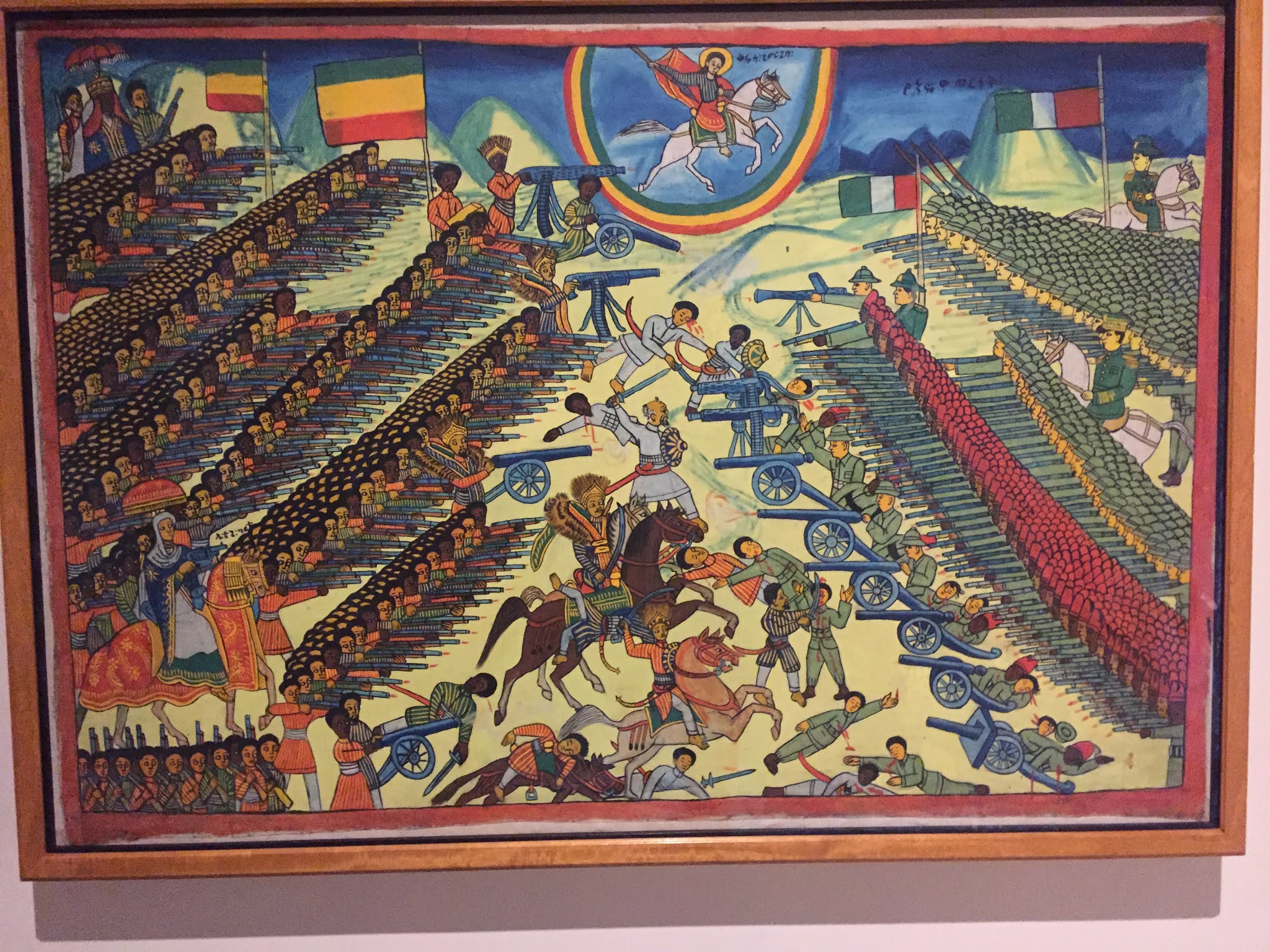
Painting by Solomon Belachew showing the defeat of Amhara Ethiopians by Ras Gobena donated to the Pitt Rivers Museum by Alan Goodwin in February 2020

At the end of February Deputy Head of Conservation Andrew Hughes and myself drove the Museum van to Osney Island, Oxford to collect an Ethiopian painting kindly donated to the Museum by Alan Goodwin. Due to the unforeseen circumstances of the Covid -19 pandemic the painting remains in the Museum’s quarantine quarters for processing. Alan had sent photographs of the painting but I was really excited to see it in the flesh. The painting is a visual treat depicting a vivid and lively battle scene commanded by Ras Gobena, General under Ethiopian Emperor Menelik II. Ras Gobena and Menelik II used guns manufactured in Europe to bring Southern and Northern areas of Ethiopia under a centralised rule. The painting clearly depicts Ras Gobena’s men painted with lighter skin attacking the Amhara Ethiopians from the Northern highlands of Ethiopia depicted in the painting with darker skin. The painting is full of contrasts; mud huts/tents, guns/spears, black/white, Christian/Animist, tunics/beaded loin cloths. This is interesting as ultimately it was the unity of Ethiopia, a country of multiple ethnicities and languages, culminating in its victory over the Italians at the Battle of Adwa in 1896, ensuring Ethiopia’s sovereignty and freedom from colonialism. The triumphant victory at Adwa brought Ethiopia to the world’s attention, strengthening the country’s image as defender of African independence. 
 

Painting by Unknown artist on display at the British Museum depicting the Battle of Adwa, 1896

The painting is by the artist Solomon Belachew. It is very similar in style to a painting held by the British Museum depicting the battle of Adwa. There are stylistic similarities in the conventions used to paint the figures and conventions applied in Ethiopian religious paintings. The battle of Adwa was a popular subject for Ethiopians to paint and Solomon Belachew also painted the scene in a painting which is now at the Smithsonian National Museum of African Art. In our Painting the lighter skinned Oromo Ethiopians are always painted as full-faced figures whilst some of the darker skinned Amhara Ethiopians are painted in profile distinguishing the forces of good from evil. The ferocity of the battle is captured in Belachew’s depiction of blood-spattered victims strewn on the ground. 


 Alastair Goodwin photographed in Africa during the 1940's.


The painting was purchased by Alan Goodwin’s father Alastair Goodwin in 1946 when he was posted to HQ British Military Mission to Ethiopia (Addas Ababa and Jimma) between May – October 1946. Solomon Belachew’s son is also an artist and continues to sale his own paintings and those of other local artist in his studio and shop in the Piazza tourist district of Addis Ababa. It was during Solomon Belachew’s father Belachew Yimar’s time that such contemporary paintings in traditional style became popular souvenirs in the 1940’s for foreign visitors such as Alastair Goodwin to take home. 


Faye Belsey 

Deputy Head of Collections

Monday, 16 January 2017

Percy Manning: the man who collected Oxfordshire


Percy Manning was an antiquarian and folklorist, who died one hundred years ago in 1917. He was particularly interested in collecting objects and information about popular folk customs, and donated over 200 objects to the Pitt Rivers Museum. We at the PRM are creating a small temporary display to celebrate this centenary. The display contains objects related to folklore customs in Oxfordshire including a Morris Dancers outfit (1895.46.1), whit horns (1902.16.7), objects collected by Percy Manning such as candlesticks (1911.29.24, 1911.29.25 and 1911.29.37) and lace makers pot (1911.29.45) and contemporary Morris dancers accessories loaned by Kirtlington Morris.


Mock up of the layout for the display case © Pitt Rivers Museum
Two lanterns collected by Percy Manning 1911.29.33 and 1911.29.34 © Pitt Rivers Museum
The PRM display is one of many exhibitions and events happening in and around Oxford in 2017 to celebrate the life and achievements of Percy Manning. For more information about them visit here 

Madeleine Ding
Curatorial Assistant

Wednesday, 20 January 2016

An Object Label with a Story: Death of a Missionary Bishop

I have been transcribing some of the Museum's old hand-written labels. Each label will be filed as part of the "related documents" for the specific object and the relevant information added to the Museum's object database. The labels have become separated from the objects and do not always include the Museum identity number for the actual object. So a bit of detective work is sometimes required to match the information to the appropriate object.

The tiny neat hand-writing is lovely to look at but the content of the label is usually basic and not particularly interesting. Typically it will only say what the object is, the year the Museum acquired the object, the name of the donor, and where it is from.

Some of the labels I have been transcribing

Recently I came across a remarkable label that included more text than usual and even referred to a brutal death. This is what the label says:

Type of dancing club used in SANTA CRUZ group. Was labelled "Norfolk I. Facsimile of club wh. killed Bp. Patteson". L.M.S. states that he was clubbed & speared at NUKAPU, S. CRUZ group. L.M.S. station is on NORFOLK I. d.d. HEREFORD mus.

L.M.S stands for the London Missionary Society and d.d. for the Latin dono dedit, meaning 'gave as a gift'.

You can see the actual label below, plus the dance club it refers to - which the labels says is similar to the one used to kill Patteson.


Left: Club PRM 1942.1.408, right: the object label © Pitt Rivers Museum

Intrigued, I did some exploring and found out this was not a straightforward story. Bishop John Coleridge Patteson (1827-71) was the first missionary Bishop of Melanesia and was related to the poet Samuel Taylor Coleridge, his mother was Coleridge's niece. He went to Balliol College in Oxford from 1845 to 1848 and became a Fellow of Merton College in 1852. He was ordained in 1854 and, in the same year, was recruited by Bishop Welwyn of New Zealand for missionary work in the South Seas. They left for Auckland together the following year.

Patteson was a good linguist, who mastered many local languages, and made many friends among the indigenous people. It was in 1861 he became Bishop of Melanesia where he worked tirelessly for many years in this vast diocese, crossing the seas again and again.

So why did he meet such a violent death, brought about by the very people he had been working for?

It seems there were no witnesses of the actual murder. When he visited Nukapu in the Solomon Islands in September 1871 he went ashore alone. Separated from the others on the ship, who were then attacked, no one knew what had happened to the Bishop. His body was later found in a canoe floating in the sea, covered with palm fibre matting. On his chest was a palm branch.

The most plausible explanation appears to be he was mistaken as a slave-trader. At the time, many men in the area were kidnapped by the 'blackbirders', who used tricks and violence to recruit labourers for the sugar plantations in Queensland and Fiji. In Nukapu five men had allegedly just been taken away by 'blackbirders' when the Bishop and his colleagues arrived. The timing, therefore, seems to have been desperately unfortunate.

An alternative point of view argues that he had unintentionally made enemies of the mothers of the Island by taking their young sons away. Boys going to be educated at his School were away from home for several years. Some have suggested these women might not have clearly understood the difference between the missionaries and the slave-traders.

The death of Bishop Patteson made headline news in England. This caused people to take an interest in both Christian missionary work and human-trafficking in Britain's Pacific territory. Public outrage resulted in stricter enforcement of the law regulating the recruitment of plantation labourers. In addition, there was a call for the improvement of their working conditions.

There is a memorial to Patteson in the chapel at Merton College in Oxford.

Left: the Chapel at Merton College, Oxford; middle and right: details of the memorials inside the Chapel
including the one to Patteson © Fusa McLynn
After researching this story I think there are still a few questions about this incident that remain unanswered. A recent paper by two Norwegian researchers re-examines the circumstances of Bishop Patteson's death and makes some fascinating suggestions. Plus I would love to know more about the connection with Hereford Museum, who donated this object to the Museum.

You can see the dance club on display in the Upper Gallery on the top floor of the Museum in case U30A.

Fusa McLynn
Collections Volunteer

References and Suggested Further Reading:

C.H. Brooke, "The Death of Bishop Patteson", Mission Life: An Illustrated Magazine of Home and Foreign Church Work, ed. Rev. J.J. Holcombe, M.A., Vol. III, Part I (new series), London: W. Wells Gardner (1872), pp. 1-23

Reverend H.N. Drummond, Bishop Patteson Pioneer and Martyr, Parkstone: Ralph and Brown (1930)

T. Kolshus and E. Hovdhaugen, "Reassessing the death of Bishop John Coleridge Patteson", Journal of Pacific History, Vol. 45, Issue 3 (2010), pp. 331-355


Wednesday, 2 December 2015

Museum Redisplay: Moving Many Shots

Our closure to the public on Monday mornings gives staff the opportunity to undertake jobs that are difficult to complete during opening hours. This was certainly the case in November when we needed to move a custom-made case displaying a painted cowhide measuring 2.2 metres by 1.7 metres. As you can imagine, the case - as well as being very large - is extremely heavy.

Before the case could move, Heather and Andrew from the Conservation Department carefully removed the cowhide. This was painted by Many Shots, a member of the North American Plains Blackfoot community. Painted robes on bison hide and cowhide showing a man's war deeds were often made for sale, and this one was commissioned for a collector in 1893.

Left to right: Painted cowhide PRM 1895.61.1; temporarily storing the glass front of the showcase while the rest of the case is relocated; Technicians removing the case from the Museum's Court Gallery © Pitt Rivers Museum 
Once the cowhide was removed, Ady, Alan, Ali and Chris from the Technical Services Team were able to tackle moving and relocating the display case.

Technicians carefully move the case from the Court Gallery into the stairwell area © Pitt Rivers Museum
All went well and The Life of Many Shots, as the cowhide is often called, is now safely relocated to the west wall of the stairwell on the ground floor. In this new, well-lit location you can clearly see the painted cowhide so, if you have an opportunity to visit, I encourage you to look at this amazing object.

Left: the stairwell wall first thing in the morning; right: now transformed to display Many Shots © Pitt Rivers Museum 
Many Shots was relocated to provide space to build new cases to improve the display of the housing and transport models. This redisplay project is possible thanks to generous funding from DCMS Wolfson. I will keep you up-to-date on the progress of the models redisplay in future blogs.

If you'd like to find out more about the scenes painted on the cowhide see Arni Brownstone's booklet The 'Many Shots' Robe, available in the Museum shop or listen to the Museum's audio guide entry here:


Zena McGreevy
Senior Assistant Curator

Wednesday, 11 November 2015

Museum Redisplay: Models On The Move

On Monday mornings when the Museum is closed we are busy doing jobs in the public areas that are difficult to do during opening hours. At the moment we are upgrading some of the model displays on the ground floor, thanks to an award of nearly £40,000 from the DCMS/ Wolfson Foundation's Museum and Galleries Improvement Fund.

This entails removing the old cases to make way for the new displays. Below you can see staff dismantling a case containing some of the building and housing models. This isn't a job that can be rushed, as each object needs to be carefully lifted out of the case. The models then need to be carefully moved out of the public gallery space.


We use trolleys to transport the objects around the Museum building. On the right you can see some of the models on a trolley ready to be moved.

They are placed into temporary storage in the areas closed to the public. This means they are easy for us to access, even during opening hours, while they are being prepared for redisplay. Below you can see some of the models in the Collections Department where we catalogue and research the objects.


They will all be individually checked by Conservation staff and will be moved to the Conservation Lab to be worked on if necessary. After Collections and Conservation staff have completed their preparatory work, Technical Services will start to design the new display.


Being able to examine the models close up provides an opportunity to see all of the details. The house model you can see below is really intricate; if you look inside you can see miniature hammocks, numerous utensils, as well as little figures.
Arawak house PRM 1901.19.1 © Pitt Rivers Museum
The new displays will be finished sometime next year. I will keep you informed of progress via this blog site. We are really grateful to the DCMS/ Wolfson Foundation's Museum and Galleries Improvement Fund for making this redisplay work possible.

Zena McGreevy
Senior Assistant Curator

Thursday, 20 August 2015

Caring for the Collections: Good Gourd!


The information found either written on an object or on a label attached
to the object allows us to track the object down on the database, assign it the
correct accession number,catalogue it and record its location making the object
more accessible for staff and researchers. © Pitt Rivers Museum

The wooden drawer units  © Pitt Rivers Museum
Box storage  © Pitt Rivers Museum

After having embarked and completed the rather large and daunting project of cataloguing and improving the storage of plant fibre clothing in the collections at our store we turned our attention to a more manageable project to see us through the summer. The Museum has a large collection of gourds kept in a less than useful wooden drawer system at the store. Gourds are particularly vulnerable to getting broken or damaged due to their delicate composition, odd shapes and sizes and varying thickness/thinness. And so, to this end, for the well being of the gourds the wooden drawer system is being replaced with conservation grade boxes and packaging.

The collections of the Pitt Rivers Museum and indeed ethnographic collections all over the world demonstrate imaginative use of the gourd. Gourds of all shapes and sizes are a natural resource across the globe and in societies today gourds are still being used as bowls, vessels, hats, musical instruments and for many other utilitarian purposes. Conservator Jeremy Uden and myself have been surprised by the variety of shapes, sizes and uses of the gourd and the varying thicknesses from eggshell thin to an inch or more thick. We are half way through the cataloguing and re-storage project and are getting an eye for identifying preferred decorative techniques from country to country. As well as gourds we are also working through vessels made from seed and nut including coconut vessels mostly from Oceania. Coconuts are readily available to Pacific Islanders and prove useful repositories for carrying and storing water and drinking water and kava from.


Above: gourds and coconut vessels in the process of being
catalogued and packed  © Pitt Rivers Museum

Gourd of the Lengua Indians; 1903.19.3  © Pitt Rivers Museum
Decorative techniques also vary greatly, with surfaces being incised with linear, figurative and geometric designs and decorated with burnt patterns known as pyro engraving. Coconut shells are inlaid with pearl shell and shell beads for aesthetic effects and white lime rubbed into incised designs to highlight the pattern. A particularly ingenious method of carving the lid so that it fits perfectly onto the gourd vessels is that of the Lengua Indians of the Paraguayan Chaco, South America. One end of the gourd is cut from the other with a zigzag line. Some of the coconuts and gourds have been decorated with perfect circular patterns created with a compass. We have more than one example of a coco de mer, or double coconut having been refashioned into a Hindu Sadhu's begging bowl with metal chain suspension for wearing around the neck. The value of the gourd as a utilitarian object is also emphasised by the local repairs found on some of them. Rather than make a new one, someone has taken the time to repair a damaged gourd already fashioned as a vessel. Later in the year the Museum will have a temporary display curated by our conservation department focusing on objects with local repairs 'Preserving What is Valued' including gourds. Some of these techniques and methods of using and decorating gourds can been seen on display in the Museum Court in the Geometric Form in Art case C.145.A and also in musical instruments particularly stringed lutes and zithers where the gourd forms the resonator part of the instrument.

Hindu Sadhu's begging bowl made from a double coconut;
1933.51.65   © Pitt Rivers Museum


Above, two gourd vessels which have local repairs where the
gourd has split and broken  © Pitt Rivers Museum


Above are coconut shells fashioned into water carrying vessels.
The top photograph shows how a plant fibre basketry frame has been
made to cradle the two coconuts and the one below has simply
been decorated with pearl shell; 1887.1.578 & 1933.38.27  © Pitt Rivers Museum

Above; gourds decorated with pyro-engraving technique, where burn marks
applied often with a poker have been used to make patterns and
decoration on the gourd; 1900.55.431 & 1934.8.102  © Pitt Rivers Museum

The two gourds above have been decorated with incised designs and
patterns and then rubbed with lime which is white and
acts highlight the design; 1935.56.15 & 1946.6.63 .2  © Pitt Rivers Museum


Faye Belsey
Assistant Curator


Wednesday, 8 April 2015

Researching Melanesian Kapkaps

Kapkap display awaiting new labels
My volunteer work at the Museum currently involves working on new labels to appear in a series of displays featuring Melanesian body ornaments. When I look at the objects in the display cases, what stand out - with their striking contrast of dark and white in mysterious geometric patterns - are the 'kapkaps'. The name sounds rather cute, doesn't it?

A traditionally made kapkap, which is worn around the neck or on the forehead, is a circular white clamshell disc overlaid with carved dark-brown turtle-shell fretwork. I was attracted and intrigued by these beautiful objects.

Finding out how they were produced was exciting and enjoyable. I found an informative article entitled "Of Skin, blood, and bone: The kapkap of New Ireland" by Graeme Were in 'Melanesia: Art and encounter' (British Museum, 2013).

The kapkaps on display in the Museum are from Papua New Guinea and the Solomon Islands. I learnt from this article that the significance of kapkaps, and the process of making them, varies - not only over time - but within the different areas of Papua New Guinea and the Solomon Islands.

Were analyses in detail the production and use of kapkaps by the Nalik speaking people in northern New Ireland, Papua New Guinea.

Two of the kapkaps on display from New Ireland, Papua New Guinea
From left to right: PRM 1938.36.1702 and PRM 1938.36.1703 © Pitt Rivers Museum

I describe some of this process below, which is specific to this particular area.

Giant clam shells on display in the Lower Gallery of the
Museum © Pitt Rivers Museum
Making a kapkap is a long and complicated process.

First, the clamshell plate, which has been heated, dried and cooled down to be hardened, is ground down. This is done in a secluded place by a group of men, who take this in turn, using a stone tool. Apparently just this process may take several weeks.

After the cooperative effort of the initial stage, the second stage - carving the turtle-shell - is a solitary business. A chosen local craftsman goes on a fast, and collects certain leaves from the forest, bundles them, and buries them in the sand on the beach as an offering. Then, in his dream, he receives an image of the kapkap to be created. In a special shelter - in a secluded location - the craftsman works along carving the turtle-shell, which is traditionally done with a shark's tooth.

The final stage is to put the smoothed clamshell disc and the turtle-shell fretwork together. A hole is drilled in the centre of each of them, through which a string is threaded and knotted to secure the two plates on top of each other.

It is said that the kapkap has a magical power to create or to ward off sorcery. For this reason, apart from at mortuary feasts, it is rarely seen publicly and is mostly hidden in some dark corner of the clan chief's house. The more power he gets in the community, the more complicated becomes the pattern of his kapkap. When he dies, his kapkap also dies. The clamshell disc and the turtle-shell fretwork are separated and are either burned, or buried, with him. Sometimes the clamshell disc is kept for recycling.

You can see these fascinating objects for yourself on the Lower Gallery on the first floor of the Museum. If you are not able to visit in person, you can look at some of the kapkaps in the Museum collection using the online object catalogue. Simply enter 'Melanesia' under continent, select 'ornament' under classification, then enter 'shell' and 'turtle' for materials. Finally perform your search.

In this podcast recorded in the Museum's galleries, listen to Graeme Were in conversation with Ben Burt (British Museum), talking about these fascinating shell ornaments:


Fusa McLynn
Collections Volunteer

Wednesday, 25 March 2015

New Acquisitions: Nok Terracottas

Replica terracottas and moulds on my desk for cataloguing, below replica terracottas.
I recently catalogued a new acquisition from the daughter of Bernard Fagg, former curator and Director of the Pitt Rivers Museum. The donation was of a number of Nok terracottas and moulds among other things detailed below. Fagg was an archaeologist and anthropologist whom, prior to becoming curator at the Pitt Rivers, worked for the British Colonial administration in Jos, Nigeria during the Second World War. During this time he excavated the Pop Rock Shelter on the Jos Plateau. It was during this excavation that Fagg found evidence of Nok culture including distinctive Nok terracotta figurines. Fagg became somewhat of an expert on Nok culture and wrote 'Nok Terracottas' published by Ethnographica for the National Museum, Lagos in 1977. A publication which was very helpful when cataloguing this collection. 
2012.103.7; cast of Nok terracotta figure, depicting a female figure mounted on a cylindrical splayed and hollow base. 


2012.103.3; cast of Nok terracotta, fragment of a figure.


2012.103.8; fragment of a figure, arm with ornaments shown on the upper arm and at the wrist. The hand is holding a hafted axe.
2012.103.9; cast of terracotta head from Nok.

2012.103.1; cast of terracotta head from Nok.
Fagg commissioned the moulds in the mid-to-late 1960s so that it would be possible for the originals to remain in Nigeria and for museums in the West to be able to show replicas of the newly discovered art. The moulds are excellent material evidence of a moment in the history of the study and presentation of African art and of the history of museological practice. The moulds are made from plaster with a rubbery/ latex inner. The replicas bare a close resemblance to the original terracottas, some of which feature in Fagg's aforementioned publication. 


2012.103.20; cast for creating replica Nok terracotta 
As well as the replica terracottas and moulds in this recent donation were also two African walking sticks belonging to Fagg, a gourd bowl with local repair, two fibreglass reproduction casts of Benin brass plaques in the PRM collections and a replica of the Cook voyage collection hei tiki, perhaps with the intention of selling it as merchandise in the Museum shop. 


2012.103.14; ornately carved gourd bowl.
2012.103.14; detail of local repair of gourd bowl.
2012.103.11; Repica Benin plaque, replica of original from PRM collections: 1900.39.2.
2012.103.15 .1 & .2; replica Forster collection hei tiki.
Faye Belsey
Assistant Curator

Wednesday, 28 January 2015

Caring for the Collections

Work at the Museum stores continued throughout the cold and gloomy winter months. Collections and conservation staff are systematically improving the storage of vulnerable collections and those things considered difficult to move and access in their current storage. We replace old boxes with new conservation grade materials. To this end we have completed the arrows project, re-storing and locating all arrows in storage, adzes and axes have been moved to larger shelves and we are now working on mats and fibre clothing.


Mats retrieved from storage in the conservation lab for humidification
© Pitt Rivers Museum 
Tubing cut to size to roll mats onto © Pitt Rivers Museum

The Museum has a good collection of mats from all over the world, which are currently stored rolled on shelves on movable racking. When the racking is moved to access collections behind or in front of the mats the mats are at risk of falling off the shelving or being squashed. The solution to this is to store the mats rolled on tubing which can be easily removed from brackets on the shelves. We have been taking the mats back to the Museum so that Senior Conservator, Jeremy Uden can humidify the mats, check their condition and eventually roll them onto the tubing once the tubes have been cut to size.

Unwrapping a Malaysian mat; 1940.3.028 (above and below) 
© Pitt Rivers Museum
Sometimes at the store we come across objects wrapped in brown paper packaging, often the packaging that the object came to the Museum in the first instance in. Unwrapping the brown paper is exciting for us. Last week we unwrapped a fabulous mat and pillow from Malaysia. The mat is richly embroidered with silk and sequins and belonged to the Sultan Idris.


Detail of embroidery on Malay mat © Pitt Rivers Museum

Plant fibre fringed skirt in new box
© Pitt Rivers Museum
Whilst or technical team work on constructing the new storage unit for the mats we have been working through the fibre clothing including many grass skirts from Polynesia, Japanese fibre rain capes and African masquerade costume. The fibre clothing is made from grasses, palm leaves, bark and other plant material. This material gets very brittle over time and becomes delicate and fragile. These items of clothing were often worn and danced and used, they were not supposed to last forever by their very nature. Given the age of the some of the pieces and the distances they have travelled to be in the collections they are in remarkably good condition. The re-storage project will involve moving the clothing to larger custom made Corex boxes. We have already discovered an important fibre skirt from Captain Cook's voyages to the Pacific which had been previously un-located.


Plant fibre skirt from Tahiti, Forster 36, 1886.1.1179 © Pitt Rivers Museum
Custom made Corex boxes filled with plant fibre clothing 
© Pitt Rivers Museum

Conservation grade standard sized boxes for 
smaller garments © Pitt Rivers Museum 

Fibre clothing laid out on the table at store for cataloguing (above and below) 
© Pitt Rivers Museum


Custom Corex boxes on store shelves © Pitt Rivers Museum 

Faye Belsey & Jeremy Uden
Assistant Curator & Senior Conservator