Showing posts with label collections care. Show all posts

Wednesday, 19 August 2020

New Acquisitions: Painting from Ethiopia

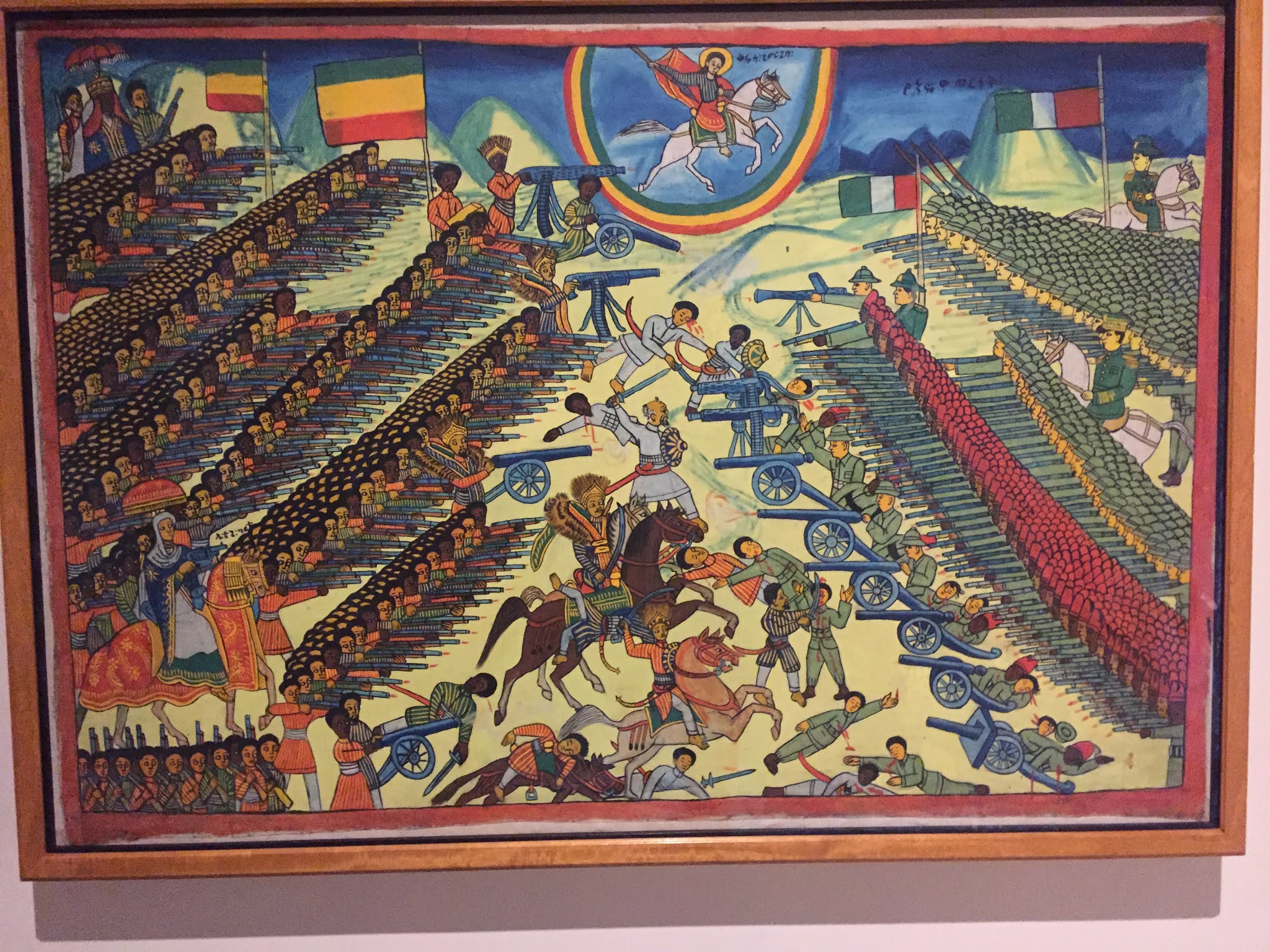
Painting by Solomon Belachew showing the defeat of Amhara Ethiopians by Ras Gobena donated to the Pitt Rivers Museum by Alan Goodwin in February 2020

At the end of February Deputy Head of Conservation Andrew Hughes and myself drove the Museum van to Osney Island, Oxford to collect an Ethiopian painting kindly donated to the Museum by Alan Goodwin. Due to the unforeseen circumstances of the Covid -19 pandemic the painting remains in the Museum’s quarantine quarters for processing. Alan had sent photographs of the painting but I was really excited to see it in the flesh. The painting is a visual treat depicting a vivid and lively battle scene commanded by Ras Gobena, General under Ethiopian Emperor Menelik II. Ras Gobena and Menelik II used guns manufactured in Europe to bring Southern and Northern areas of Ethiopia under a centralised rule. The painting clearly depicts Ras Gobena’s men painted with lighter skin attacking the Amhara Ethiopians from the Northern highlands of Ethiopia depicted in the painting with darker skin. The painting is full of contrasts; mud huts/tents, guns/spears, black/white, Christian/Animist, tunics/beaded loin cloths. This is interesting as ultimately it was the unity of Ethiopia, a country of multiple ethnicities and languages, culminating in its victory over the Italians at the Battle of Adwa in 1896, ensuring Ethiopia’s sovereignty and freedom from colonialism. The triumphant victory at Adwa brought Ethiopia to the world’s attention, strengthening the country’s image as defender of African independence. 
 

Painting by Unknown artist on display at the British Museum depicting the Battle of Adwa, 1896

The painting is by the artist Solomon Belachew. It is very similar in style to a painting held by the British Museum depicting the battle of Adwa. There are stylistic similarities in the conventions used to paint the figures and conventions applied in Ethiopian religious paintings. The battle of Adwa was a popular subject for Ethiopians to paint and Solomon Belachew also painted the scene in a painting which is now at the Smithsonian National Museum of African Art. In our Painting the lighter skinned Oromo Ethiopians are always painted as full-faced figures whilst some of the darker skinned Amhara Ethiopians are painted in profile distinguishing the forces of good from evil. The ferocity of the battle is captured in Belachew’s depiction of blood-spattered victims strewn on the ground. 


 Alastair Goodwin photographed in Africa during the 1940's.


The painting was purchased by Alan Goodwin’s father Alastair Goodwin in 1946 when he was posted to HQ British Military Mission to Ethiopia (Addas Ababa and Jimma) between May – October 1946. Solomon Belachew’s son is also an artist and continues to sale his own paintings and those of other local artist in his studio and shop in the Piazza tourist district of Addis Ababa. It was during Solomon Belachew’s father Belachew Yimar’s time that such contemporary paintings in traditional style became popular souvenirs in the 1940’s for foreign visitors such as Alastair Goodwin to take home. 


Faye Belsey 

Deputy Head of Collections

Tuesday, 21 April 2020

What’s in our Drawers? Transforming a hidden collection

As many visitors to the Pitt Rivers Museum have discovered, you will certainly not be short of things to see. But did you know that some 270 drawers in the Court and Lower Gallery are currently being reimagined? In this transformational project, generously supported by The Clothworkers’ Foundation, a largely hidden collection will be made accessible to visitors and open up another exciting dimension to the rich ethnographic collections cared for by the Museum.


Many drawers are overcrowded, resulting in poor visibility of the collection and damage to the objects
At present, these drawers have been used as ‘overspill’ to house objects from the collection and have been added to over the years. With a collection as vast as the Pitt Rivers, it is easy to imagine how crowded these drawers have become. Not only has this resulted in some damage to the objects, it has also limited the accessibility of these objects to visitors.

These display drawers are contemporaneous to the Museum and, like the cabinets, form part of the well-known fabric of the museum often containing objects of the same ‘type’. Younger visitors enjoy pulling open the drawers and seeing what’s hidden inside, but the very action of opening the drawers currently risks further damage to the contents. Here lies the challenge: how do you go about updating these displays whilst working with historic display units? The answer comes in the form of a laser cutter and a lot of Plastazote foam!

Curating the Drawers

The first step in their transformation involves retrieving the drawer and selecting a group of objects to keep on display in the drawer, those that do not make the cut are then packed for storage. Like the larger display cabinets in the Museum the drawers contain a wide variety of objects that span the globe and present a unique curatorial challenge. Most of the drawers are far too full and so the project of redisplay gives us the opportunity to rationalise what we display in any one drawer. This can be difficult when some of the topics are as complex as ‘divination and religious objects from Africa’. Often these objects have complicated histories. Sometimes these are explained on old handwritten metal rimmed labels and so where possible we try to make these labels visible. The hand-written labels are not without their problems, often they contain old fashioned or even offensive terminology. Luckily objects in the Pitt Rivers Museum have often been donated in multiples of the same thing, by different donors. Aesthetically it is nice to group objects in odd numbers and sometimes it can be easy to discount objects on the fact that they may be in a bad condition and there is another example of the same thing which can be used. Again selecting objects which are from the same geographic area is a good rationale as is selecting similar objects from different regions to demonstrate the ingenuity of people from all over the world to make objects for the same function from the resources they have available to them. We have allocated a postcard sized space to accommodate a short explanatory label for each drawer, this also provides a challenge to write a short text interesting enough to aid the visitor in understanding what can be seen but brief enough to fit on a postcard and cover the diverse range of geographical areas and different cultures represented by the multiple objects displayed in a single drawer. Each week we look forward to discovering the contents of a drawer and are excited to see what lies in wait for us. 

Conserving the Drawers Contents

Rebeccas re-humidifying a plant fibre sample


The project has also allowed for remedial intervention to be carried out on some objects that have deteriorated or been damaged whilst stored in the drawers. Conservation treatment has ranged from re-bonding broken clay figurines, re-humidifying pineapple fibre textile samples, and carrying out tear repairs on a folding paper scene. The sheer variety of conservation challenges has been a wonderful opportunity to get to know objects that have remained largely unseen for a number of years. Not only does this ensure that objects are stabilised, it also means that they can be discovered anew by both staff and visitors.

The plant fibre sample before (above) and after (below) conservation treatment

Redisplaying the Drawers

Another exciting aspect of this project has allowed for the development of a technique which allows custom-made Plastazote trays to be created. The new object layouts are photographed, and outlines produced in Adobe Illustrator, before being programmed into the museum’s laser cutter. 

Preparing the Plastazote foam for laser cutting
The result? A foam tray that can be neatly slotted into the drawer. With a cushioning barrier now surrounding each object, a much safer and more attractive display has been achieved.

To date, 56 drawers have been totally transformed. And a huge 2061 individual objects have been processed! So, once we are able to return to the museum why not have a look in our drawers? You never know what you might discover . . . 


The transformed drawer layouts
Interested in following this project? The conservation department post regular updates about the ‘What’s in our Drawers?’ project and many other intriguing finds through their Instagram account. Just search for @pittriversmuseumconservation

Rebecca Plumbe (conservation intern) and Faye Belsey (Deputy Head of Collections)

Wednesday, 15 January 2020

Interning with the Pitt Rivers Collections Department

Last summer I spent five weeks interning with the Pitt Rivers Museum’s (PRM) Collections department, this was an invaluable experience for me as a student looking to pursue a career in the museum sector. The internship taught me a lot; both in practical skills and about working in museums in general. I am very grateful for the opportunity, and for the Santander award funding I received through the Oxford University Internship Programme.

For the duration of my internship I was shadowing Faye Belsey and Nicholas Crowe in their day-to-day work. They, the whole Collections team, and everyone working at the Pitt Rivers were incredibly welcoming, friendly, and always eager to answer any questions that I had. I got to engage with so many different tasks, ranging from photographing La Madeline stone tools, to collecting objects from museums cases, to researching objects. Here I will just summarise a few tasks I undertook.

Over the course of my internship I assisted with two research visits, one from a curator of the Sarawak Museum, and one from a Maori art collective. These were very interesting experiences as they allowed me to engage hands on with material and learn more about the objects from people who really understood the context of the objects. Assisting with the Maori research visit was definitely a highlight of my time at the PRM. The objects the artists were exploring were mostly cloaks, but there were also woven bags, a piece of bark cloth, a Huia bird skin, and a tuatara knife. These artists explored the collection with excitement and passion, able to analyse every woven stitch to uncover how the object was made. Before beginning their research, a statement was made and their hands were washed, with some of the artists being moved to tears. This was incredible to see as it really contextualised the objects as belonging to a present cultural group, not some past peoples, as is so often expected of early collected ethnographic material. 

For the Sarawak research visit the objects were: two tobacco boxes, two shirts, four jackets, one hat. Of particular interest to the researcher was the hat (sera’ong). The this type of bamboo hat offers a protective power to a woman and child when worn. It offers protection from the sun, and from snakes and head hunters in the area outside the longhouse. The researcher had come across the hat on the PRM Online Database and thought there was a possibility it may have once been in the collections of the Sarawak Museum. It was a very exciting moment when, through handling the object, the Sarawak Museum Accession Number was uncovered, confirming the researcher’s theory.


Hat and inside of hat, 1923.86.102 . ©  Pitt Rivers Museum

Kesang Ball, London 2018. © Nyema Droma and Pitt Rivers Museum


At a later date, I helped with the transcribing of subtitles for the video of interviews shot by Nyema Droma during her photoshoots. It was particularly interesting to see how different people held conflicting opinions on the basis of identity, such as how much of it is symbolised by local dress. For example, Tsewang Gonpostated,“I think Tibetans should wear traditional costume more often as wearing a Tibetan outfit shows your Tibetan identity.” Whereas Tsering Yata believes, My Tibetan identity is not about what I am wearing.” 

During my internship, the largest piece of independent research I undertook was the documentation of the John Driver acquisition. This was a collection of eighteen items donated to the museum after the passing of linguist John Driver. The objects were a selection of items from Driver’s time in Tibet, and were all textile based. I greatly enjoyed handling the textiles and trying to uncover their function and relation to other objects. One piece that was particularly exciting to analyse was the mask (2018.220.1) 

Mask, 2018.220.1 © Pitt Rivers Museum


Through searching online I discovered that this particular style of mask is a soft-shaped mask, of the hard quality type. It was made using paperboard as a roughcast and then cloth and animal skin are stuck on, with holes cut out for the eyes and mouth. This type of mask is seen primarily in folk operas, dancing performances, singing, and story-telling. They are basic and unsophisticated, displaying a strong influence of Tibetan folk art and the characteristics of the primitive art of masks. After researching the objects, I updated their information on the database, sewed on their labels and photographed them. It was incredibly rewarding being able to work with a group of objects from start to finish as I got to see first-hand the amount of work that goes into acquisitioning an object.

Both these research activities involved getting to grips with the Objects PRM Database. This was initially a difficult piece of software for me to navigate, but with time I got the hang of things and could confidently update information and search for objects. Near the end of my internship I attended a meeting centred on understanding how the database is used across the museum, and the functions that must be obtained when the software is updated. This was really interesting as I was able to learn how the database was used across the different departments; from collections, to conservation, and education.

One very exciting job I was lucky enough to assist with was the hanging of the Performing Tibetan Identities exhibition, photographed by Nyema Droma. It was fantastic to see the amount of work different departments do to both plan for and install an exhibition, and wonderful to see that a year of work had culminated in such a great result. The end result was stunning and conceptually interesting, with the installation boldly filling the empty space above the cabinets in the Great Court, producing the aesthetic of contemporary western art whilst echoing the form of strings of traditional Tibetan prayer flags.

This focus on the importance of traditional dress in identity making was particularly interesting to me having worked with the Tibetan textiles from the John Driver acquisition. Some of the pieces I researched were exquisitely made, and it would have been interesting to have discussed with their makers how they felt the pieces were reflective of Tibetan identity in the same way Nyema has asked contemporary Tibetans.

Another key task I performed during my internship was working at the off-site store. The OPS project has meant that all the material stored at the off-site store needed to be audited and packed to be moved. I arrived in the last few weeks of this project and assisted with the packaging of spears and identifying objects that had been found unnumbered.

The spears I was packing were mostly Australian or Asian, but there were also spears from all across the world. The variety was extraordinary, ranging from a sharpened stick to those that were ornately decorated, such as spears from Nagaland, North East India. Great caution had to be taken while packing so as not to damage the object, but also to avoid causing injury to myself or others around me. The approach was to consider all objects likely to be poisoned, which I had discussed with the Conservation department beforehand, and I was made aware of the safety precautions that ought to be taken.

The found unnumbered objects (FUs) are objects that had been found in the packing of the collections without an accession number on them. I worked with Joanna Cole to try and match these objects to database entries, and where it was not possible we endeavoured to describe the object and its possible use in as much detail as possible.

This experience has definitely affirmed my desire to work in the museum sector. Being able to engage with the different tasks of research visits, independent database work, exhibition planning, and collections management/organisation has definitely encouraged me to pursue work in a Collections team specifically. I have had an amazing experience interning at the Pitt Rivers, and am incredibly grateful to Nico and Faye for all their help, and I would certainly recommend the internship to others.

Catherine O’Brien

Thursday, 15 September 2016

A Gift from the New South Africa


Cruet sets. Right to left: Mandela and De Klerk (2016.44.1), Tutu and Terre Blanche (2016.44.2) and Elizabeth II and Prince Philip (2016.44.3) © Pitt Rivers Museum
I have recently accessioned an interesting new acquisition of Africana into the collections. At the time of the first free elections in South Africa in 1994 a local pottery in Bryanston, S. Africa, called Baker Street originals produced two salt and pepper sets, one depicting Nelson Mandela and F.W. Klerk and the other Archbishop Tutu and Eugene Terre Blanche; subsequently at the time of the Queen's state visit to South Africa a couple of years later they produced a third set representing the Queen and Prince Philip. Baker Street trading the manufacturers of the cruet sets was established in 1986 and through the years has manufactured various items for the home and garden including the now famous and collectable cruet sets of South African political figures. The company are still manufacturing goods but no longer produce the cruet sets, which were produced in small quantities. The Mandela and De Klerk and the Archbishop Tutu and Terre Blanche sets were donated with their original packing, a cardboard box illustrated by South African cartoonist Peter Mascher, who has worked for South African newspapers Beeld, Citizen and Daily Dispatch. The cruet sets are made from terracotta and have been hand painted, they are caricatures of the famous South African political figures and British monarch. Mandela and Tutu were famously anti-apartheid freedom fighters whilst the position of De Klerk is more complicated, he was Head of State under the apartheid era but helped to broker the end of apartheid and supported the transformation of South Africa into a non-racial democracy whilst Terre Blanche was a white supremacist, a major figure in the right-wing backlash against the collapse of apartheid.

Pepper shaker depicting Nelson Mandela (2016.44.1 .1)  © Pitt Rivers Museum
Pair of salt and pepper shakers depicting Archbishop Tutu and Eugene Terre Blanche with souvenir cardboard box (2016.44.2) © Pitt Rivers Museum
Following a series of tense negotiations and years of liberation struggle, the first democratic election was held in South Africa on the 27th April, 1994. This election changed the history of South Africa. It paved the way towards a new democratic dispensation and a new constitution for the country. For the first time all races in the country were going to the polls to vote for a government of their choice. Nineteen political parties participated and twenty-two million people voted. The African National Congress (ANC) won the election, they formed the Government of National Unity and Nelson Mandela became South Africa’s first black president. De Klerk was the last Head of State of South Africa under the apartheid era and acted as deputy president during the presidency of Mandela. Controversially, the Nobel Peace Prize 1993 was awarded jointly to Mandela and De Klerk "for their work for the peaceful termination of the apartheid regime, and for laying the foundations for a new democratic South Africa"

Pepper shaker depicting Queen Elizabeth II (2016.44.3 .1)  © Pitt Rivers Museum
Queen Elisabeth II visited Cape Town, Johannesburg, Pretoria, Durban and Port Elisabeth between the 19 - 25th March 1995 on a state visit to South Africa. It was the first visit of a British monarch since 1947. Her trip marked the country's return to the Commonwealth following the election of its first multi-racial government. Her visit was as Head of State visiting an independent country and also as Head of the Commonwealth to mark South Africa's return to the organisation in July 1994.

Faye Belsey
Assistant Curator 

Thursday, 30 June 2016

Collections Care: Boxing Clever

The Pitt Rivers Museum is currently in the process of packing over 100,000 objects in the reserve collections to move them to a new storage facility. Many of these objects have not been stored in suitable conditions during their lifetimes in the Museum. The project team are endeavouring to improve these conditions for the future. This work includes packing into chemically inert boxes, so either physical movement or pollutants do not damage the objects. To achieve this, large numbers of acid-free cardboard boxes in a range of standardised sizes are purchased from G. Ryder & Co. Ltd, based in Bletchley, Buckinghamshire. Founded in 1914, Ryder's specialise in hand-made boxes for museums and galleries. They also produce the boxes used to hold the scrolls given when receiving an honour from the Queen, hence holding a Royal Warrant since 1988.

In an effort to understand the box making process, and to discuss future requirements for the project, some of the OPS move team visited Ryder's on 26 May 2016.

OPS move team at Ryder's. From left to right: Andrew, Ashleigh, Meghan and Marina
Firstly, we were amazed at how small the premises were considering the quantity and size of boxes they produce for us, let alone all of their other customers. The second thing that stood out was how labour intensive the process is, with lots of people - each one working on one particular element of a box's production throughout the day.

Monique using the machine that creates the crease line in the card to enable folding
Tania using the machine that cuts slots in the card before the box can be folded

Janice using the machine that wire-stitches the boxes together at the end of the process

Each of these processes seemed quite manageable for the boxes they were working on that day. We realised their tasks would become infinitely more difficult with some of the large boxes we have ordered, which are over a metre long and nearly half a metre wide.

Another thing that our host, manager Rob Honour, explained was how many of the machines they are still using are upwards of 50-100 years old. This makes servicing and repairs a nightmare, with replacement parts needing to be specially made. It also limits the size of the flat sheet material that can be used to make a box. Considering these constraints, we are now working with Rob to design a box that is 1.5 metres long to be able to pack wooden clubs largely from the Pacific Islands. Rob is worried about a revolt from the ladies on the shop floor given how complicated this will be!

To see updates on how the team are using the boxes, and for news on the project, keep an eye on this blog or follow us on twitter

Heather Richardson
Head of Conservation

Wednesday, 25 May 2016

Museum Redisplay: Working on Watercraft

I am currently part of a team working on a new display of model boats. I feel privileged to be part of this creative process and thought you'd enjoy an insight into the display taking shape.

Conservators, Andrew and Jem, have examined each of the models, carrying out any necessary treatments before the boats go on display. Thanks to their patience and skill, I've often seen a dramatic transformation in the appearance of the models.

Below you can see two of the models Jem has recently researched so he could accurately position the sails.

Model reed boat, or balsa, like ones used on Lake Titicaca in Bolivia and Peru
PRM 1891.2.1 © Pitt Rivers Museum

Model skin-covered boat, or umiak, like ones used by Inuit people in Greenland
PRM 1884.81.40 © Pitt Rivers Museum

Keep an eye on this blog page and I will continue to share the display process with you.

When it is finished you will be able to see this display in the Court Gallery, on the ground floor of the Museum. The boat models will be housed in a brand new case, which has been possible thanks to the DCMS/ Wolfson Foundation's Museum and Galleries Improvement Fund.

Zena McGreevy
Senior Assistant Curator


Thursday, 20 August 2015

Caring for the Collections: Good Gourd!


The information found either written on an object or on a label attached
to the object allows us to track the object down on the database, assign it the
correct accession number,catalogue it and record its location making the object
more accessible for staff and researchers. © Pitt Rivers Museum

The wooden drawer units  © Pitt Rivers Museum
Box storage  © Pitt Rivers Museum

After having embarked and completed the rather large and daunting project of cataloguing and improving the storage of plant fibre clothing in the collections at our store we turned our attention to a more manageable project to see us through the summer. The Museum has a large collection of gourds kept in a less than useful wooden drawer system at the store. Gourds are particularly vulnerable to getting broken or damaged due to their delicate composition, odd shapes and sizes and varying thickness/thinness. And so, to this end, for the well being of the gourds the wooden drawer system is being replaced with conservation grade boxes and packaging.

The collections of the Pitt Rivers Museum and indeed ethnographic collections all over the world demonstrate imaginative use of the gourd. Gourds of all shapes and sizes are a natural resource across the globe and in societies today gourds are still being used as bowls, vessels, hats, musical instruments and for many other utilitarian purposes. Conservator Jeremy Uden and myself have been surprised by the variety of shapes, sizes and uses of the gourd and the varying thicknesses from eggshell thin to an inch or more thick. We are half way through the cataloguing and re-storage project and are getting an eye for identifying preferred decorative techniques from country to country. As well as gourds we are also working through vessels made from seed and nut including coconut vessels mostly from Oceania. Coconuts are readily available to Pacific Islanders and prove useful repositories for carrying and storing water and drinking water and kava from.


Above: gourds and coconut vessels in the process of being
catalogued and packed  © Pitt Rivers Museum

Gourd of the Lengua Indians; 1903.19.3  © Pitt Rivers Museum
Decorative techniques also vary greatly, with surfaces being incised with linear, figurative and geometric designs and decorated with burnt patterns known as pyro engraving. Coconut shells are inlaid with pearl shell and shell beads for aesthetic effects and white lime rubbed into incised designs to highlight the pattern. A particularly ingenious method of carving the lid so that it fits perfectly onto the gourd vessels is that of the Lengua Indians of the Paraguayan Chaco, South America. One end of the gourd is cut from the other with a zigzag line. Some of the coconuts and gourds have been decorated with perfect circular patterns created with a compass. We have more than one example of a coco de mer, or double coconut having been refashioned into a Hindu Sadhu's begging bowl with metal chain suspension for wearing around the neck. The value of the gourd as a utilitarian object is also emphasised by the local repairs found on some of them. Rather than make a new one, someone has taken the time to repair a damaged gourd already fashioned as a vessel. Later in the year the Museum will have a temporary display curated by our conservation department focusing on objects with local repairs 'Preserving What is Valued' including gourds. Some of these techniques and methods of using and decorating gourds can been seen on display in the Museum Court in the Geometric Form in Art case C.145.A and also in musical instruments particularly stringed lutes and zithers where the gourd forms the resonator part of the instrument.

Hindu Sadhu's begging bowl made from a double coconut;
1933.51.65   © Pitt Rivers Museum


Above, two gourd vessels which have local repairs where the
gourd has split and broken  © Pitt Rivers Museum


Above are coconut shells fashioned into water carrying vessels.
The top photograph shows how a plant fibre basketry frame has been
made to cradle the two coconuts and the one below has simply
been decorated with pearl shell; 1887.1.578 & 1933.38.27  © Pitt Rivers Museum

Above; gourds decorated with pyro-engraving technique, where burn marks
applied often with a poker have been used to make patterns and
decoration on the gourd; 1900.55.431 & 1934.8.102  © Pitt Rivers Museum

The two gourds above have been decorated with incised designs and
patterns and then rubbed with lime which is white and
acts highlight the design; 1935.56.15 & 1946.6.63 .2  © Pitt Rivers Museum


Faye Belsey
Assistant Curator