Showing posts with label museum storage. Show all posts

Thursday, 20 August 2015

Caring for the Collections: Good Gourd!


The information found either written on an object or on a label attached
to the object allows us to track the object down on the database, assign it the
correct accession number,catalogue it and record its location making the object
more accessible for staff and researchers. © Pitt Rivers Museum

The wooden drawer units  © Pitt Rivers Museum
Box storage  © Pitt Rivers Museum

After having embarked and completed the rather large and daunting project of cataloguing and improving the storage of plant fibre clothing in the collections at our store we turned our attention to a more manageable project to see us through the summer. The Museum has a large collection of gourds kept in a less than useful wooden drawer system at the store. Gourds are particularly vulnerable to getting broken or damaged due to their delicate composition, odd shapes and sizes and varying thickness/thinness. And so, to this end, for the well being of the gourds the wooden drawer system is being replaced with conservation grade boxes and packaging.

The collections of the Pitt Rivers Museum and indeed ethnographic collections all over the world demonstrate imaginative use of the gourd. Gourds of all shapes and sizes are a natural resource across the globe and in societies today gourds are still being used as bowls, vessels, hats, musical instruments and for many other utilitarian purposes. Conservator Jeremy Uden and myself have been surprised by the variety of shapes, sizes and uses of the gourd and the varying thicknesses from eggshell thin to an inch or more thick. We are half way through the cataloguing and re-storage project and are getting an eye for identifying preferred decorative techniques from country to country. As well as gourds we are also working through vessels made from seed and nut including coconut vessels mostly from Oceania. Coconuts are readily available to Pacific Islanders and prove useful repositories for carrying and storing water and drinking water and kava from.


Above: gourds and coconut vessels in the process of being
catalogued and packed  © Pitt Rivers Museum

Gourd of the Lengua Indians; 1903.19.3  © Pitt Rivers Museum
Decorative techniques also vary greatly, with surfaces being incised with linear, figurative and geometric designs and decorated with burnt patterns known as pyro engraving. Coconut shells are inlaid with pearl shell and shell beads for aesthetic effects and white lime rubbed into incised designs to highlight the pattern. A particularly ingenious method of carving the lid so that it fits perfectly onto the gourd vessels is that of the Lengua Indians of the Paraguayan Chaco, South America. One end of the gourd is cut from the other with a zigzag line. Some of the coconuts and gourds have been decorated with perfect circular patterns created with a compass. We have more than one example of a coco de mer, or double coconut having been refashioned into a Hindu Sadhu's begging bowl with metal chain suspension for wearing around the neck. The value of the gourd as a utilitarian object is also emphasised by the local repairs found on some of them. Rather than make a new one, someone has taken the time to repair a damaged gourd already fashioned as a vessel. Later in the year the Museum will have a temporary display curated by our conservation department focusing on objects with local repairs 'Preserving What is Valued' including gourds. Some of these techniques and methods of using and decorating gourds can been seen on display in the Museum Court in the Geometric Form in Art case C.145.A and also in musical instruments particularly stringed lutes and zithers where the gourd forms the resonator part of the instrument.

Hindu Sadhu's begging bowl made from a double coconut;
1933.51.65   © Pitt Rivers Museum


Above, two gourd vessels which have local repairs where the
gourd has split and broken  © Pitt Rivers Museum


Above are coconut shells fashioned into water carrying vessels.
The top photograph shows how a plant fibre basketry frame has been
made to cradle the two coconuts and the one below has simply
been decorated with pearl shell; 1887.1.578 & 1933.38.27  © Pitt Rivers Museum

Above; gourds decorated with pyro-engraving technique, where burn marks
applied often with a poker have been used to make patterns and
decoration on the gourd; 1900.55.431 & 1934.8.102  © Pitt Rivers Museum

The two gourds above have been decorated with incised designs and
patterns and then rubbed with lime which is white and
acts highlight the design; 1935.56.15 & 1946.6.63 .2  © Pitt Rivers Museum


Faye Belsey
Assistant Curator


Wednesday, 28 January 2015

Caring for the Collections

Work at the Museum stores continued throughout the cold and gloomy winter months. Collections and conservation staff are systematically improving the storage of vulnerable collections and those things considered difficult to move and access in their current storage. We replace old boxes with new conservation grade materials. To this end we have completed the arrows project, re-storing and locating all arrows in storage, adzes and axes have been moved to larger shelves and we are now working on mats and fibre clothing.


Mats retrieved from storage in the conservation lab for humidification
© Pitt Rivers Museum 
Tubing cut to size to roll mats onto © Pitt Rivers Museum

The Museum has a good collection of mats from all over the world, which are currently stored rolled on shelves on movable racking. When the racking is moved to access collections behind or in front of the mats the mats are at risk of falling off the shelving or being squashed. The solution to this is to store the mats rolled on tubing which can be easily removed from brackets on the shelves. We have been taking the mats back to the Museum so that Senior Conservator, Jeremy Uden can humidify the mats, check their condition and eventually roll them onto the tubing once the tubes have been cut to size.

Unwrapping a Malaysian mat; 1940.3.028 (above and below) 
© Pitt Rivers Museum
Sometimes at the store we come across objects wrapped in brown paper packaging, often the packaging that the object came to the Museum in the first instance in. Unwrapping the brown paper is exciting for us. Last week we unwrapped a fabulous mat and pillow from Malaysia. The mat is richly embroidered with silk and sequins and belonged to the Sultan Idris.


Detail of embroidery on Malay mat © Pitt Rivers Museum

Plant fibre fringed skirt in new box
© Pitt Rivers Museum
Whilst or technical team work on constructing the new storage unit for the mats we have been working through the fibre clothing including many grass skirts from Polynesia, Japanese fibre rain capes and African masquerade costume. The fibre clothing is made from grasses, palm leaves, bark and other plant material. This material gets very brittle over time and becomes delicate and fragile. These items of clothing were often worn and danced and used, they were not supposed to last forever by their very nature. Given the age of the some of the pieces and the distances they have travelled to be in the collections they are in remarkably good condition. The re-storage project will involve moving the clothing to larger custom made Corex boxes. We have already discovered an important fibre skirt from Captain Cook's voyages to the Pacific which had been previously un-located.


Plant fibre skirt from Tahiti, Forster 36, 1886.1.1179 © Pitt Rivers Museum
Custom made Corex boxes filled with plant fibre clothing 
© Pitt Rivers Museum

Conservation grade standard sized boxes for 
smaller garments © Pitt Rivers Museum 

Fibre clothing laid out on the table at store for cataloguing (above and below) 
© Pitt Rivers Museum


Custom Corex boxes on store shelves © Pitt Rivers Museum 

Faye Belsey & Jeremy Uden
Assistant Curator & Senior Conservator
Wednesday, 6 August 2014

Paddles Project in the Lower Gallery

The lower gallery of the Museum is currently closed to enable the movement of several large display cases at the east end of the gallery. While the gallery is closed a team of conservators, collection managers and technicians are taking the opportunity to take down over 500 objects suspended from the floor of the gallery above. All four sides of the gallery have paddles, walking sticks, staffs and calendar sticks on open display above the heads of the visitors.

Grills in the floor 
© Pitt Rivers Museum


The last time the objects were taken down and cleaned was in 2009, when the Museum was closed to redevelop the entrance and install air conditioning equipment. As part of the building works, holes were cut into the floor of both galleries and metal grills installed. This was done to improve circulation of the cooled air to all parts of the Museum. Unfortunately, collections and conservation staff have become concerned over the past year that the addition of the grills in the floor has substantially increased the levels of dust and debris settling on the objects suspended beneath. While high levels of dust are not good for an object, it can generally be removed fairly easily. However, we have found paddles with new water stains, sweetie wrappers and even breadcrumbs stuck to the surface.


Examples of some of the paddles covered with dust and debris 
in the areas directly below the grills © Pitt Rivers Museum

Staff originally tried to think of a way to prevent the dust and debris falling through, but this was problematic as the grills needed to remain clear for the air to circulate. It was also not possible to remove the objects, as the Museum does not have capacity in its stores for over 500 additional long objects. Even if space were available, it would be a sad decision as the paddles on open display are part of the quirky nature of the Museum.


A conservator removing the dust a debris with a brush and vacuum 
© Pitt Rivers Museum

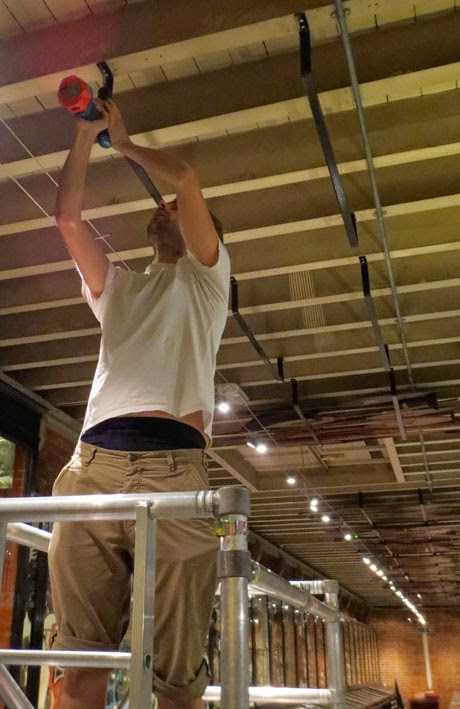
Technician Alan Cooke working from a scaffold tower 
to remove the brackets from the old positions 
© Pitt Rivers Museum
The solution we have devised is to move the brackets supporting the objects to positions where the objects do not sit directly below the grills in the floor. This involves taking down all the objects from a rack, unscrewing the brackets and moving them to the new positions along the wooden beams. In some areas the brackets need to be re-orientated to avoid the grills. While the objects are down they are cleaned, assigned a condition assessment, and their cataloguing and location information checked. The objects are then returned to their new positions.

When the gallery re-opens on Saturday 6th September, remember to look up!

Heather Richardson

Head of Conservation