Showing posts with label cataloguing. Show all posts

Wednesday, 19 August 2020

New Acquisitions: Painting from Ethiopia

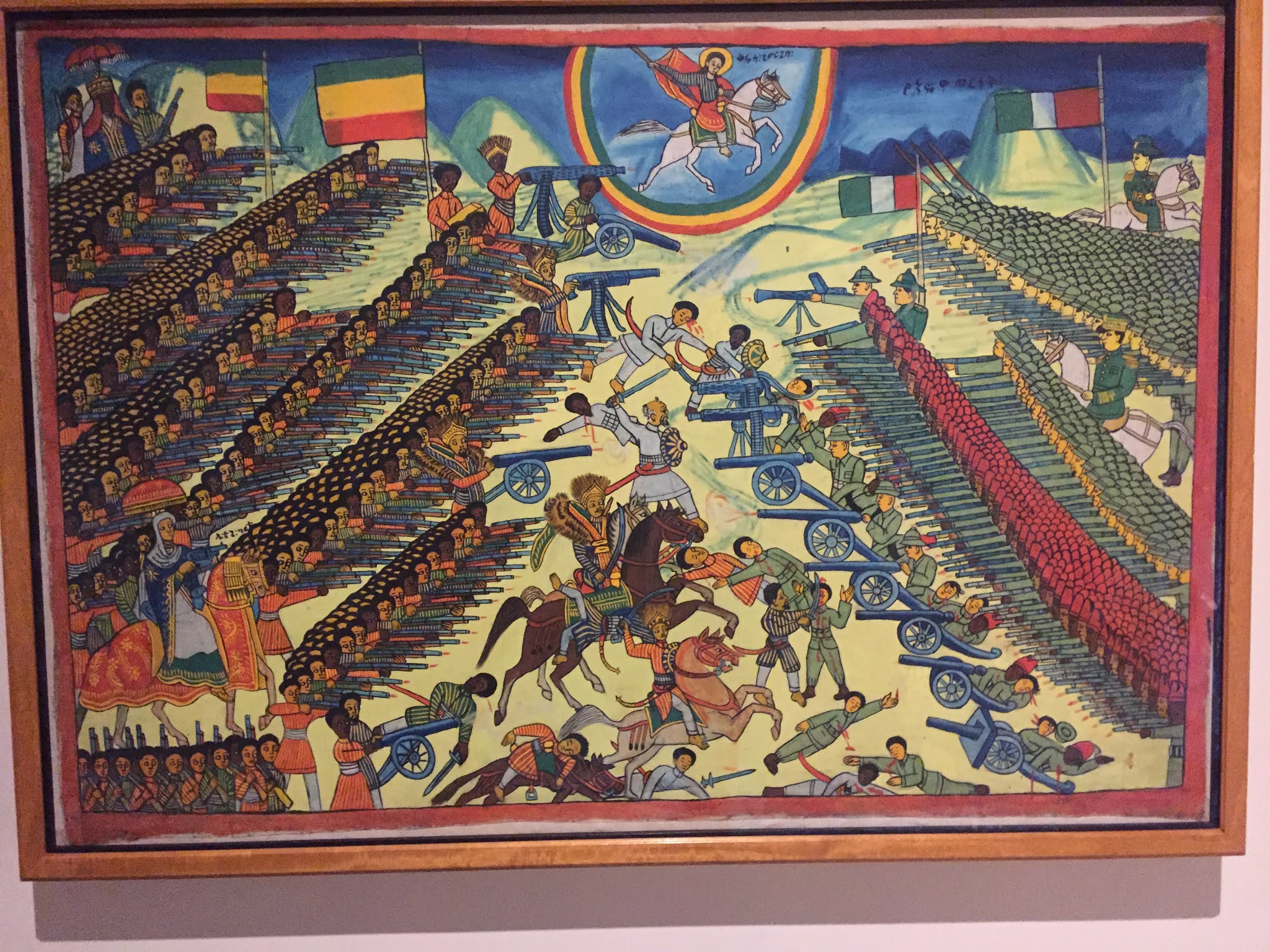
Painting by Solomon Belachew showing the defeat of Amhara Ethiopians by Ras Gobena donated to the Pitt Rivers Museum by Alan Goodwin in February 2020

At the end of February Deputy Head of Conservation Andrew Hughes and myself drove the Museum van to Osney Island, Oxford to collect an Ethiopian painting kindly donated to the Museum by Alan Goodwin. Due to the unforeseen circumstances of the Covid -19 pandemic the painting remains in the Museum’s quarantine quarters for processing. Alan had sent photographs of the painting but I was really excited to see it in the flesh. The painting is a visual treat depicting a vivid and lively battle scene commanded by Ras Gobena, General under Ethiopian Emperor Menelik II. Ras Gobena and Menelik II used guns manufactured in Europe to bring Southern and Northern areas of Ethiopia under a centralised rule. The painting clearly depicts Ras Gobena’s men painted with lighter skin attacking the Amhara Ethiopians from the Northern highlands of Ethiopia depicted in the painting with darker skin. The painting is full of contrasts; mud huts/tents, guns/spears, black/white, Christian/Animist, tunics/beaded loin cloths. This is interesting as ultimately it was the unity of Ethiopia, a country of multiple ethnicities and languages, culminating in its victory over the Italians at the Battle of Adwa in 1896, ensuring Ethiopia’s sovereignty and freedom from colonialism. The triumphant victory at Adwa brought Ethiopia to the world’s attention, strengthening the country’s image as defender of African independence. 
 

Painting by Unknown artist on display at the British Museum depicting the Battle of Adwa, 1896

The painting is by the artist Solomon Belachew. It is very similar in style to a painting held by the British Museum depicting the battle of Adwa. There are stylistic similarities in the conventions used to paint the figures and conventions applied in Ethiopian religious paintings. The battle of Adwa was a popular subject for Ethiopians to paint and Solomon Belachew also painted the scene in a painting which is now at the Smithsonian National Museum of African Art. In our Painting the lighter skinned Oromo Ethiopians are always painted as full-faced figures whilst some of the darker skinned Amhara Ethiopians are painted in profile distinguishing the forces of good from evil. The ferocity of the battle is captured in Belachew’s depiction of blood-spattered victims strewn on the ground. 


 Alastair Goodwin photographed in Africa during the 1940's.


The painting was purchased by Alan Goodwin’s father Alastair Goodwin in 1946 when he was posted to HQ British Military Mission to Ethiopia (Addas Ababa and Jimma) between May – October 1946. Solomon Belachew’s son is also an artist and continues to sale his own paintings and those of other local artist in his studio and shop in the Piazza tourist district of Addis Ababa. It was during Solomon Belachew’s father Belachew Yimar’s time that such contemporary paintings in traditional style became popular souvenirs in the 1940’s for foreign visitors such as Alastair Goodwin to take home. 


Faye Belsey 

Deputy Head of Collections

Friday, 7 September 2018

Stones and Skirts: Interning at the Pitt Rivers Museum

I remember the first time I went to a museum in primary school, on a fieldtrip. I had been interested in history even then, and seeing history manifest itself in material objects, all in one place, blew my little mind. As I grew older, my interest in history and the cultures and peoples of the past continued to develop, and ultimately, after gaining a Bachelor’s in Anthropology and Sociology, I decided to pursue a Master’s in Archaeology at Oxford University. It was stressful and very difficult at times, but whenever I needed a break to rekindle my love for my studies, I would go and roam around the various museums of Oxford, and the Pitt Rivers Museum (PRM) quickly became one of my favourites, as it combined my love of both anthropology and archaeological material culture. When I heard that the PRM was offering a summer internship, I knew that I had to apply.

Interior view of the Pitt Rivers Museum © Pitt Rivers Museum

I applied to the paid five-week internship at the Pitt Rivers, funded by the Santander Award, through the Oxford University Internship Programme (OUIP), which allows students of the University of Oxford to apply to a large variety of internships both in the UK and abroad. I, along with another intern who is to begin after I finish, were selected for the Collections Internship at the Pitt Rivers. I was both excited and intimidated, and the feeling has not diminished even after the 5 weeks that I have spent here.

I performed a wide variety of tasks at the PRM, as the internship was meant to give me an idea of the various types of jobs and roles which are available in museum work; from shadowing Faye Belsey and Nicholas Crowe (my two supervisors) as they went about their various daily tasks (working on displays, meeting researchers, moving objects from various stores to the museum, etc.), learning how to catalogue objects into the museum’s database and doing research for future exhibitions, to spending afternoons with various museum staff to learn about their projects and going with them to collect new acquisitions, this internship gave me a taster of the various types of jobs that are available in the museum sector. 

In my first few weeks, I spent a lot of time shadowing different people, and looking at the projects which they were working on. I spent an afternoon looking at the journals and writings of Makereti Papakura, a Maori noblewoman, guide and ethnographer; she was the first Maori ethnographer, and one of the first to focus on women in the Maori culture. Her writings gave me a fascinating insight into both her life, and the culture and traditions of a people I knew very little about. I spent another afternoon looking through photographs donated by a British photographer of his travels, primarily through Asia and Africa, places which look significantly different than they did 70 years ago, with the pictures serving as archives of rapidly changing landscapes. 

One day a week, I helped the team at the Museum store; a large amount of the Pitt Rivers collection is stored there and is in the process of being catalogued, packed and relocated. Most of my days there I spent packing objects (mostly spears and amulets), in awe of the creative and vastly different designs human beings employ for the same objects. 

I also spent a large amount of time cataloguing and recording stone tools from Rohri, Pakistan. Some of the tools had not been previously recorded, and the experience of learning how the cataloguing system worked, how to record information about the stone tools and going through accession books trying to match the tools to their correct accession numbers, was extremely informative. Furthermore, the stone tools came from an area about 70 miles from Mohenjo-Daro, one of the largest settlements of the ancient Indus Valley Civilization, and an area of the world which holds a special place in my heart, as I am from Pakistan, and my research interests lie there as well. To be able to handle, record and engage with these tools in such a manner, and to be able to learn more about lithic analysis while doing so (something which I knew very little about), remains one of the highlights of my internship.

Original catalogues with drawings of stone tools © Pitt Rivers Museum
Alongside cataloguing the stone tools, one of the most interesting tasks which I performed was looking up information on two Iraqw skirts which the museum is to put on display soon. The skirts are examples of some of the most elaborately decorated textiles in East Africa, and were made by girls during the Marmo initiation ritual, where girls were taken away by elder women and secluded for up to a year. During this time, the girls were fed foods which were rich in fat and resulted in obesity, the area around their mouths was blackened with charcoal, animal oil was applied to their skin to make them shine, their bodies were scented with perfume obtained from a tree, they were taught folk songs and word games as well as sexual manners and were allowed to embroider their leather capes with beads of their own designs, making them into the skirts to be displayed. The girls would also be circumcised during this time. The ritual was thought to purify the girls, so that when they emerged from their seclusion, wearing their skirts and being highly adorned, they were thought to be reborn with a new innocence and dignity. Even though the ritual was banned in 1930, it is speculated that it was still carried out in secret. The skirts were absolutely stunning, and looking up information about them, and as a result, information about the Iraqw people and the marmo ritual, gave me insight into a part of the world and a people which I knew very little about. 

Iraqw skirts 1940.7.0114 and 2017.139.1© Pitt Rivers Museum

Aside from gaining valuable work experience and being able to look at various objects through the lens of a (albeit temporary) museum employee rather than just a visitor, one of the best things about my internship was also the people whom I worked with. Both Faye and Nicholas were incredibly kind, friendly, involved, and genuinely interested in what I wanted my internship experience to be like, and then tailoring it to my needs and interests. Everybody else in the museum was also genuinely passionate about their work, and were always more than happy to talk to me about it. 

I believe that this internship has not only given me a fantastic job experience, but has also rekindled my passion for working in the museum industry, and for all of these things, I am grateful. 

Hadiqa Khan 

Wednesday, 11 November 2015

Museum Redisplay: Models On The Move

On Monday mornings when the Museum is closed we are busy doing jobs in the public areas that are difficult to do during opening hours. At the moment we are upgrading some of the model displays on the ground floor, thanks to an award of nearly £40,000 from the DCMS/ Wolfson Foundation's Museum and Galleries Improvement Fund.

This entails removing the old cases to make way for the new displays. Below you can see staff dismantling a case containing some of the building and housing models. This isn't a job that can be rushed, as each object needs to be carefully lifted out of the case. The models then need to be carefully moved out of the public gallery space.


We use trolleys to transport the objects around the Museum building. On the right you can see some of the models on a trolley ready to be moved.

They are placed into temporary storage in the areas closed to the public. This means they are easy for us to access, even during opening hours, while they are being prepared for redisplay. Below you can see some of the models in the Collections Department where we catalogue and research the objects.


They will all be individually checked by Conservation staff and will be moved to the Conservation Lab to be worked on if necessary. After Collections and Conservation staff have completed their preparatory work, Technical Services will start to design the new display.


Being able to examine the models close up provides an opportunity to see all of the details. The house model you can see below is really intricate; if you look inside you can see miniature hammocks, numerous utensils, as well as little figures.
Arawak house PRM 1901.19.1 © Pitt Rivers Museum
The new displays will be finished sometime next year. I will keep you informed of progress via this blog site. We are really grateful to the DCMS/ Wolfson Foundation's Museum and Galleries Improvement Fund for making this redisplay work possible.

Zena McGreevy
Senior Assistant Curator

Wednesday, 25 March 2015

New Acquisitions: Nok Terracottas

Replica terracottas and moulds on my desk for cataloguing, below replica terracottas.
I recently catalogued a new acquisition from the daughter of Bernard Fagg, former curator and Director of the Pitt Rivers Museum. The donation was of a number of Nok terracottas and moulds among other things detailed below. Fagg was an archaeologist and anthropologist whom, prior to becoming curator at the Pitt Rivers, worked for the British Colonial administration in Jos, Nigeria during the Second World War. During this time he excavated the Pop Rock Shelter on the Jos Plateau. It was during this excavation that Fagg found evidence of Nok culture including distinctive Nok terracotta figurines. Fagg became somewhat of an expert on Nok culture and wrote 'Nok Terracottas' published by Ethnographica for the National Museum, Lagos in 1977. A publication which was very helpful when cataloguing this collection. 
2012.103.7; cast of Nok terracotta figure, depicting a female figure mounted on a cylindrical splayed and hollow base. 


2012.103.3; cast of Nok terracotta, fragment of a figure.


2012.103.8; fragment of a figure, arm with ornaments shown on the upper arm and at the wrist. The hand is holding a hafted axe.
2012.103.9; cast of terracotta head from Nok.

2012.103.1; cast of terracotta head from Nok.
Fagg commissioned the moulds in the mid-to-late 1960s so that it would be possible for the originals to remain in Nigeria and for museums in the West to be able to show replicas of the newly discovered art. The moulds are excellent material evidence of a moment in the history of the study and presentation of African art and of the history of museological practice. The moulds are made from plaster with a rubbery/ latex inner. The replicas bare a close resemblance to the original terracottas, some of which feature in Fagg's aforementioned publication. 


2012.103.20; cast for creating replica Nok terracotta 
As well as the replica terracottas and moulds in this recent donation were also two African walking sticks belonging to Fagg, a gourd bowl with local repair, two fibreglass reproduction casts of Benin brass plaques in the PRM collections and a replica of the Cook voyage collection hei tiki, perhaps with the intention of selling it as merchandise in the Museum shop. 


2012.103.14; ornately carved gourd bowl.
2012.103.14; detail of local repair of gourd bowl.
2012.103.11; Repica Benin plaque, replica of original from PRM collections: 1900.39.2.
2012.103.15 .1 & .2; replica Forster collection hei tiki.
Faye Belsey
Assistant Curator

Wednesday, 28 January 2015

Caring for the Collections

Work at the Museum stores continued throughout the cold and gloomy winter months. Collections and conservation staff are systematically improving the storage of vulnerable collections and those things considered difficult to move and access in their current storage. We replace old boxes with new conservation grade materials. To this end we have completed the arrows project, re-storing and locating all arrows in storage, adzes and axes have been moved to larger shelves and we are now working on mats and fibre clothing.


Mats retrieved from storage in the conservation lab for humidification
© Pitt Rivers Museum 
Tubing cut to size to roll mats onto © Pitt Rivers Museum

The Museum has a good collection of mats from all over the world, which are currently stored rolled on shelves on movable racking. When the racking is moved to access collections behind or in front of the mats the mats are at risk of falling off the shelving or being squashed. The solution to this is to store the mats rolled on tubing which can be easily removed from brackets on the shelves. We have been taking the mats back to the Museum so that Senior Conservator, Jeremy Uden can humidify the mats, check their condition and eventually roll them onto the tubing once the tubes have been cut to size.

Unwrapping a Malaysian mat; 1940.3.028 (above and below) 
© Pitt Rivers Museum
Sometimes at the store we come across objects wrapped in brown paper packaging, often the packaging that the object came to the Museum in the first instance in. Unwrapping the brown paper is exciting for us. Last week we unwrapped a fabulous mat and pillow from Malaysia. The mat is richly embroidered with silk and sequins and belonged to the Sultan Idris.


Detail of embroidery on Malay mat © Pitt Rivers Museum

Plant fibre fringed skirt in new box
© Pitt Rivers Museum
Whilst or technical team work on constructing the new storage unit for the mats we have been working through the fibre clothing including many grass skirts from Polynesia, Japanese fibre rain capes and African masquerade costume. The fibre clothing is made from grasses, palm leaves, bark and other plant material. This material gets very brittle over time and becomes delicate and fragile. These items of clothing were often worn and danced and used, they were not supposed to last forever by their very nature. Given the age of the some of the pieces and the distances they have travelled to be in the collections they are in remarkably good condition. The re-storage project will involve moving the clothing to larger custom made Corex boxes. We have already discovered an important fibre skirt from Captain Cook's voyages to the Pacific which had been previously un-located.


Plant fibre skirt from Tahiti, Forster 36, 1886.1.1179 © Pitt Rivers Museum
Custom made Corex boxes filled with plant fibre clothing 
© Pitt Rivers Museum

Conservation grade standard sized boxes for 
smaller garments © Pitt Rivers Museum 

Fibre clothing laid out on the table at store for cataloguing (above and below) 
© Pitt Rivers Museum


Custom Corex boxes on store shelves © Pitt Rivers Museum 

Faye Belsey & Jeremy Uden
Assistant Curator & Senior Conservator

Wednesday, 17 December 2014

A miscellany of things on an Assistant Curators desk!


From left to right; two Mexican ceramic heads; 1977.15.1& .2; mummified ibis 1894.40.11894.40.1; figure of Buddha, Myanmar 1894.27.167; tattooing apparatus, Myanmar 1884.27.41; mummified ibis in pottery vessel 1901.30.1 & .2; zither in the shape of a crocodile, Myanmar; 1938.34.58 © Pitt Rivers Museum

As a member of the collections department I often have a number of interesting objects for cataloguing and photography on my desk. The objects out on this particular day were so for a number of reasons. The Mexican pottery heads were for a photographic request. Scholars often require studio images of objects for publication and research. I retrieve the object from storage/display and get the object to our professional photographer. The mummified ibises were out for a request to be sampled. Sampling requests for scientific research have to be considered very carefully in consultation with the conservation department. The zither, statue and tattooing implement from Myanmar will go on loan for exhibition to The Linden Museum Stuttgart, Germany for the exhibition 'Myanmar - The Golden Land'. Before objects can be loaned we have to assess if they are suitable for travel before the loan is approved they then have to be catalogued and condition checked. These are just some of the elements of work, highlighted by the objects on my desk on one particular day that goes on in the collections department of the Pitt Rivers Museum.

Faye Belsey 
Assistant Curator

Wednesday, 26 November 2014

New Accessions


Cataloguing of new accession; 2013.57.1


Wooden vessel imitating a calabash. This was a very welcome donation to the Museums collections. The vessel is interesting as it is imitating a Hawaiian calabash. In fact, it is not a calabash at all but a locally turned wooden lidded bowl that was presented to the donor’s grandfather, a British immigrant rancher in Hawaii in 1890.  The Museum did not hold any examples of the 'wooden calabashes' that were produced in Hawaii from the 1840s, and while this is not necessarily a typical example, it is an interesting manifestation of cross-cultural production, both as an example of the production in turned wood of 'traditional' Hawaiian forms and in the way it has been modified by those who presented it, having been adapted into a presentation vessel with cow horn legs. In ‘Little Britain, Letters from the Hawaiian Kingdom (2002)’, which reproduces Ernest Burchardt's letters home to his mother Jane in Liverpool from 1884 - 1891, written by Joan Burchardt, Joan refers to the vessel as such "Before he left Hawaii Ernest was presented with a large calabash, silver mounted on three cow's horn feet, with boar's tusks for handles. This object was much hated by my mother, I regret to say; (mutterings of 'ugly, useless dust-trap')…” The vessel was donated to the Museum with a copy of the published book of letters home and the silver presentation plates now detached from the vessel itself. The main silver presentation plate reads as follows: “ALOA NUI to E A. A. G. Fr. Burchardt Molali Makaaniani Kahauanu of Kahua Ranch Kohala Hawaii For they are jolly good fellows, and so say all of the Kohala Boys July 1890. There is also another plate with a list of the presenters, as follows:- Wm John Brodie, Rev J M Silver, J Maguire, C S Kinnersley, R Wallce, C E Kempster, J O Desborough, H Bryant, G Byrant, F Northrup R H Atkins, J M Smithies, J R Mossman, J S Kay,  C L Wight, J H Mackenzie, A Gunning, A S Spencer, Robert Hall.”

Faye Belsey
Assistant Curator