Showing posts with label museum displays. Show all posts

Wednesday, 10 January 2018

Loan to the exhibition 'The Fabric of Our Land: Salish Weaving at the Museum of Anthropology at the University of British Columbia, Canada

Facade of the Museum of Anthropology on the University of British Columbia campus. Designed by Canadian architect Arthur Erickson. The building is set on the cliffs of Point Grey, a location which is the traditional territory of the Musqueam people. © Pitt Rivers Museum
The crate containing the PRM blanket being palletised for transport by Air Canada © Pitt Rivers Museum


On Monday 13th of November I was lucky enough to travel to Canada with a very special blanket destined for an exhibition at the Museum of Anthropology (MOA) at the University of British Colombia in Vancouver. This was an amazing opportunity for me having worked closely with collections held by the Pitt Rivers Museum from the North-West Coast First Nation peoples in my nine-year career at the Museum. A highlight of my time at the PRM to date has been a visit in 2009 of a delegation of Haida from Haida Gwaii (formally the Queen Charlotte Islands) and whist I was unable to make the epic three-day journey to Haida Gwaii I was able to visit the Bill Reid Gallery and met with a friend I made from that trip whilst in Victoria on Vancouver Island.
Installing the blanket in the exhibition gallery. The blanket was unpacked and condition checked before being carefully placed in the specially design showcase © Pitt Rivers Museum
Contemporary Coast Salish weaving on display alongside the historic pieces © Pitt Rivers Museum
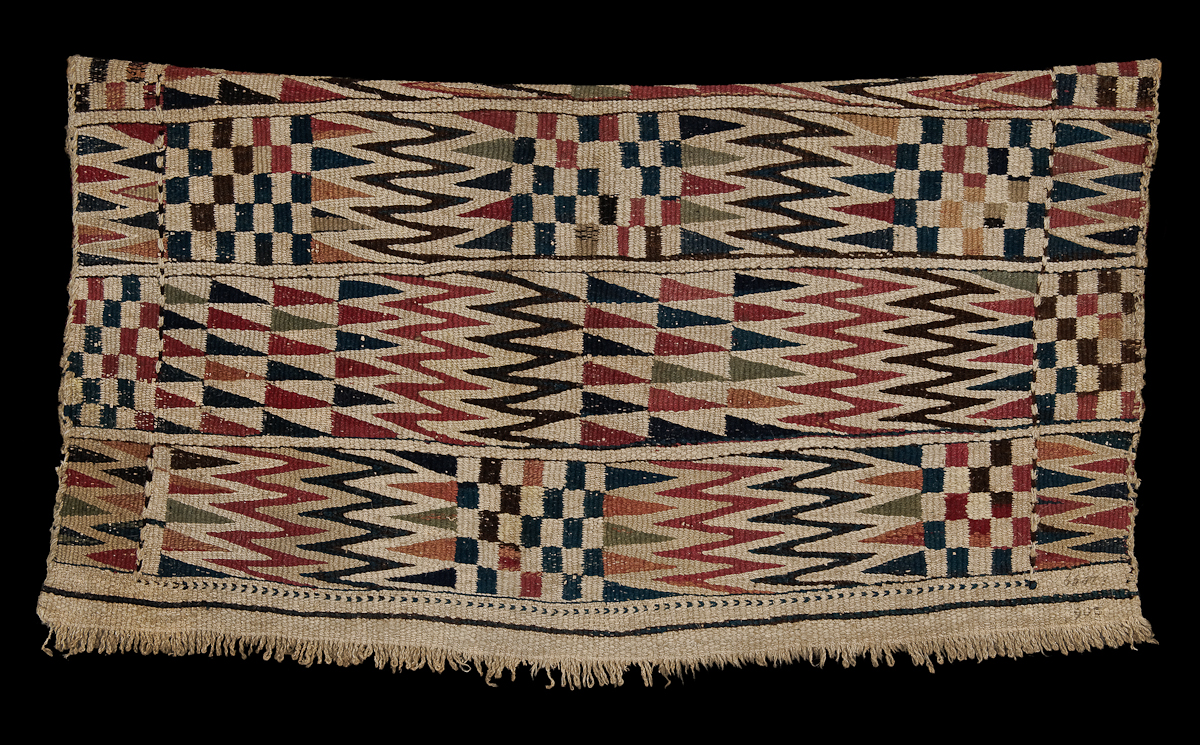
Coast Salish blanket 1884.88.9 © Pitt Rivers Museum


The blanket I was couriering is from the Coast Salish people of the North-West Coast of Canada/Northern USA. More specifically from San Juan Islands which sits in the Haro Strait between Vancouver Island and the North-West mainland coast, just south of Vancouver. It is from the Museum’s founding collection donated to the Museum in 1884 by General Augustus Henry Lane FoxPitt-Rivers on the formation of the Museum at the University of Oxford. It is woven from Coast Salish woolly dog hair and goat hair. The use of dog hair dates the blanket as being made before 1884 as the native dog whose hair was used in Salish weaving had died out by 1860. The blanket is one of ten chosen by Salish weavers from the 1800s to be part of the exhibition 'The Fabric of Our Land' with others from Scotland, Finland and the United States. The historical blankets are displayed among contemporary Salish weavings providing a unique opportunity to compare and contrast the rich tradition of weaving for the Salish people. The exhibition is curated by Sue Rowley who kindly had me stay with her whilst I was in Vancouver. Sue worked in collaboration with the local Musqueam people to create the exhibition. Again, I was fortunate enough to meet some contemporary weavers and be present for the exhibition opening which had around 900 attendees and included speeches by Musqueam weavers Wendy John and Debra Sparrow. The blanket will be on display until 15th of April 2018. On returning to bring the blanket back to Oxford there will be community visits arranged at MOA for weavers and Salish people to see the blanket up close. This work is crucial for the continuity of the craft and tradition of Salish weaving and its importance is summed up in this quote from Wendy Grant-John (Musqueam weaver and political leader) ‘Touching blankets that are over a hundred years old creates such a spiritual feeling, an understanding that the skill you’re reacquiring is the same that our ancestors had’

My visit to Canada gave me a glimpse of the importance of traditional craft and ways of life embedded in objects in European Museum’s far from their place of origin. Loans to exhibits such as ‘The Fabric of Our Land’ make it possible for First Nations people to really experience and get close to their ancestors who were involved in the creation of these special objects. The effect this has on future generations of, in this case weavers and Salish people is significant, it is vital that we enable and facilitate such exchanges. There is still much to do in addressing issues of colonial legacies inherent in ethnographic collections but efforts like this make small inroads.

The trip also provided me with the chance to learn from Canadian colleagues about differences and similarities in our curatorial practice and collections management. I was incredibly fortunate to have this experience and endeavoured to learn as much as possible from my trip. I was also lucky enough to spend time in Vancouver and able to visit Vancouver Island. What really impressed on me during my time in British Columbia was the amazing landscape, particularly the relationship between land, sea and nature so rooted in North-West coast iconography, myth and belief. I feel that I returned to Oxford with a greater understanding of North-West coast culture. It is clear that MOA as an institution is leading the sector in Canada and indeed globally for the work they do with indigenous communities particularly artists and young people and whilst the context is different for European collections where the objects are far from their home I feel that the physical distance only gives us greater responsibility to ensure that we make such objects as accessible as possible to whom these objects truly belong. As part of the public programme for the exhibition Salish weavers and artists will be giving gallery tours and talks as well as weaving demonstrations. There is even the chance to have a go at weaving yourself in the gallery should you get the chance to visit.

Faye Belsey

Assistant Curator

Wednesday, 11 November 2015

Museum Redisplay: Models On The Move

On Monday mornings when the Museum is closed we are busy doing jobs in the public areas that are difficult to do during opening hours. At the moment we are upgrading some of the model displays on the ground floor, thanks to an award of nearly £40,000 from the DCMS/ Wolfson Foundation's Museum and Galleries Improvement Fund.

This entails removing the old cases to make way for the new displays. Below you can see staff dismantling a case containing some of the building and housing models. This isn't a job that can be rushed, as each object needs to be carefully lifted out of the case. The models then need to be carefully moved out of the public gallery space.


We use trolleys to transport the objects around the Museum building. On the right you can see some of the models on a trolley ready to be moved.

They are placed into temporary storage in the areas closed to the public. This means they are easy for us to access, even during opening hours, while they are being prepared for redisplay. Below you can see some of the models in the Collections Department where we catalogue and research the objects.


They will all be individually checked by Conservation staff and will be moved to the Conservation Lab to be worked on if necessary. After Collections and Conservation staff have completed their preparatory work, Technical Services will start to design the new display.


Being able to examine the models close up provides an opportunity to see all of the details. The house model you can see below is really intricate; if you look inside you can see miniature hammocks, numerous utensils, as well as little figures.
Arawak house PRM 1901.19.1 © Pitt Rivers Museum
The new displays will be finished sometime next year. I will keep you informed of progress via this blog site. We are really grateful to the DCMS/ Wolfson Foundation's Museum and Galleries Improvement Fund for making this redisplay work possible.

Zena McGreevy
Senior Assistant Curator

Wednesday, 20 May 2015

Temporary Exhibition: 'Preserving What is Valued'

Three arm ornaments from Africa with different methods of original repair
 © Pitt Rivers Museum
The Conservation Team are currently preparing a small temporary exhibition for a display case in the Museum's Lower Gallery showing objects that have been repaired by their original owners.

Given the nature of our work we study objects in great detail and part of our role is often to determine at what stage a repair to an object has been made. Has the repair been made while the object was still in use in the originating community, or by the original collector, or has it been repaired in the Museum?

When we find examples of repairs from originating communities we feel it gives the object a deeper resonance and is something we strive to preserve. Why was this object repaired by its original owners rather than replaced? Is it a fine example of craftsmanship or is it a sacred object? Were the materials it is made from scarce or expensive? These are just some of the questions we aim to explore in the exhibition.

We decided on the idea last summer when two of us attended the opening of an exhibition at the Japanese Embassy in London called 'Gold: All that Glisters - Japanese Gold Decoration.' One aspect of this exhibition focused on kintsugi, the Japanese method of repairing damaged or broken ceramics using urushi lacquer and, most commonly, gold powder. From early times, imperfection has been the subject of aesthetic appreciation in Japan, particularly with regard to the repair of valued items that have suffered in the course of their daily use. This idea of celebrating imperfection chimed with our attitude in Conservation and the repairs we had seen on objects from all parts of the world. We also felt that the theme of the exhibition fitted in well with the current Need, Make, Use Project, which has a focus on crafts skills and technology.

It isn't every day that Conservators have the opportunity to curate an exhibition based on their own idea and we started out by submitting an exhibition proposal to various museum committees for approval. We borrowed the working title 'Preserving What is Valued' from a book published by Canadian conservator Miriam Clavir (with her permission) and it seems to have stuck.

Having received the thumbs up, we then had to work around the schedule for the display case in the Lower Gallery used for temporary exhibitions. A gap was found for late June 2015 until January 2016, which we snapped up. At this point we also started to progress plans in collaboration with the Need, Make, Use Team for some tie-in events over the period of the exhibition. In the autumn we sent an email to all Collections staff to keep a look out for suitable objects.

We are fortunate that the Museum object database contains a search term 'repaired (local)', which refers to a repair made to the object by the originating community.

Database page showing the search term 'repaired (local)'
The term is either added to the record when the object is catalogued by the Collections Team or by Conservators when they work on the object.

Searching by this term initially produced approximately 500 records. We decided to only select object that were in storage, with the aim of producing a Museum Trail to guide visitors around some of the repaired objects on permanent display.

At this stage we were able to export the database information into a spread sheet.

Part of the working spread sheet
This enabled us to work through the list, physically finding and examining the objects to narrow the selection down further. It also made it easier to see if we had a good geographic spread.

We were down to 35 objects when we prepared a test layout. In the Conservation Lab we marked up a group of tables to the dimension of the display case and experimented with groupings. When working on the layout we considered how objects would need to be mounted in the display and how time-consuming it could be. As we work closely with the Museum Display Technicians, we are fully aware of their busy schedule and needed to make the display as uncomplicated as possible.

Test layout for the display in the Conservation Lab
Following the layout we are now down to 31 objects and have discussed the mounting requirements with Chris and Alan, who  will be working on the display. As we do not currently have any examples of kintsugi ceramics in the collection we have arranged to borrow one or two examples from a local private collector.

The selected Museum objects are now in the Conservation Lab being assessed, photographed, some mounts made and the text prepared. This stage will be completed by the end of May ready for the objects to be passed on to Chris and Alan to begin work on a mock-up of the display from the 1st June. All being well the exhibition 'Preserving What is Valued' will be installed by the 29th June. Please look out for the exhibition and the range of tie-in events we hope to have over autumn 2015.

Heather Richardson
Head of Conservation

Thursday, 11 December 2014

Collections A Hive Of Activity

Jeremy busy at his desk © Pitt Rivers Museum
I thought you might enjoy seeing what everyone in the Collections Department is doing this morning.  All is a hive of activity:

Jeremy, Curator and Joint Head of Collections, is busy answering enquiries.

Marina is doing some research on objects in the collection made by the Ainu people from Japan.

In the Photo Collection are images of an Ainu village set up at the 1910 Japan-British exhibition in London. These images were also produced commercially as postcards. Marina has been able to match objects in these pictures to objects now in the Museum collection.

Marina studying the photos and postcards to identify the objects from the collections © Pitt Rivers Museum
Maddie and Faye are busy showing part of the textile collection to a group of tapestry weavers.

Left: Maddie getting the textiles out ready, right: Maddie & Faye during the tapestry weavers visit © Pitt Rivers Museum
Meanwhile, Sian has been to the off-site store to bring back some objects ready for a new metalwork display; while I am working on updating the introductory guide for the West African masks.

Left: Sian bringing objects back to the Museum, right: me, working at my desk © Pitt Rivers Museum

All in all another busy day...

Zena McGreevy
Senior Assistant Curator