Showing posts with label Canada. Show all posts

Wednesday, 10 January 2018

Loan to the exhibition 'The Fabric of Our Land: Salish Weaving at the Museum of Anthropology at the University of British Columbia, Canada

Facade of the Museum of Anthropology on the University of British Columbia campus. Designed by Canadian architect Arthur Erickson. The building is set on the cliffs of Point Grey, a location which is the traditional territory of the Musqueam people. © Pitt Rivers Museum
The crate containing the PRM blanket being palletised for transport by Air Canada © Pitt Rivers Museum


On Monday 13th of November I was lucky enough to travel to Canada with a very special blanket destined for an exhibition at the Museum of Anthropology (MOA) at the University of British Colombia in Vancouver. This was an amazing opportunity for me having worked closely with collections held by the Pitt Rivers Museum from the North-West Coast First Nation peoples in my nine-year career at the Museum. A highlight of my time at the PRM to date has been a visit in 2009 of a delegation of Haida from Haida Gwaii (formally the Queen Charlotte Islands) and whist I was unable to make the epic three-day journey to Haida Gwaii I was able to visit the Bill Reid Gallery and met with a friend I made from that trip whilst in Victoria on Vancouver Island.
Installing the blanket in the exhibition gallery. The blanket was unpacked and condition checked before being carefully placed in the specially design showcase © Pitt Rivers Museum
Contemporary Coast Salish weaving on display alongside the historic pieces © Pitt Rivers Museum
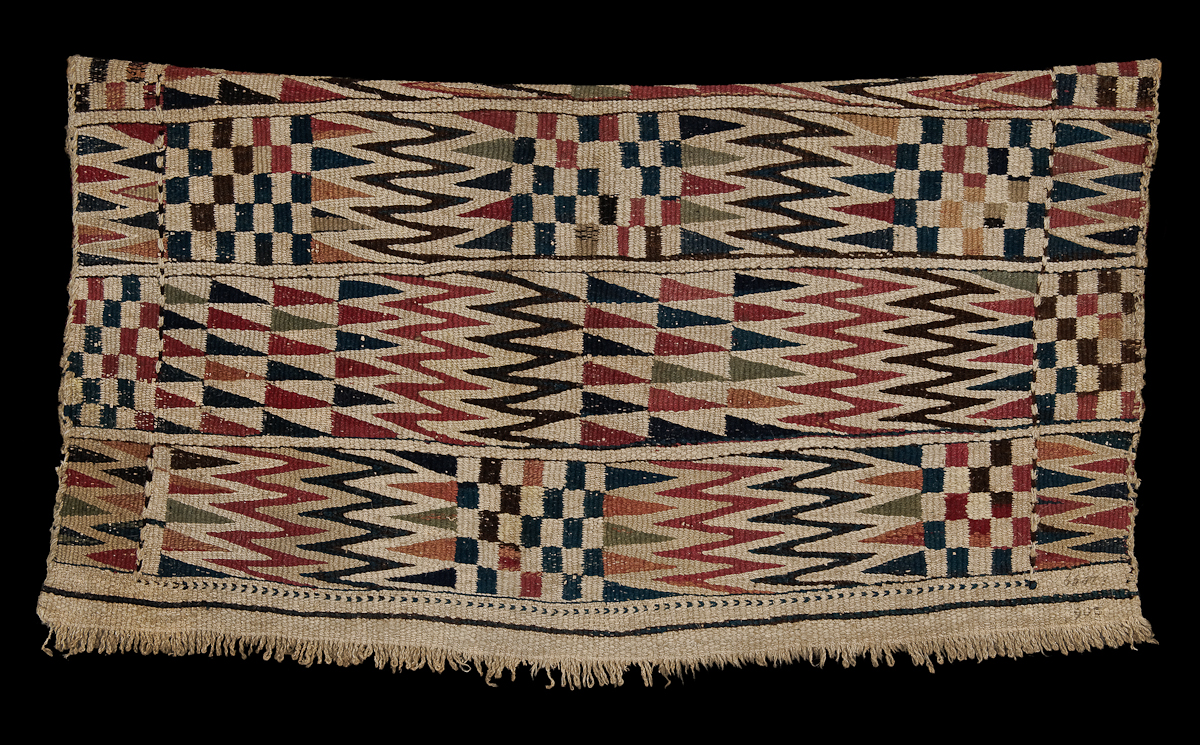
Coast Salish blanket 1884.88.9 © Pitt Rivers Museum


The blanket I was couriering is from the Coast Salish people of the North-West Coast of Canada/Northern USA. More specifically from San Juan Islands which sits in the Haro Strait between Vancouver Island and the North-West mainland coast, just south of Vancouver. It is from the Museum’s founding collection donated to the Museum in 1884 by General Augustus Henry Lane FoxPitt-Rivers on the formation of the Museum at the University of Oxford. It is woven from Coast Salish woolly dog hair and goat hair. The use of dog hair dates the blanket as being made before 1884 as the native dog whose hair was used in Salish weaving had died out by 1860. The blanket is one of ten chosen by Salish weavers from the 1800s to be part of the exhibition 'The Fabric of Our Land' with others from Scotland, Finland and the United States. The historical blankets are displayed among contemporary Salish weavings providing a unique opportunity to compare and contrast the rich tradition of weaving for the Salish people. The exhibition is curated by Sue Rowley who kindly had me stay with her whilst I was in Vancouver. Sue worked in collaboration with the local Musqueam people to create the exhibition. Again, I was fortunate enough to meet some contemporary weavers and be present for the exhibition opening which had around 900 attendees and included speeches by Musqueam weavers Wendy John and Debra Sparrow. The blanket will be on display until 15th of April 2018. On returning to bring the blanket back to Oxford there will be community visits arranged at MOA for weavers and Salish people to see the blanket up close. This work is crucial for the continuity of the craft and tradition of Salish weaving and its importance is summed up in this quote from Wendy Grant-John (Musqueam weaver and political leader) ‘Touching blankets that are over a hundred years old creates such a spiritual feeling, an understanding that the skill you’re reacquiring is the same that our ancestors had’

My visit to Canada gave me a glimpse of the importance of traditional craft and ways of life embedded in objects in European Museum’s far from their place of origin. Loans to exhibits such as ‘The Fabric of Our Land’ make it possible for First Nations people to really experience and get close to their ancestors who were involved in the creation of these special objects. The effect this has on future generations of, in this case weavers and Salish people is significant, it is vital that we enable and facilitate such exchanges. There is still much to do in addressing issues of colonial legacies inherent in ethnographic collections but efforts like this make small inroads.

The trip also provided me with the chance to learn from Canadian colleagues about differences and similarities in our curatorial practice and collections management. I was incredibly fortunate to have this experience and endeavoured to learn as much as possible from my trip. I was also lucky enough to spend time in Vancouver and able to visit Vancouver Island. What really impressed on me during my time in British Columbia was the amazing landscape, particularly the relationship between land, sea and nature so rooted in North-West coast iconography, myth and belief. I feel that I returned to Oxford with a greater understanding of North-West coast culture. It is clear that MOA as an institution is leading the sector in Canada and indeed globally for the work they do with indigenous communities particularly artists and young people and whilst the context is different for European collections where the objects are far from their home I feel that the physical distance only gives us greater responsibility to ensure that we make such objects as accessible as possible to whom these objects truly belong. As part of the public programme for the exhibition Salish weavers and artists will be giving gallery tours and talks as well as weaving demonstrations. There is even the chance to have a go at weaving yourself in the gallery should you get the chance to visit.

Faye Belsey

Assistant Curator

Wednesday, 27 May 2015

'Object Lives' visit

On the 13th April Professor Laura Peers, Lecturer and Curator of the Americas at the Pitt Rivers Museum hosted a visit of a delegation of twelve academics, curators, researchers and students from various Museums and Universities across Canada as part of the ‘Object Lives’ project headed up by Beverly Lemire, Professor in the Department of History and Classics at the University of Alberta.

‘Object Lives and Global Histories in Northern North America’ is a collaborative research project with Edmonton and Montreal as the geographic hubs for its enquiry. The project will explore the histories of material culture within these regions, linked to wider global flows of influence that arise from trade, colonialism and migration. The object histories will be developed through the project’s multi-disciplinary partnership, generating essential new knowledge about people and object interactions. The stories of the selected objects will be presented on the 'Object Lives' website, detailing the biographies of goods that acted as surrogates of early globalization and cross-cultural exchange.

Laura Peers and delegates in the PRM research room © Pitt Rivers Museum
As part of this project, delegates are visiting object collections in Canada and more globally to develop object histories. During the groups visit to the Pitt Rivers Museum staff from collections and conservation facilitated the visit by retrieving and cataloguing those objects selected for research and being present during the visit to take notes and provide information on handling and the histories of how the objects came to be in the Pitt Rivers collections.

Wampum belt, 1952.5.08 © Pitt Rivers Museum 

The objects selected included garments, wampum belts, moccasins, horse gear and fishing equipment all from North America and the Canadian Great Lakes areas; Quebec, Ontario, Saskatchewan and some arctic regions. Indeed, in the case of some of the objects the group were building on knowledge from previous researchers when the objects were studied by the Great Lakes Research Alliance for theStudy of Aboriginal Arts and Cultures (GRASAC) research team in 2007. An example of such an object is the wampum belt (1952.5.08) retrieved for both visits. In 2007 the GRASAC team noted that the warp threads on this particular belt were unusually wide. An expert on wampum belts, Jonathan Lainey, an archivist at the Canadian Library and Archives, Ottawa, Ontario made the same observation.


Saddle and crupper, 1884.51.14 © Pitt Rivers Museum
The ‘Object Lives’ delegates visited over three days, spending time in the research room to study in detail the twenty-five objects selected for the visit. Several of the objects promoted animated discussion and interest among the group. I was particularly excited to hear the group’s thoughts on a padded saddle and crupper decorated with quillwork (1884.51.14). The crupper consists of a loop (the crupper itself) and an adjustable strap (crupper strap or back strap) that connects the crupper to back of a riding saddle or the other parts of a harness. The strap runs from the horse's dock, over the croup, to the saddle or to the back band (sometimes called the saddle) of a harness. The saddle had been buried away at the Museum stores and not seen by Museum staff since 2007 when it was last retrieved for cataloguing. The saddle came to the Museum as part of Pitt Rivers founding collection in 1884. It is not possible to know how Pitt Rivers acquired the saddle, most likely from his circle of antiquarian friends or network of dealers. The saddle has the label “NORTH AMERICAN INDIAN SADDLE. Ornamented with porcupine quills in the finest quality of embroidery now no longer employed. The form of stirrup has a long history. It was originally Arab having been derived from the east. It was untouched by the Moors into Spain and by the Spaniards into America, from there it was copied by the Americans of both North and South America.” The group were excited by the saddle, commenting that it was rare to see the saddle and crupper together. Of special interest was the exemplary quillwork showing a range of skill and technique; loom woven, braided edging, quill wrapped beads suggesting the work of more than one woman demonstrating their ability in quillwork. What was also interesting about the saddle was that it was made using only indigenous materials, nothing imported. Retrieving the saddle for the purpose of this visit gave us the opportunity to improve the enhance it's database entry and replace the existing old black and white photograph with a colour photograph. All the objects retrieved for this visit also went through our conservation department and had their condition assessed and improved.

Conservation intern Naomi using the dinoxcope to examine dog harness, 1954.9.26 © Pitt Rivers Museum
Garments in the research room ready for day 2 of visit © Pitt Rivers Museum 
Delegates examining deer skin coat, 1906.83.1 © Pitt Rivers Museum

Wool suit, 1896.21.1 © Pitt Rivers Museum
Other objects, which captured the imagination of the group, were the various garments, of which, a striking blue felted wool coat and leggings became a good talking point (1896.21.1). Donated to the Museum in 1896 by Mrs. L. A. Tollemache, the outfit has been attributed to NE Woodlands, Wendat. The coat, in contrast to the saddle is made from a combination of indigenous and imported materials made in blue blanket cloth, lined with wool tartan material and decorated with moose hair applique floral design it is easy to see the global influences in the tailored construction of the coat and floral design of the embroidery. The European tailoring was also seen in a painted deerskin coat viewed by the group on the same day (1906.83.1). The group were particularly interested to hear Cynthia Cooper's thoughts, Head of Collections and Research and Curator of Costume and Textiles at the McCord Museum, Montreal, Quebec. With the use of a Dinoxcope digital microscope facilitated by PRM conservation intern Naomi Bergmans, the group were able to examine the textiles in detail. Cynthia was able to talk about their construction with her expert knowledge and using the Internet find similar examples in other collections. The blue wool hat, leggings and coat can be seen on display in the Museum Court, case C.10.A – North American clothing. Interestingly the outfit is mounted on a carved wooden mannequin complete with fig leaf donated to Museum in 1953 intended to display a suit of Japanese Samurai armour! (1953.5.1 .23).

Cynthia with the rest of the group, object research in action! © Pitt Rivers Museum 
One group member, Judy Half, Aboriginal Liaison Officer at the Royal Alberta Museum, was interested to take a closer look at a pouch made from the hide of a white-tailed deer and decorated with quillwork, brass thimbles, jingles and dewclaws (1954.9.22). Judy is making a dewclaw bag herself and so wanted to see how the historic one was made. Judy spoke of the ritual life of the bag, used in ceremonial dances by men. The fragility of the claws and jingles suggest that the bag was worn for slow moving dances, where there are pauses to hear and appreciate the gentle tinkle of jingles. The variety in the size and shape of the thimbles and the use of metal jingles again demonstrate the flow of global influences in Canada and Northern USA at the time that these objects were made and collected.

Dewclaw bag, 1954.9.22 © Pitt Rivers Museum
It was a real pleasure to be part of the ‘Object Lives’ visit and to be present during the lively and stimulating discussions around the interesting histories and stories of these objects. I look forward to following the progress of the project through the ‘Object Lives’ website.

Faye Belsey
Assistant Curator


Wednesday, 17 September 2014

Haida Great Box Project

Jaalen and Gwaai with the new box on the left and
the original box on the right © Pitt Rivers Museum
This week skilled Haida artists Gwaai and Jaalen Edenshaw talked to staff about their work carving a replica of a box in the Museum collection.

The original box, made in the late 1800s, is from Haida Gwaii, a group of islands on the northwest coast of Canada. This first came to the attention of Gwaai and Jaalen during a Haida First Nation visit to examine collections at the Pitt Rivers Museum and the British Museum in 2009.

At the time the Haida delegates identified the box as a masterpiece in carving and pointed out objects like this are needed in Haida Gwaii to inspire artists and carvers.

Haida box PRM 1884.57.25 © Pitt Rivers Museum
Consequently, I am really pleased that Gwaai and Jaalen have finally been able to return to the Museum and feel privileged to witness this new box being made.

Even the Western red cedar wood being used to make the box has travelled specially all the way from Haida Gwaii.

Known as a bentwood box, I was really impressed to hear how this is carved from a single section of wood. Gwaai and Jaalen explained how they had to firstly make an undercut in the wood. The area along the undercut was then steamed for about 15 minutes. This made the wood pliable enough to bend to form a corner.

Jaalen working on the new box
© Pitt Rivers Museum
I was also interested to find out that the painted carved designs on the sides of the box show the face of the Chief of the Undersea World (Konankada) with Mouse Woman (Kuugin Jaad) standing underneath.

Pointing out the face of the Chief of the Undersea World with
Mouse Woman below on the replica box © Pitt Rivers Museum


If you are a carver and live nearby I encourage you to come to book a space this Thursday (18 September) at 2 pm when Gwaii and Jaalen are having a 'woodcarvers gathering'.

You can also keep up-to-date with the  'Great Box Project' by following blogs posted by Laura Peers, the Museum Curator of the Americas collections. Laura will also be giving a free Saturday spotlight talk about the project in the Museum on 15 November at 2.30 pm. I encourage you to come along if you can.

Zena McGreevy
Senior Assistant Curator