Showing posts with label collections. Show all posts

Wednesday, 19 August 2020

New Acquisitions: Painting from Ethiopia

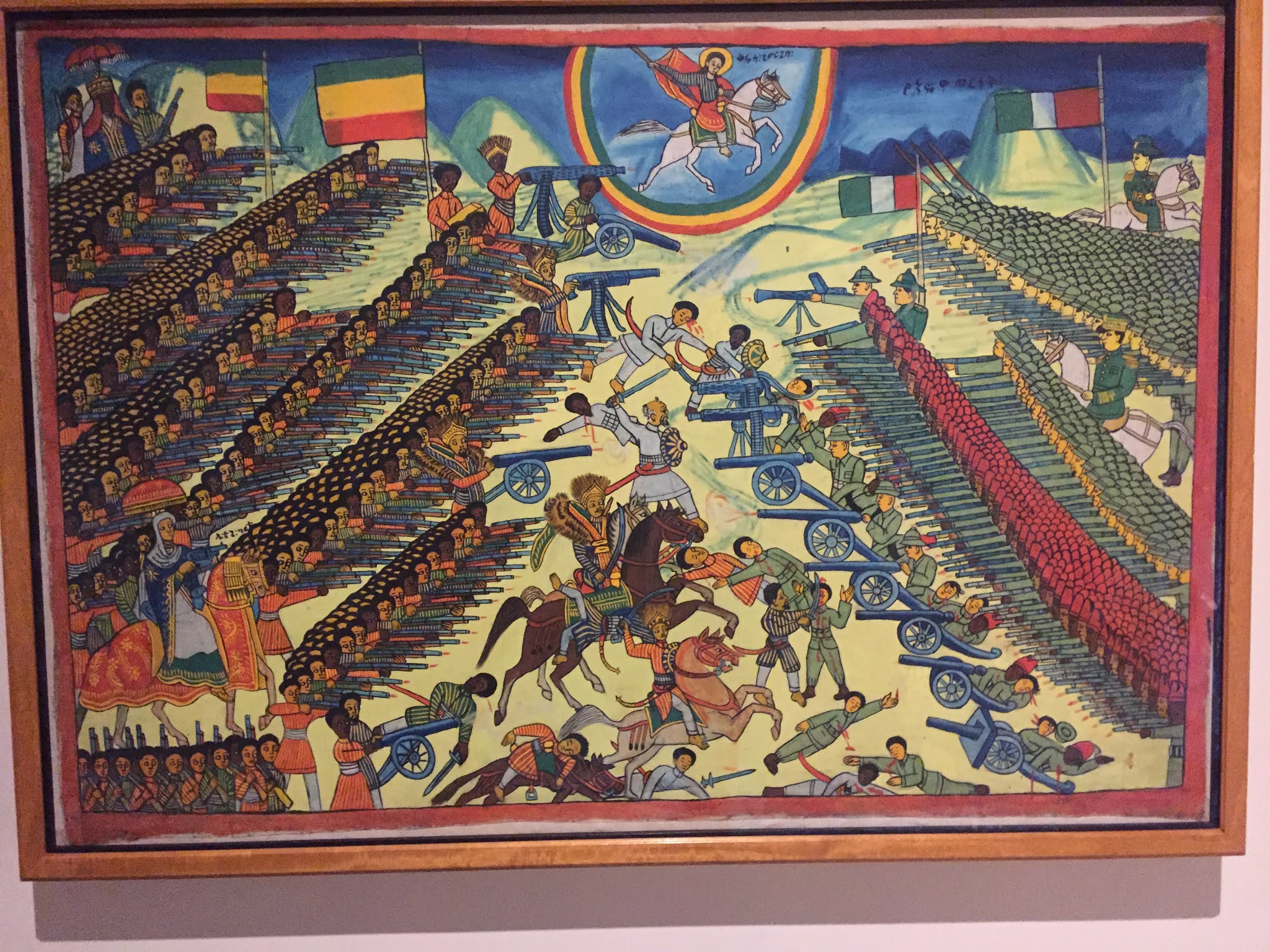
Painting by Solomon Belachew showing the defeat of Amhara Ethiopians by Ras Gobena donated to the Pitt Rivers Museum by Alan Goodwin in February 2020

At the end of February Deputy Head of Conservation Andrew Hughes and myself drove the Museum van to Osney Island, Oxford to collect an Ethiopian painting kindly donated to the Museum by Alan Goodwin. Due to the unforeseen circumstances of the Covid -19 pandemic the painting remains in the Museum’s quarantine quarters for processing. Alan had sent photographs of the painting but I was really excited to see it in the flesh. The painting is a visual treat depicting a vivid and lively battle scene commanded by Ras Gobena, General under Ethiopian Emperor Menelik II. Ras Gobena and Menelik II used guns manufactured in Europe to bring Southern and Northern areas of Ethiopia under a centralised rule. The painting clearly depicts Ras Gobena’s men painted with lighter skin attacking the Amhara Ethiopians from the Northern highlands of Ethiopia depicted in the painting with darker skin. The painting is full of contrasts; mud huts/tents, guns/spears, black/white, Christian/Animist, tunics/beaded loin cloths. This is interesting as ultimately it was the unity of Ethiopia, a country of multiple ethnicities and languages, culminating in its victory over the Italians at the Battle of Adwa in 1896, ensuring Ethiopia’s sovereignty and freedom from colonialism. The triumphant victory at Adwa brought Ethiopia to the world’s attention, strengthening the country’s image as defender of African independence. 
 

Painting by Unknown artist on display at the British Museum depicting the Battle of Adwa, 1896

The painting is by the artist Solomon Belachew. It is very similar in style to a painting held by the British Museum depicting the battle of Adwa. There are stylistic similarities in the conventions used to paint the figures and conventions applied in Ethiopian religious paintings. The battle of Adwa was a popular subject for Ethiopians to paint and Solomon Belachew also painted the scene in a painting which is now at the Smithsonian National Museum of African Art. In our Painting the lighter skinned Oromo Ethiopians are always painted as full-faced figures whilst some of the darker skinned Amhara Ethiopians are painted in profile distinguishing the forces of good from evil. The ferocity of the battle is captured in Belachew’s depiction of blood-spattered victims strewn on the ground. 


 Alastair Goodwin photographed in Africa during the 1940's.


The painting was purchased by Alan Goodwin’s father Alastair Goodwin in 1946 when he was posted to HQ British Military Mission to Ethiopia (Addas Ababa and Jimma) between May – October 1946. Solomon Belachew’s son is also an artist and continues to sale his own paintings and those of other local artist in his studio and shop in the Piazza tourist district of Addis Ababa. It was during Solomon Belachew’s father Belachew Yimar’s time that such contemporary paintings in traditional style became popular souvenirs in the 1940’s for foreign visitors such as Alastair Goodwin to take home. 


Faye Belsey 

Deputy Head of Collections

Monday, 30 March 2020

One of my favourite objects: A Bridal Headdress from Palestine

In the Body Arts section of the Lower Gallery of the Museum, a Palestinian bridal headdress (1952.5.86) is to be found. It is one of my favourite objects in the museum. 


The headdress is from Bethlehem, it is made from cotton and lavishly decorated with 1600 silver and gold modern and ancient coins attached to it. It was presented to the bride’s family as a gift from the family of the bridegroom. The headdress was collected by Charles Warren in 1870 when he was working in Palestine and donated to the Museum in 1952. Shelagh Weir suggests that the headdress may have been made around 1845 due to the presence of a large number of coins milled in 1844.

The headdress was and still is an emblem of the wealth and social status of the bridegroom’s family within rural society in Palestine. The headdress usually has either silver or gold coins, so the headdress displayed in the museum is untypical because it contains both. 


It is worn on the head and the bride also wears a long black embroidered dress as well as a black embroidered headdress (a Palestinian bridal headdress is to be found in the textile section of the museum). The embroidered patterns stitched on the dress as well as on the headdress belong to the area where the bridegroom’s family live. 

After the religious ceremony has commenced on the agreed wedding day, the bridegroom’s family visits the bride’s family to take the bride to her new home. The tradition is gradually fading away as more people from the country move towards the city where the wedding traditions are different. 

George Kwaider 
Gallery Attendant 

Wednesday, 19 February 2020

Resurrections and Resonances- the stories of the Nun’s Book

During my time at the Pitt Rivers I had the opportunity to work with a range of amazing objects from across the collection. My day might range from accessioning Palaeolithic stone tools, to photographing Ecuadorian terracotta votives, to trying to piece together letter fragments from the 19th century found in an ancient Peruvian pot. However, of all these objects and their associated histories, one that struck me the most came in an unlikely form- a 17th century manual on loop braiding, the so-called ‘Nun’s Book’ (2008.67.1). What had begun as a routine exercise in cross-referencing the database, unfolded into a compelling tale of the resurrection of a lost art form and its associated lives. These lives subsequently challenge our preconceptions of historical intimacy and relationships, while also offering an interesting test case in how we might locate ordinary ‘queer’ lives in history. Ultimately, the book attests to the unexpected power and insight that seemingly mundane objects can hold, a tenet that holds true of the museum’s collection as a whole.


Detail of braid included in 'Nun's book'
Below: Page from Nun's book 2008.67.1


Loop braiding or fingerloop braiding is the name given to a number of techniques where loops of thread, attached to a central point, are hooked around fingers and interlaced in different ways to create braids. This technique was common in Europe through the Medieval and the beginning of the Early Modern period, but the craft appears to have fallen into obscurity from the 17th century onwards. Historical examples of such braids are rare due to the degrading of the textiles through the centuries but a number of manuscripts survive with ‘patterns’ for such braids. The Nun’s Book is one such pattern-book, notable for having surviving examples of braids (figs. 1 & 2) but the book becomes truly unique when you consider the type of braids it contains, letter-braids. These are braids with letters and messages woven into them of which very few examples remain. The technique of creating such braids was all but lost until the pioneering research and analysis of Naomi Speiser and Joy Boutrup. While the Nun’s Book is a pattern book the instructions contained within are incredibly opaque to a modern reader, a series of baffling tables seemingly impenetrable even by experts. However, through in depth analysis of the surviving braids and experimentation, the technique has been cracked, resurrected after more than 200 years and along with it an intriguing glimpse into their original creators and the braids’ potential purposes.

In Appendix I of Speiser & Boutrup (2009) is a list, straightforwardly titled ‘Texts for Letter Braids’, suggestions found within The Nun’s Book and other manuscripts of messages people could weave into their braids. What I found within this list was strange, surprising, and touching. The majority of the texts were deeply affectionate messages directed towards the wearer-

Deare friend I’le do my best Indeaver- To knit your affection unto me forever
No greater portion would I crave- Then whilst I live your Love to have
Take it and wear and think withal- My Love is great though gift be small
Though far a parte- Yet neare in hearte 

Moreover, we find similar messages suggested in other letter braid manuscripts suggesting that this is not simply a peculiarity of The Nun’s Book but an intended characteristic in the creation of these braids-

My Love in this: Presented is[iv]

These suggest the braids were intended as gifts between close friends or lovers, a memento while the other was absent. A touching piece of history, but the story becomes more intriguing when we realise these were most likely primarily exchanged between women, an interpretation Speiser suggests in her work which is also apparent in some of the suggested messages-

Heare May you see in Letters few- The Love of her that honoreth you

Another aspect worth noting is the emphasis some place on concealment of affection, a notion that the two cannot freely express themselves-

I love you well but dare not show it- Doe you the like but let me know it
The Love I owe I cannot showe

The question then becomes- what was the nature of these relationships? Can we see these as expressing romantic love between two women? Or do these instead show different standards of expressing affection than modern normative conceptions? Are they both? While the lives of the women who created and exchanged these braids are lost and we cannot speak in certainties these grant us a tantalising glimpse into expressions of intimacy between ordinary women of the 17th century. Even without these certainties, it certainly serves as a potential challenge to our preconceptions of this historical period, while also providing us examples of how and where we might locate ‘queer’ lives in history.

Alex Grindley

Collections Intern


Tuesday, 5 June 2018

Exploring the Economic Botany Collection at Kew Botanic Gardens

The newly refurbished and opened Temperate House at Kew


On Friday 11th May I was invited to attend a workshop on ‘Economic Botany in the UK’ at the Royal Botanic Gardens, Kew. With large thanks to Kew’s first Director, Sir William Jackson Hooker Kew Gardens holds a substantial collection of material classed as ‘economic botany’ a term which is unfamiliar to most. Economic botany is the study of useful plants. Such collections combine raw specimens with cultural artefacts which the raw material has been crafted into, combining natural history specimens with cultural ‘ethnographic’ objects, often referred to as ‘biocultural’ collections. 

Kew's economic botany collection as displayed to the public as a Museum in 1847. The Museum closed in the 1950s.

At the height of Empire such collections were amassed and displayed in dedicated museums and galleries during the Victoria era to demonstrate the successes of Imperial expansion, global trade and exploration (which can be translated as exploitation of natural resources in the colonies by the British Empire and underpinned negative legacies of Empire such as colonisation and slavery). 

As part of a three-year AHRC funded project The Mobile Museum will examine the circulation of objects into and out of Kew Museum between 1847 and 1987. The Museum of Economic Botany at Kew was originally established by Hooker in 1847 to house ‘all kinds of useful and curious Vegetable products’ However, in the 1980’s the Museum buildings closed, the displays were disbanded and the Economic Botany collection moved to a purpose-built research store. Today, the collection, numbering some 100,000 items is a key resource. Throughout its history the entry and exit books provide clear evidence of the Museum as an important centre of knowledge exchange between other institutions, with a large number of exchanges and transfers from Kew to Museums in the UK and overseas, of which the Pitt Rivers Museum was one recipient. 


Warrington Museum

The workshop visited the project at its half way stage whereby lots of data about the collection has been gathered and the team are now looking more at data analysis, interpretation and education. We heard of a concurrent project looking at one of Kew’s eminent donor’s, Richard Spruce, an English botanist who spent many years collecting specimens from the Amazon rainforest. The theme of duplicates ran through the day with Spruce amassing a great number of specimens with the endless distribution of duplicates to Museum collections back in the UK evident in collection histories. Presentations from Manchester Museum, Warrington Museum, and Glasgow Museums followed, all institutions having significant botany collections and having benefited from the various redistributing of economic botany objects from Kew, which have largely been split between botany and ethnographic collections for curation and display today. 

I was struck by the similarities of Warrington Museum with the Pitt Rivers Museum with its galleried layout and wall cases. The botany gallery at Warrington displays material by use and purpose such as ‘the plant as dye’. For a long time, the botany gallery served as a vocational gallery for the local population highlighting that many local industries such tanning, weaving and chemical manufacture depends on plants. We heard how at Glasgow, of the thousands of specimens  that were transferred from Kew, only a handful are known to survive today and no raw materials, only the end products of economic botany. Collections care, conservation, limitations of record keeping and changes in classification could explain the unaccounted-for material. However, of the material accounted for the most cohesive outcome of the economic botany collections to have come from Kew are the bark cloth including important samples of Hawaiian and Tahitian bark cloth from the voyage of HMS Blonde accompanied by naturalist Andrew Bloxam in 1824 and HMS Galatea in 1867-1869 commanded by Prince Alfred, Duke of Edinburgh, Queen Victoria’s second son. 


Wardian case in the collections at Kew

A tasty lunch the Orangery at Kew, a building which once exhibited the wood samples of the economic botany collections was followed by a fascinating tour of the economic botany collection as it is stored today led by Mark Nesbitt and Caroline Cornish. At the stores we were able to view the entry and exit books kept by Kew, the exit book being of particular interest as the project is focusing on dispersal as much as acquisition, unusual in collections research where it is more common to give greater weight to how, when and why the object was acquired rather than its afterlife should it leave the Museum, which we are learning from this project can be just as colourful and interesting. Also brought to our attention at the store was a ‘Wardian case’ invented by Nathaniel Bagshaw Ward. The Wardian case proved an ideal way to transport plant specimens from the colonies aboard ship as the wooden framed glass case provided the most suitable micro climate for plants to survive in. 


Walking sticks manufactured by Henry Howell & Co. 

We were also walked down aisles of wood specimens including a sample of Acacia dealbata which formed part of the Tasmanian Timber Trophy, a defining feature of the 1862 London International Exhibition. I found most interesting a collection of walking sticks acquired from manufacturer Henry Howell & Co. The relationship between Howell & Co and Kew proved mutually beneficial as Howell donated hundreds of walking sticks, both the final product and the ‘blank’ for each wood. Kew were able to advise on the durability and suitability of the particular wood specimen for purpose. Of course there were items which one would expect to find in an economic botany/ethnographic collection today such as temple models carved from pith and samples of lace bark which one curator observed had been catalogued as ‘dusters’ in her collection due to the natural shape. We were also shown an incredible bark cloth poncho called a tiputa from Tahiti which had been carefully conserved by conservator Misa Tamura during the project ‘Situating Pacific barkcloth in time and place’ We have similar tiputa in the collections of the Pitt Rivers Museum 


Tiputa from Tahiti in the Kew collection

The final presentation of the day came from Caroline Cornish and Iban textile expert Traude Gavin. Traude visited the Pitt Rivers in 2017 to investigate further the complex history of a very old Iban cloth in the collections. Traude and Caroline’s talk looked more at the provenance of the cloth and how it came to be at the Pitt Rivers, another example of the complex exchange networks taking place in 19th-century collecting of botanical, natural history and ethnographic specimens and artefacts. 

The cloth has a complex history. It found its way to the Pitt Rivers Museum in 1886 having been transferred from the Ashmolean Museum. However, it would appear that the textile was originally one of thirteen cloths considered of duplicate value to have been sent from Sarawak by Sir James Brooke, the first Rajah of Sarawak. Brooke sent the cloths to his friend, scientist and botanist William Hooker, first director of Kew Gardens. The cloth was sent by Brooke with commercial enterprise in mind, Brooke was interested in opportunities for economic development in Sarawak and the cloth demonstrated that it was possible that natural cotton used in textile manufacture could be grown in a region of Borneo effectively under British rule and ripe for exploitation. Hooker decided to keep one of the thirteen cloths for Kew and sent a number of them to his friend at the British Museum Augustus Wollaston Franks. Franks, in turn was trustee of the Christy collection along with Hooker’s son and predecessor Joseph Hooker. The Henry Christy collection formed the basis of the ethnographic collection of the British Museum. In 1869 the textile destined for the PRM was included as part of an exchange with the Ashmolean Museum which in turn was sent in 1886 to the Pitt Rivers Museum just as the Museum opened to the public. Since then the cloth has been studied by researchers and information about the cloth has been accumulated and added to the Museum database


Iban textile at the Pitt Rivers Museum; 1886.1.259


This particular case study acts to illustrate the concept of the ‘duplicate’ and the network of exchange between institutions driven by individuals in place during the 19th century. The project team hope to discover more about the dispersed collections from Kew including the items that eventually came to the Pitt Rivers Museum so do follow the projects progress via the Mobile Museum website


Faye Belsey
Deputy Head of Collections

Thursday, 18 January 2018

What is the Specific Moment that makes thinking about the Colonial possible?


With funding from the Friends of the Pitt Rivers Kenneth Kirkwood Memorial Fund I was able to travel to the Research Centre for Material Culture at the NationalMuseum of World Cultures, Leiden, to attend the conference ‘Reckoning with History: Colonial Pasts, Museum Futures and DoingJustice in the Present’. The conference brought together academics, curators, artists and Museum professionals from all over the world. It was led by the charismatic Professor Wayne Modest. Early in the proceedings Prof. Modest asked “what is this specific moment? What is the conjuncture? What is at stake now that makes it possible to speak about these changes? What is the specific moment that makes thinking about the colonial possible?” He indicated that this was a new era for Museums and a changing mood has begun to encompass Museum thinking. In recent years what was formally a taboo subject, colonialism, has become a buzz word and everyone is keen to jump on the band wagon. But why is this and what does it mean to confront our chequered colonial pasts? Indeed a question that we hope to tackle at the next Museum Ethnographers Group Conference hosted at the Pitt Rivers Museum in April later this year. 2017 was an interesting year on mainland Europe where a number of Museums engaged in redisplay, redevelopment and exhibition programmes exposing and laying bare colonial genealogies. The conference offered the possibility to critique this approach and analyse public reaction to such explicit reckonings with the colonial past. I feel that this approach to Museum practice both internally and more publicly has been absent in Museums in the UK. One reason for attending this conference was to be able to think more about how we confront the colonial past through the collections at the Pitt Rivers Museum.

However as The Guardian observed in an editorial commending Germany’s effort to face up to its colonial legacy through the exhibition ‘German Colonialism: Fragments Past and Present’ symbolically held at the German Historical Museum in Berlin, Britain would struggle to do the same. As the editorial goes on to point out as much as we ignore it, the colonial past is still present today, as a nation we have a habit of making rosy our troubled past and choosing to remember all that supposedly made Britain ‘Great’ We are also very fragmented as Brexit made clear and lack any shared view of our historical past and for that matter our political future. This would make any effort to confront and narrate the complex and difficult truths regarding our colonial legacies difficult to do. Yes, these reasons alone are not adequate excuses to continue as we are. In fact, arguably Ethnographic Museums are best placed to address these ‘wrongs’ through reconciliation, justice and truth. As Modest suggested “The ethnographic museum as a congregation, as a bringing together, under circumstances of violence, might allow us to give credence to the multiplicity of different ways of being in the world. The ethnographic collections might be the place where we really give into the idea that we are multiple, that we are not the only ones who know, who have laws.” Though efforts to do so have proved hard, as an example given closer to home reflected. Sumaya Kassim, boldly claimed ‘The Museum will not be decolonised’ when describing the challenges faced in trying to bring context to Birmingham Museum and Art Gallery. During the project Kassim faced many challenges particularly from Museum staff and structures as she writes Decolonising is deeper than just being represented. When projects and institutions proclaim a commitment to ‘diversity’, ‘inclusion’ or ‘decoloniality’ we need to attend to these claims with a critical eye. Decoloniality is a complex set of ideas – it requires complex processes, space, money, and time, otherwise it runs the risk of becoming another buzzword, like ‘diversity”. 


Whether or not the Museum can be decolonised I believe remains to be seen but any effort to do so should focus on practice and structures and should be carried out with commitment, a willingness to change and an investment to do so. Rajkamal Kahlon’s exhibition ‘Staying with Trouble’ as part of her residency at the Museum of Ethnology,Vienna, reimagines ethnographic portrait photography redrawing and repainting the bodies of native subjects inviting visitors to question their own gaze. Kahlon spoke of her reservations about working with an ethnographic collection and her fear of her work being employed as an instrument to lessen colonial guilt. Having just undergone a major redisplay Kahlon was left feeling uncomfortable with the inclusion in the new displays of a trophy head from the Munduruku people from Brazil. Whilst for most (white) European Museum visitors this would not cause distress she stressed the trauma associated with such displays for people of colour and asked “What is the work of recovery? What is the work of recuperation? What does it mean to live with extermination? During an earlier panel, we were reminded of issues of law, ethics and responsibility. Catherine Lu, associate professor of political science stated “The project of reconciliation should not be understood as the same as the project of justice” and whilst repatriation is one act of decolonising the Museum this act alone does not exclusively make amends for past wrong doings. Repatriation is a process of reconciliation but arguably the relationships built whilst negotiating these acts of decolonisation are just as valuable as the act itself.


There were moments during the two days when I thought the future looked quite bleak, it was even suggested that the only reasonable resolution would be to abolish the Museum and I was left fretting about my curatorial responsibility and indeed my chosen career path. As the last session of the conference dawned the conclusion was reached that perhaps the best we can hope for is to ‘live with the trouble’. But to feel troubled and to be troubled is progress and perhaps on the horizon lies hope and the ability to imagine new structures and ways of being for the Ethnographic Museum, one of equally and transparency, honesty and truth. We have important lessons to earn and much work to do but I still believe that there is a place for the Museum in the contemporary world.

Faye Belsey
Assistant Curator

Bibliography:

‘Should museums display human remains from other cultures?’ The Art Newspaper, Katherine Hickley 8th January 2018.

‘Rajkamal Kahlon: Staying with Trouble’ Museum of Ethnology, Vienna, Austria. 25th October 2017 – 31st March 2018.

‘German Colonialism. Fragments Past and Present’ German Historical Museum, Berlin, Germany. 14th October 2016 – 14th May 2017

‘The Guardian view on the colonial past: a German lesson for Britain. Editorial’ Monday 26th December 2016

‘The museum will not be decolonised’ Media Diversified, Sumaya Kassim 15th November 2015