Showing posts with label Artist. Show all posts

Wednesday, 19 August 2020

New Acquisitions: Painting from Ethiopia

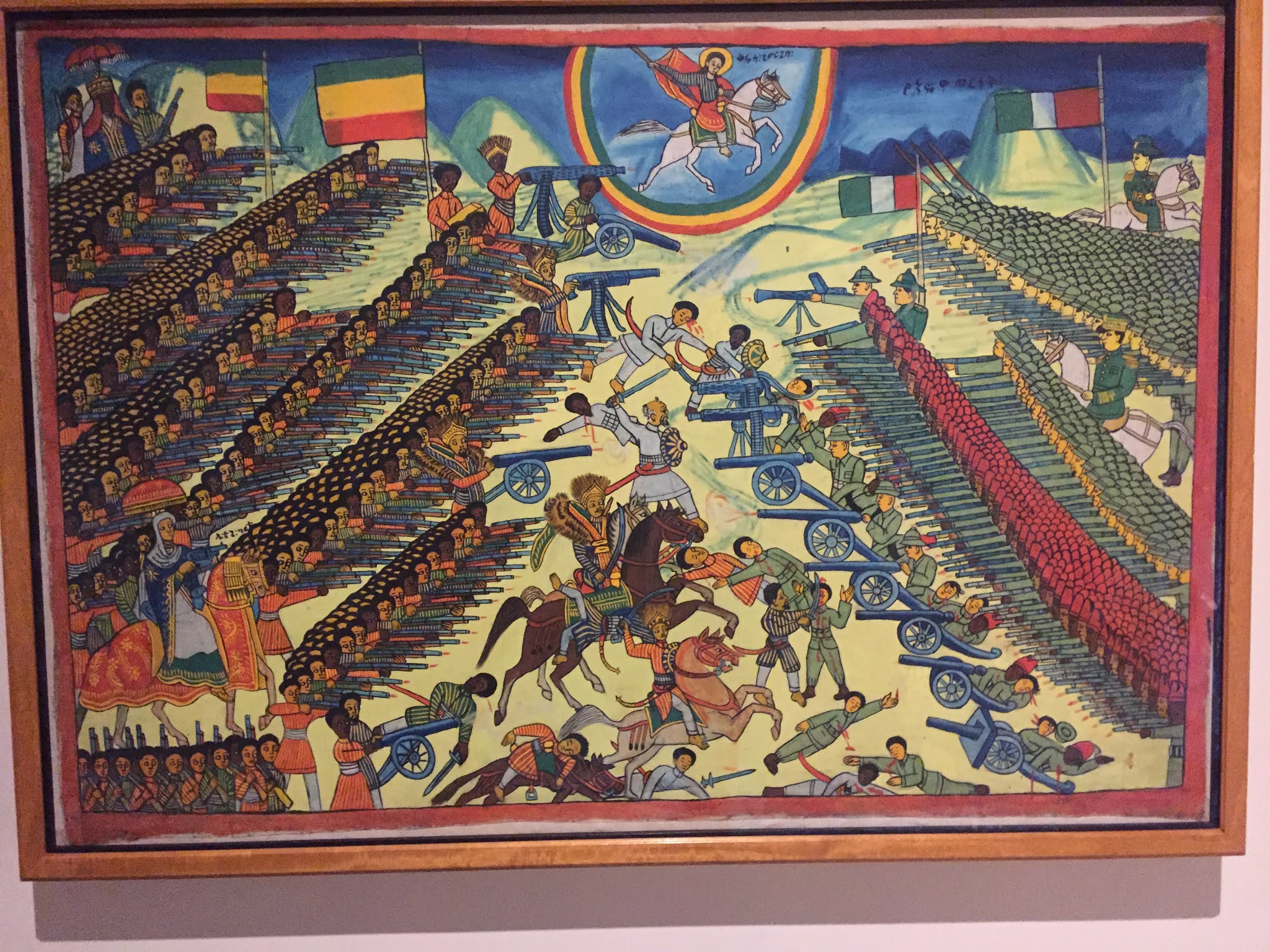
Painting by Solomon Belachew showing the defeat of Amhara Ethiopians by Ras Gobena donated to the Pitt Rivers Museum by Alan Goodwin in February 2020

At the end of February Deputy Head of Conservation Andrew Hughes and myself drove the Museum van to Osney Island, Oxford to collect an Ethiopian painting kindly donated to the Museum by Alan Goodwin. Due to the unforeseen circumstances of the Covid -19 pandemic the painting remains in the Museum’s quarantine quarters for processing. Alan had sent photographs of the painting but I was really excited to see it in the flesh. The painting is a visual treat depicting a vivid and lively battle scene commanded by Ras Gobena, General under Ethiopian Emperor Menelik II. Ras Gobena and Menelik II used guns manufactured in Europe to bring Southern and Northern areas of Ethiopia under a centralised rule. The painting clearly depicts Ras Gobena’s men painted with lighter skin attacking the Amhara Ethiopians from the Northern highlands of Ethiopia depicted in the painting with darker skin. The painting is full of contrasts; mud huts/tents, guns/spears, black/white, Christian/Animist, tunics/beaded loin cloths. This is interesting as ultimately it was the unity of Ethiopia, a country of multiple ethnicities and languages, culminating in its victory over the Italians at the Battle of Adwa in 1896, ensuring Ethiopia’s sovereignty and freedom from colonialism. The triumphant victory at Adwa brought Ethiopia to the world’s attention, strengthening the country’s image as defender of African independence. 
 

Painting by Unknown artist on display at the British Museum depicting the Battle of Adwa, 1896

The painting is by the artist Solomon Belachew. It is very similar in style to a painting held by the British Museum depicting the battle of Adwa. There are stylistic similarities in the conventions used to paint the figures and conventions applied in Ethiopian religious paintings. The battle of Adwa was a popular subject for Ethiopians to paint and Solomon Belachew also painted the scene in a painting which is now at the Smithsonian National Museum of African Art. In our Painting the lighter skinned Oromo Ethiopians are always painted as full-faced figures whilst some of the darker skinned Amhara Ethiopians are painted in profile distinguishing the forces of good from evil. The ferocity of the battle is captured in Belachew’s depiction of blood-spattered victims strewn on the ground. 


 Alastair Goodwin photographed in Africa during the 1940's.


The painting was purchased by Alan Goodwin’s father Alastair Goodwin in 1946 when he was posted to HQ British Military Mission to Ethiopia (Addas Ababa and Jimma) between May – October 1946. Solomon Belachew’s son is also an artist and continues to sale his own paintings and those of other local artist in his studio and shop in the Piazza tourist district of Addis Ababa. It was during Solomon Belachew’s father Belachew Yimar’s time that such contemporary paintings in traditional style became popular souvenirs in the 1940’s for foreign visitors such as Alastair Goodwin to take home. 


Faye Belsey 

Deputy Head of Collections

Thursday, 15 December 2016

Visit to South Africa the Art of a Nation at the British Museum

On Thursday 8th December, I visited the exhibition South Africa the Art of a Nation at the British Museum with members of the Museum Ethnographers Group. It is always interesting to get out of the office and visit other museums and exhibitions and I was particularly excited about seeing this exhibition given South Africa’s remarkable history. We were lucky enough to be given an insight into the curatorial process of creating the exhibition with one of its curator’s Chris Spring, curator of contemporary, sastern and southern Africa at the British Museum. The exhibition was very much a collaborative venture working closely with museums, art galleries and heritage centres in South Africa itself and contemporary South African artists.

The earliest item in the exhibition is a pebble found at Makapansgat with three circular indentations. The pebble did not originate in this location, with water-worn indentations suggesting that it was carried from water to Makapansgat by early humans. It has been suggested that the pebble is the first appreciation of art in that these early humans recognised a face in the weathered pebble and so showed an aesthetic appreciation of the pebble by collecting it. In contrast is the last room of the exhibition which display’s contemporary art pieces by the likes of Willie Bester and Lionel Davis acknowledging that South Africa’s history is not resolved by the end of apartheid but complexities still exist in the ‘New South Africa’ best demonstrated by white South African Candice Breitz video installation where she inserts herself as a passive presence in the Black South African soap opera Generations questioning her role in South African society as a white person. Most striking is the installation by Mary Sibande where the representation of her mother, her grandmother and her great grandmother through a mannequin dressed in Victorian costume alluding to the roles they had as maids in white South African households stands in juxtaposition to a second figure dressed in purple representing Sibande herself. The use of the colour purple is significant and refers to the purple dye used in the police water cannons during the anti-apartheid Purple Rain protests of 1989. In this installation Sibande is saying goodbye to her past and embracing or confronting her present and future. Overall the exhibition successfully displays the art of South Africa old and new in an interesting way, comparing and contrasting past and present and acknowledging the colourful and turbulent history of a nation.

Mary Sibande's installation, A Reversed Retrogress, Scene 1

Faye Belsey 
Assistant Curator

Wednesday, 11 February 2015

New Acquisitions: Pigeon Whistles

"Perched in three small vitrines, which themselves sit high above the other cases of the court, small, strange bamboo faces peer down upon the museum's visitors. Appearing almost like tiny masks, these objects are described as Pigeon Whistles from China" 


During 2012 - 2013 the Pitt Rivers Museum was lucky enough to benefit from the presence and creativity of artist, composer, performer and sound designer Nathaniel Mann. Nathaniel was appointed artist-in-residence at the Pitt Rivers Museum and Oxford Contemporary Music as part of Sound and Music's 'Embedded' programme. Nathaniel was a perfect match for the PRM. Performing solo as Animateddog and as one third of Dead Rat Orchestra, his work draws strongly on folk idioms whilst using unusual objects (including 2x4, ukulele, guitar, phonofiddle and meat cleaver!) and conventional instruments to create unique and playfully experimental music. The unique and varied collections of the PRM ensured that there was no shortage of inspiration for Nathaniel to draw on. With a large collection of musical instruments on display and in the Museum stores, both unusual and conventional, Nathaniel was able to come up with great ideas for new work and performances during his residency.


Pigeon whistle on (1921.36.14) display in the Museum 
attached to a stuffed pigeon
Pigeon whistle (2014.44.5) made and 
used for 'Audible Forces' 


One group of objects that caught his attention quite early on in his residency was a collection of pigeon whistles on display in the Museum's Court. There are 78 pigeon whistles in the PRM collections, all from China and Indonesia. In China there has been a long tradition of attaching these light whistles - often made from gourd and bamboo - to the tail feathers of a flock of pigeons so that when the birds fly, the wind blowing through the whistles sets them vibrating, and this produces an open air concert for the instruments in the same flock are all different. According to the Chinese these whistles are intended to keep the flock together and to protect the pigeons from attacks of birds of prey. 


Pigeon whistles donated by Nathaniel Mann 
(2014.44.1, 2014.44.2, 2014.44.3, 2014.44.4, 2014.44.5)
Nathaniel decided that he would design his own pigeon whistles and fly a flock of pigeons wearing them. The ‘Audible Forces’ project toured the UK and proved to be a huge success. To read more about the development of the project and to see and hear video and audio of the whistles in action visit the PRM’s 'Embedded’ blog. 

After Nathaniel’s residency in 2014, he was kind enough to donate a number of Indonesian pigeon whistles, contemporary and traditional in style from his own personal collection as well as one of his home made pigeon whistles designed for the project. The whistles complement the historical whistles that already existed in the collections. It is interesting to compare and contrast the shapes and materials of old and new. The pigeon whistle designed for the purpose of the project is made from recycled materials; a 35 mm film pot, a piece of a Chris de Burgh record and lolly pop sticks! The lightness of the material meant that the pigeons were comfortable wearing them and it did not hurt them or worry them too much. Nathaniel also kindly donated a fabulous book on pigeon whistles to the Balfour library; Beijing Pigeon Whistles by Wang Shixiang is a beautifully illustrated volume with detailed descriptions of the different styles of Chinese pigeon whistles, how they are made and how they are carried by the birds.


As well as the pigeon whistles the PRM also acquired a custom-made tuned meat cleaver, which featured in Nathaniel’s residency finale ‘Rough Music’, which incorporated his Dead Rat Orchestra colleagues and a piece featuring the pigeon whistles.


Nathaniel Mann playing his meat cleaver in the Museum

Tuned meat cleaver (2014.44.7) used for 'Rough Music' performance 

Faye Belsey

Assistant Curator