Showing posts with label ethnography. Show all posts

Wednesday, 19 August 2020

New Acquisitions: Painting from Ethiopia

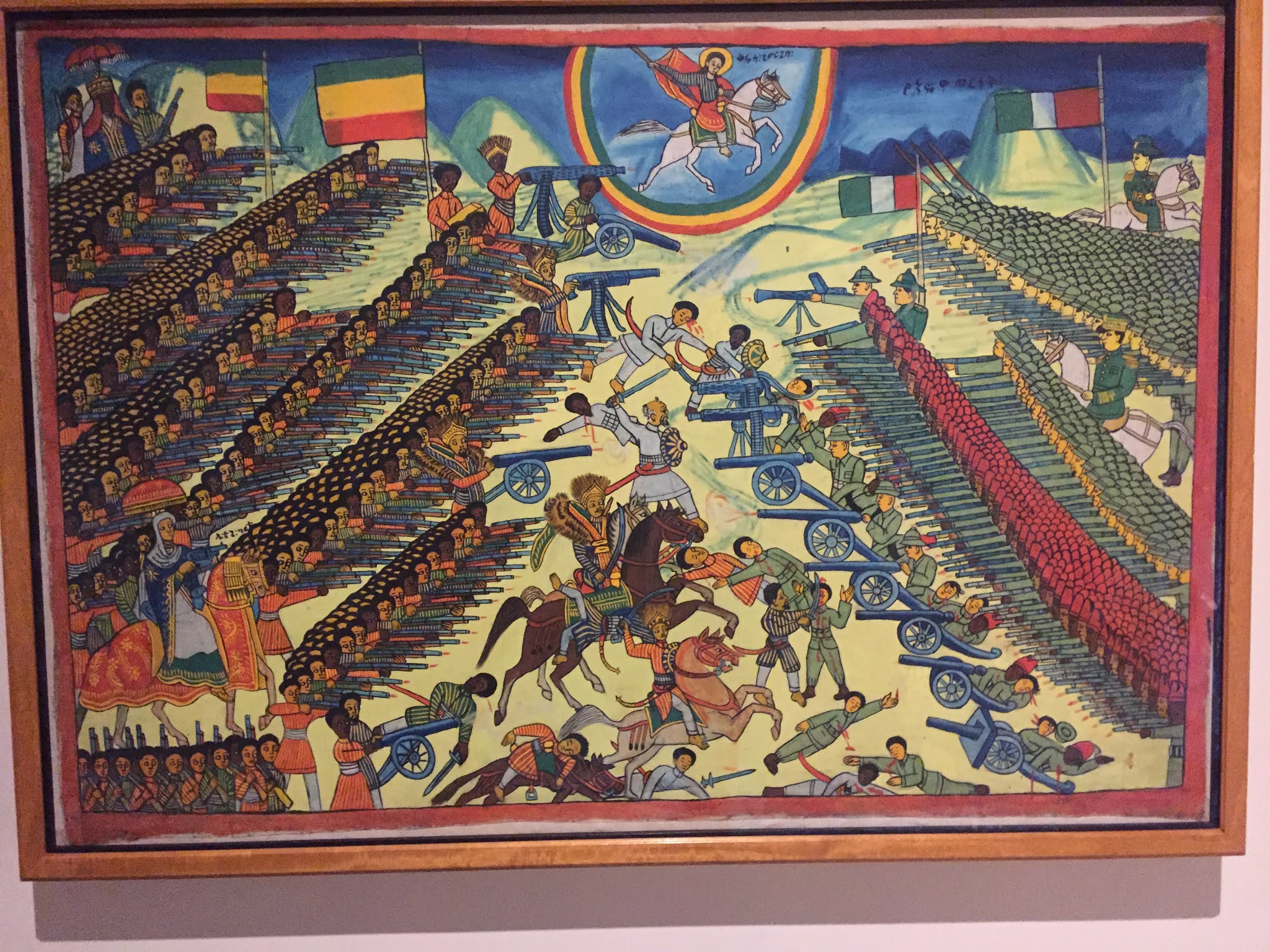
Painting by Solomon Belachew showing the defeat of Amhara Ethiopians by Ras Gobena donated to the Pitt Rivers Museum by Alan Goodwin in February 2020

At the end of February Deputy Head of Conservation Andrew Hughes and myself drove the Museum van to Osney Island, Oxford to collect an Ethiopian painting kindly donated to the Museum by Alan Goodwin. Due to the unforeseen circumstances of the Covid -19 pandemic the painting remains in the Museum’s quarantine quarters for processing. Alan had sent photographs of the painting but I was really excited to see it in the flesh. The painting is a visual treat depicting a vivid and lively battle scene commanded by Ras Gobena, General under Ethiopian Emperor Menelik II. Ras Gobena and Menelik II used guns manufactured in Europe to bring Southern and Northern areas of Ethiopia under a centralised rule. The painting clearly depicts Ras Gobena’s men painted with lighter skin attacking the Amhara Ethiopians from the Northern highlands of Ethiopia depicted in the painting with darker skin. The painting is full of contrasts; mud huts/tents, guns/spears, black/white, Christian/Animist, tunics/beaded loin cloths. This is interesting as ultimately it was the unity of Ethiopia, a country of multiple ethnicities and languages, culminating in its victory over the Italians at the Battle of Adwa in 1896, ensuring Ethiopia’s sovereignty and freedom from colonialism. The triumphant victory at Adwa brought Ethiopia to the world’s attention, strengthening the country’s image as defender of African independence. 


Painting by Unknown artist on display at the British Museum depicting the Battle of Adwa, 1896

The painting is by the artist Solomon Belachew. It is very similar in style to a painting held by the British Museum depicting the battle of Adwa. There are stylistic similarities in the conventions used to paint the figures and conventions applied in Ethiopian religious paintings. The battle of Adwa was a popular subject for Ethiopians to paint and Solomon Belachew also painted the scene in a painting which is now at the Smithsonian National Museum of African Art. In our Painting the lighter skinned Oromo Ethiopians are always painted as full-faced figures whilst some of the darker skinned Amhara Ethiopians are painted in profile distinguishing the forces of good from evil. The ferocity of the battle is captured in Belachew’s depiction of blood-spattered victims strewn on the ground. 


 Alastair Goodwin photographed in Africa during the 1940's.


The painting was purchased by Alan Goodwin’s father Alastair Goodwin in 1946 when he was posted to HQ British Military Mission to Ethiopia (Addas Ababa and Jimma) between May – October 1946. Solomon Belachew’s son is also an artist and continues to sale his own paintings and those of other local artist in his studio and shop in the Piazza tourist district of Addis Ababa. It was during Solomon Belachew’s father Belachew Yimar’s time that such contemporary paintings in traditional style became popular souvenirs in the 1940’s for foreign visitors such as Alastair Goodwin to take home. 


Faye Belsey 

Deputy Head of Collections

Friday, 7 September 2018

Stones and Skirts: Interning at the Pitt Rivers Museum

I remember the first time I went to a museum in primary school, on a fieldtrip. I had been interested in history even then, and seeing history manifest itself in material objects, all in one place, blew my little mind. As I grew older, my interest in history and the cultures and peoples of the past continued to develop, and ultimately, after gaining a Bachelor’s in Anthropology and Sociology, I decided to pursue a Master’s in Archaeology at Oxford University. It was stressful and very difficult at times, but whenever I needed a break to rekindle my love for my studies, I would go and roam around the various museums of Oxford, and the Pitt Rivers Museum (PRM) quickly became one of my favourites, as it combined my love of both anthropology and archaeological material culture. When I heard that the PRM was offering a summer internship, I knew that I had to apply.

Interior view of the Pitt Rivers Museum © Pitt Rivers Museum

I applied to the paid five-week internship at the Pitt Rivers, funded by the Santander Award, through the Oxford University Internship Programme (OUIP), which allows students of the University of Oxford to apply to a large variety of internships both in the UK and abroad. I, along with another intern who is to begin after I finish, were selected for the Collections Internship at the Pitt Rivers. I was both excited and intimidated, and the feeling has not diminished even after the 5 weeks that I have spent here.

I performed a wide variety of tasks at the PRM, as the internship was meant to give me an idea of the various types of jobs and roles which are available in museum work; from shadowing Faye Belsey and Nicholas Crowe (my two supervisors) as they went about their various daily tasks (working on displays, meeting researchers, moving objects from various stores to the museum, etc.), learning how to catalogue objects into the museum’s database and doing research for future exhibitions, to spending afternoons with various museum staff to learn about their projects and going with them to collect new acquisitions, this internship gave me a taster of the various types of jobs that are available in the museum sector. 

In my first few weeks, I spent a lot of time shadowing different people, and looking at the projects which they were working on. I spent an afternoon looking at the journals and writings of Makereti Papakura, a Maori noblewoman, guide and ethnographer; she was the first Maori ethnographer, and one of the first to focus on women in the Maori culture. Her writings gave me a fascinating insight into both her life, and the culture and traditions of a people I knew very little about. I spent another afternoon looking through photographs donated by a British photographer of his travels, primarily through Asia and Africa, places which look significantly different than they did 70 years ago, with the pictures serving as archives of rapidly changing landscapes. 

One day a week, I helped the team at the Museum store; a large amount of the Pitt Rivers collection is stored there and is in the process of being catalogued, packed and relocated. Most of my days there I spent packing objects (mostly spears and amulets), in awe of the creative and vastly different designs human beings employ for the same objects. 

I also spent a large amount of time cataloguing and recording stone tools from Rohri, Pakistan. Some of the tools had not been previously recorded, and the experience of learning how the cataloguing system worked, how to record information about the stone tools and going through accession books trying to match the tools to their correct accession numbers, was extremely informative. Furthermore, the stone tools came from an area about 70 miles from Mohenjo-Daro, one of the largest settlements of the ancient Indus Valley Civilization, and an area of the world which holds a special place in my heart, as I am from Pakistan, and my research interests lie there as well. To be able to handle, record and engage with these tools in such a manner, and to be able to learn more about lithic analysis while doing so (something which I knew very little about), remains one of the highlights of my internship.

Original catalogues with drawings of stone tools © Pitt Rivers Museum
Alongside cataloguing the stone tools, one of the most interesting tasks which I performed was looking up information on two Iraqw skirts which the museum is to put on display soon. The skirts are examples of some of the most elaborately decorated textiles in East Africa, and were made by girls during the Marmo initiation ritual, where girls were taken away by elder women and secluded for up to a year. During this time, the girls were fed foods which were rich in fat and resulted in obesity, the area around their mouths was blackened with charcoal, animal oil was applied to their skin to make them shine, their bodies were scented with perfume obtained from a tree, they were taught folk songs and word games as well as sexual manners and were allowed to embroider their leather capes with beads of their own designs, making them into the skirts to be displayed. The girls would also be circumcised during this time. The ritual was thought to purify the girls, so that when they emerged from their seclusion, wearing their skirts and being highly adorned, they were thought to be reborn with a new innocence and dignity. Even though the ritual was banned in 1930, it is speculated that it was still carried out in secret. The skirts were absolutely stunning, and looking up information about them, and as a result, information about the Iraqw people and the marmo ritual, gave me insight into a part of the world and a people which I knew very little about. 

Iraqw skirts 1940.7.0114 and 2017.139.1© Pitt Rivers Museum

Aside from gaining valuable work experience and being able to look at various objects through the lens of a (albeit temporary) museum employee rather than just a visitor, one of the best things about my internship was also the people whom I worked with. Both Faye and Nicholas were incredibly kind, friendly, involved, and genuinely interested in what I wanted my internship experience to be like, and then tailoring it to my needs and interests. Everybody else in the museum was also genuinely passionate about their work, and were always more than happy to talk to me about it. 

I believe that this internship has not only given me a fantastic job experience, but has also rekindled my passion for working in the museum industry, and for all of these things, I am grateful. 

Hadiqa Khan 

Thursday, 18 January 2018

What is the Specific Moment that makes thinking about the Colonial possible?


With funding from the Friends of the Pitt Rivers Kenneth Kirkwood Memorial Fund I was able to travel to the Research Centre for Material Culture at the NationalMuseum of World Cultures, Leiden, to attend the conference ‘Reckoning with History: Colonial Pasts, Museum Futures and DoingJustice in the Present’. The conference brought together academics, curators, artists and Museum professionals from all over the world. It was led by the charismatic Professor Wayne Modest. Early in the proceedings Prof. Modest asked “what is this specific moment? What is the conjuncture? What is at stake now that makes it possible to speak about these changes? What is the specific moment that makes thinking about the colonial possible?” He indicated that this was a new era for Museums and a changing mood has begun to encompass Museum thinking. In recent years what was formally a taboo subject, colonialism, has become a buzz word and everyone is keen to jump on the band wagon. But why is this and what does it mean to confront our chequered colonial pasts? Indeed a question that we hope to tackle at the next Museum Ethnographers Group Conference hosted at the Pitt Rivers Museum in April later this year. 2017 was an interesting year on mainland Europe where a number of Museums engaged in redisplay, redevelopment and exhibition programmes exposing and laying bare colonial genealogies. The conference offered the possibility to critique this approach and analyse public reaction to such explicit reckonings with the colonial past. I feel that this approach to Museum practice both internally and more publicly has been absent in Museums in the UK. One reason for attending this conference was to be able to think more about how we confront the colonial past through the collections at the Pitt Rivers Museum.

However as The Guardian observed in an editorial commending Germany’s effort to face up to its colonial legacy through the exhibition ‘German Colonialism: Fragments Past and Present’ symbolically held at the German Historical Museum in Berlin, Britain would struggle to do the same. As the editorial goes on to point out as much as we ignore it, the colonial past is still present today, as a nation we have a habit of making rosy our troubled past and choosing to remember all that supposedly made Britain ‘Great’ We are also very fragmented as Brexit made clear and lack any shared view of our historical past and for that matter our political future. This would make any effort to confront and narrate the complex and difficult truths regarding our colonial legacies difficult to do. Yes, these reasons alone are not adequate excuses to continue as we are. In fact, arguably Ethnographic Museums are best placed to address these ‘wrongs’ through reconciliation, justice and truth. As Modest suggested “The ethnographic museum as a congregation, as a bringing together, under circumstances of violence, might allow us to give credence to the multiplicity of different ways of being in the world. The ethnographic collections might be the place where we really give into the idea that we are multiple, that we are not the only ones who know, who have laws.” Though efforts to do so have proved hard, as an example given closer to home reflected. Sumaya Kassim, boldly claimed ‘The Museum will not be decolonised’ when describing the challenges faced in trying to bring context to Birmingham Museum and Art Gallery. During the project Kassim faced many challenges particularly from Museum staff and structures as she writes Decolonising is deeper than just being represented. When projects and institutions proclaim a commitment to ‘diversity’, ‘inclusion’ or ‘decoloniality’ we need to attend to these claims with a critical eye. Decoloniality is a complex set of ideas – it requires complex processes, space, money, and time, otherwise it runs the risk of becoming another buzzword, like ‘diversity”. 


Whether or not the Museum can be decolonised I believe remains to be seen but any effort to do so should focus on practice and structures and should be carried out with commitment, a willingness to change and an investment to do so. Rajkamal Kahlon’s exhibition ‘Staying with Trouble’ as part of her residency at the Museum of Ethnology,Vienna, reimagines ethnographic portrait photography redrawing and repainting the bodies of native subjects inviting visitors to question their own gaze. Kahlon spoke of her reservations about working with an ethnographic collection and her fear of her work being employed as an instrument to lessen colonial guilt. Having just undergone a major redisplay Kahlon was left feeling uncomfortable with the inclusion in the new displays of a trophy head from the Munduruku people from Brazil. Whilst for most (white) European Museum visitors this would not cause distress she stressed the trauma associated with such displays for people of colour and asked “What is the work of recovery? What is the work of recuperation? What does it mean to live with extermination? During an earlier panel, we were reminded of issues of law, ethics and responsibility. Catherine Lu, associate professor of political science stated “The project of reconciliation should not be understood as the same as the project of justice” and whilst repatriation is one act of decolonising the Museum this act alone does not exclusively make amends for past wrong doings. Repatriation is a process of reconciliation but arguably the relationships built whilst negotiating these acts of decolonisation are just as valuable as the act itself.


There were moments during the two days when I thought the future looked quite bleak, it was even suggested that the only reasonable resolution would be to abolish the Museum and I was left fretting about my curatorial responsibility and indeed my chosen career path. As the last session of the conference dawned the conclusion was reached that perhaps the best we can hope for is to ‘live with the trouble’. But to feel troubled and to be troubled is progress and perhaps on the horizon lies hope and the ability to imagine new structures and ways of being for the Ethnographic Museum, one of equally and transparency, honesty and truth. We have important lessons to earn and much work to do but I still believe that there is a place for the Museum in the contemporary world.

Faye Belsey
Assistant Curator

Bibliography:

‘Should museums display human remains from other cultures?’ The Art Newspaper, Katherine Hickley 8th January 2018.

‘Rajkamal Kahlon: Staying with Trouble’ Museum of Ethnology, Vienna, Austria. 25th October 2017 – 31st March 2018.

‘German Colonialism. Fragments Past and Present’ German Historical Museum, Berlin, Germany. 14th October 2016 – 14th May 2017

‘The Guardian view on the colonial past: a German lesson for Britain. Editorial’ Monday 26th December 2016

‘The museum will not be decolonised’ Media Diversified, Sumaya Kassim 15th November 2015