Showing posts with label loans. Show all posts

Wednesday, 10 January 2018

Loan to the exhibition 'The Fabric of Our Land: Salish Weaving at the Museum of Anthropology at the University of British Columbia, Canada

Facade of the Museum of Anthropology on the University of British Columbia campus. Designed by Canadian architect Arthur Erickson. The building is set on the cliffs of Point Grey, a location which is the traditional territory of the Musqueam people. © Pitt Rivers Museum
The crate containing the PRM blanket being palletised for transport by Air Canada © Pitt Rivers Museum


On Monday 13th of November I was lucky enough to travel to Canada with a very special blanket destined for an exhibition at the Museum of Anthropology (MOA) at the University of British Colombia in Vancouver. This was an amazing opportunity for me having worked closely with collections held by the Pitt Rivers Museum from the North-West Coast First Nation peoples in my nine-year career at the Museum. A highlight of my time at the PRM to date has been a visit in 2009 of a delegation of Haida from Haida Gwaii (formally the Queen Charlotte Islands) and whist I was unable to make the epic three-day journey to Haida Gwaii I was able to visit the Bill Reid Gallery and met with a friend I made from that trip whilst in Victoria on Vancouver Island.
Installing the blanket in the exhibition gallery. The blanket was unpacked and condition checked before being carefully placed in the specially design showcase © Pitt Rivers Museum
Contemporary Coast Salish weaving on display alongside the historic pieces © Pitt Rivers Museum
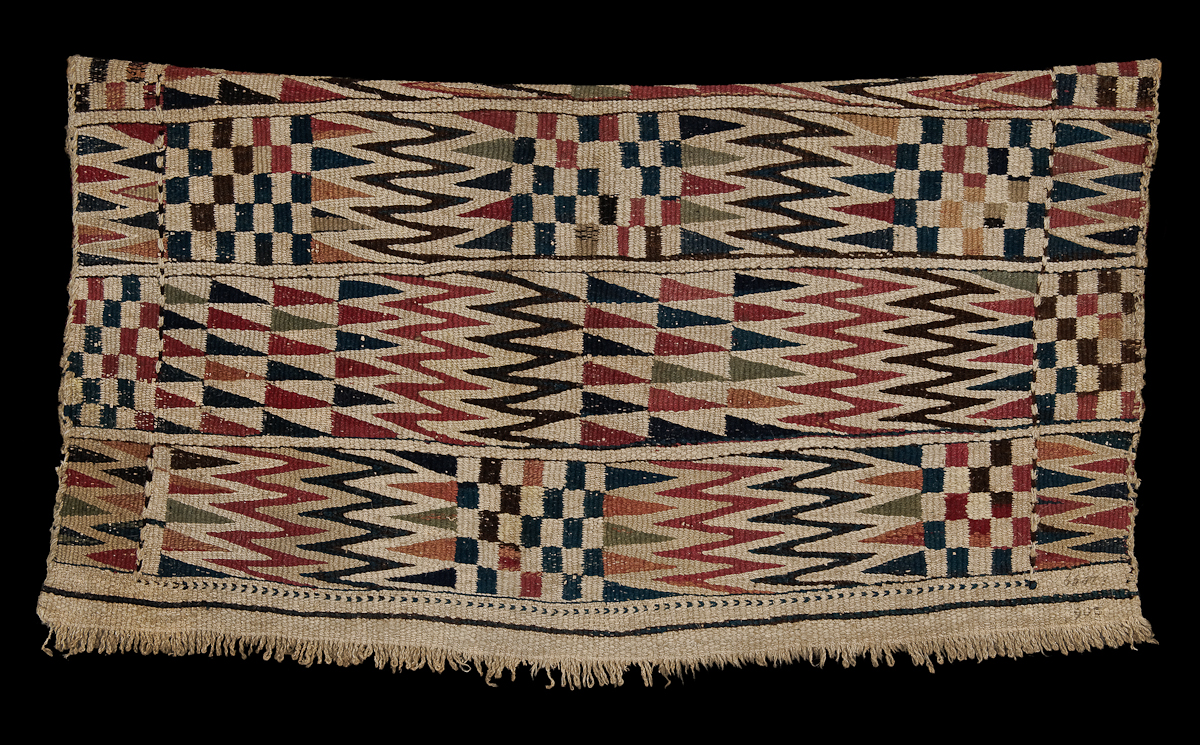
Coast Salish blanket 1884.88.9 © Pitt Rivers Museum


The blanket I was couriering is from the Coast Salish people of the North-West Coast of Canada/Northern USA. More specifically from San Juan Islands which sits in the Haro Strait between Vancouver Island and the North-West mainland coast, just south of Vancouver. It is from the Museum’s founding collection donated to the Museum in 1884 by General Augustus Henry Lane FoxPitt-Rivers on the formation of the Museum at the University of Oxford. It is woven from Coast Salish woolly dog hair and goat hair. The use of dog hair dates the blanket as being made before 1884 as the native dog whose hair was used in Salish weaving had died out by 1860. The blanket is one of ten chosen by Salish weavers from the 1800s to be part of the exhibition 'The Fabric of Our Land' with others from Scotland, Finland and the United States. The historical blankets are displayed among contemporary Salish weavings providing a unique opportunity to compare and contrast the rich tradition of weaving for the Salish people. The exhibition is curated by Sue Rowley who kindly had me stay with her whilst I was in Vancouver. Sue worked in collaboration with the local Musqueam people to create the exhibition. Again, I was fortunate enough to meet some contemporary weavers and be present for the exhibition opening which had around 900 attendees and included speeches by Musqueam weavers Wendy John and Debra Sparrow. The blanket will be on display until 15th of April 2018. On returning to bring the blanket back to Oxford there will be community visits arranged at MOA for weavers and Salish people to see the blanket up close. This work is crucial for the continuity of the craft and tradition of Salish weaving and its importance is summed up in this quote from Wendy Grant-John (Musqueam weaver and political leader) ‘Touching blankets that are over a hundred years old creates such a spiritual feeling, an understanding that the skill you’re reacquiring is the same that our ancestors had’

My visit to Canada gave me a glimpse of the importance of traditional craft and ways of life embedded in objects in European Museum’s far from their place of origin. Loans to exhibits such as ‘The Fabric of Our Land’ make it possible for First Nations people to really experience and get close to their ancestors who were involved in the creation of these special objects. The effect this has on future generations of, in this case weavers and Salish people is significant, it is vital that we enable and facilitate such exchanges. There is still much to do in addressing issues of colonial legacies inherent in ethnographic collections but efforts like this make small inroads.

The trip also provided me with the chance to learn from Canadian colleagues about differences and similarities in our curatorial practice and collections management. I was incredibly fortunate to have this experience and endeavoured to learn as much as possible from my trip. I was also lucky enough to spend time in Vancouver and able to visit Vancouver Island. What really impressed on me during my time in British Columbia was the amazing landscape, particularly the relationship between land, sea and nature so rooted in North-West coast iconography, myth and belief. I feel that I returned to Oxford with a greater understanding of North-West coast culture. It is clear that MOA as an institution is leading the sector in Canada and indeed globally for the work they do with indigenous communities particularly artists and young people and whilst the context is different for European collections where the objects are far from their home I feel that the physical distance only gives us greater responsibility to ensure that we make such objects as accessible as possible to whom these objects truly belong. As part of the public programme for the exhibition Salish weavers and artists will be giving gallery tours and talks as well as weaving demonstrations. There is even the chance to have a go at weaving yourself in the gallery should you get the chance to visit.

Faye Belsey

Assistant Curator

Wednesday, 17 June 2015

Museum Ethnographers Group 2015 Conference Review

MEG Conference – Powell-Cotton Museum, Kent, 20/21 April Nature and Culture in Museums

Every year the Museum Ethnographers Group holds a two-day conference to explore an important theme within the discipline of museum ethnography. As web officer for the Museum Ethnographers group I was lucky enough to attend the 2015 conference. This year’s conference theme was aptly chosen to suit the unique setting of the conference host, the Powell-Cotton Museum.


The Powell-Cotton Museum has long embraced in its displays the duality of nature and culture, natural and man-made, animals and objects. This was emphasised during conference organiser and Head of Collections at the Powell-Cotton Museum Inbal Livne’s welcoming speech. The first day of the conference was held in Gallery 1, an inspiring gallery, finished in 1939 with wall-to-wall dioramas displaying the animals of north and west African and India, speakers had a hard job competing with the visual stimulus of the gallery but often what was being spoken was directly being reinforced by the displays. This was particularly useful for Jude Philips (Macleay Museum, Sydney University Museums) talk on the Macleay Museum’s recent exhibition ‘Stuffed, stitched and studied’. When Jude’s power point presentation struggled to get working Jude was able to use the displays as her visual prompts to illustrate her talk. After a stirling effort of Powell-Cotton Museum staff the power point was up and running and Jude was able to share images of the exhibition with the group including quirky artist photographic portraits of taxidermed specimens emphasising taxidermy as a human endeavour and the anthropomorphical attributes we assign to them.


Our first speaker, Paolo Viscardi (Horniman Museum) was the first of other speakers to talk of the role of collaboration between anthropologists and natural historians, referencing the early cabinets of curiosities or ‘wunderkammer’, encyclopaedic collections where categorical distinctions and boundaries between disciplines; art, geology, archaeology, ethnology and natural history were yet to be made. This was also alluded to by Alison Clark (Cambridge University Museum of Archaeology and Anthropology) in her presentation ‘All the World for Sale: Nature and Culture at Gerrard and Sons’, taxidermist and art dealer whose sales room often included zoology specimens alongside ethnographic collections. Alison also reminded us that ethnographic collections are made up from composite objects, made up from animal parts as well as other organic materials. Collecting practices during the 19th century reflected in publications such as ‘hints to travellers’ encouraged this multidisciplinary approach and resulted in collections including a diverse range of objects exploring the natural and man made world, nature and culture. Jenny Walklate was the third speaker to reference ‘wunderkammer’ in her presentation ‘Swifts in the Tower of the House of God: The Reciprocal Framing of Nature and Culture in the Oxford University Museum of Natural History’ and the complex relationship the building reflects between science and faith. Jenny finished her presentation with an insightful auto-ethnography of her personal reflections on how the Victorian aesthetic of the museum impacts upon contemporary personal interpretations of the natural world.

A long and very tasty lunch gave delegates the first opportunity to look around the Museum galleries and gardens including the much anticipated newly opened Gallery 6. The subject of an ACE funded project ‘Securing the Future of Our Past’ the gallery has been re-designed to encourage every visitor to be a researcher, introducing Percy Powell-Cotton's expeditions on which he amassed his collections. The gallery also puts the Museum’s handling collection at its centre, a combination of natural history and ethnographic objects for visitors to experience first hand. The modern design of Gallery 6 contrasted with the more traditional displays in the rest of the Museum but highlighted the Museum’s potential.


The end of day one saw interesting presentations from Caroline Cornish (Royal Holloway) and Mark Nesbitt (Royal Botanic Gardens, Kew) on ‘Seeds of Industry and Empire: Revitalising Economic Botany Collections’. I was not overly familiar with the concept of ‘economic botany’ defined by Caroline and Mark simply as ‘plants transformed into items of use to human beings’ These collections were established and displayed in colonised countries, modelled on the oldest such collection, the Kew Museum of Economic Botany. The end of empire marked the end of these collections and many were dispersed and put into storage. Caroline and Mark, through the course of their project on the subject have been re-discovering these collections and exploring their relevance today.

Lastly, the day was finished on an entertaining note with a look at the role of animals and Museum displays and marketing campaigns in Antonia Lovelace’s presentation ‘Comparing the meerkat and falling for ‘Digital’ monkey – How trending animal totems playfully impact on our relationship with real animals and Museum displays’ Antonia has had to present a case for acquiring some of these popular characters into the collections at Leeds City Museum, a collection that already includes toys. Her paper asked ‘is there a place for these objects in contemporary collecting?

The day’s sessions finished at 5.00pm allowing more time for exploration of the galleries, a drinks reception and a short talk from Chris Spring of the British Museum on the temporary touring exhibition ‘Social Fabric: African Textiles Today’. Delegates enjoyed top-notch catering of a delicious three-course meal provided by the Powell-Cotton’s in house caterers.


Day two of the conference was opened by Anita Herle (Cambridge Museum of Archaeology and Anthropology), Tony Eccles (Royal AlbertMemorial Museum Exeter) and Alison Brown (University of Aberdeen) and their paper ‘Storied Landscapes: Enlivening Blackfoot Collections in UK Museums’ and the work all three are doing through their respective institutions extending networks between Blackfoot people and UK collections and how for Blackfoot people landscape and sites of encounter contribute to a fuller understanding of Blackfoot historic collections.

The interdisciplinary aspect of the conference theme ‘Nature and Culture’ was metamorphasied by interventionist artist Alana Jelinek by cleverly using the science of ecology as a metaphor for the art world. Alana reinstated and emphasised the reoccurring themes of the conference; that the dichotomy between nature and culture may not exist, there is no clear divide between what is human and what is not human. Alana proposed using the science of ecology to understand the complex interactions between the range of cultural practices at play in the art world.


As well as the more thematic papers on ‘Nature and Culture’, the conference as usual offered a plethora of interesting ‘work in progress’ papers for colleagues to share and up-date members on current projects in the sector often reflecting current trends and practice in ethnography more generally. Included in this was an update from Len Pole on the ‘Uniques’project: getting to know more about ethnographic collections in Kent and Sussex’, Alison Petch on progress being made on researching Spencer and Gillen collections outside of Australia, Heather Donoghue on cataloguing the Cooke Daniels collections at the British Museum before she embarks on fieldwork in Papua New Guinea, Clare Wintle’s potential project exploring ethnographic museums at the end of empire, 1945-1980, a period often thought of as the ‘dark ages of museum ethnography’, but how far is this theory true, in what ways were museums in the UK contributing to wider political, economic and social change during the middle years of the twentieth century? Catherine Harvey spoke about a recent significant acquisition for Hasting’s Museum of North American material from Colin Taylor and the challenges faced by small local museums during difficult economic times in advocating world culture collections. Alison Brown concluded the work on progress papers having just returned from Russia having, through an AHRC funded project facilitated the loan of a mammoth ivory model of ysyakh from the British Museum to the National Museum of the Arts, Yakutiia.


A selection of papers from the conference will be available in the next issue of the Journal of Museum Ethnography (JME) (available from April 2016).

Faye Belsey 
Assistant Curator


Wednesday, 17 December 2014

A miscellany of things on an Assistant Curators desk!


From left to right; two Mexican ceramic heads; 1977.15.1& .2; mummified ibis 1894.40.11894.40.1; figure of Buddha, Myanmar 1894.27.167; tattooing apparatus, Myanmar 1884.27.41; mummified ibis in pottery vessel 1901.30.1 & .2; zither in the shape of a crocodile, Myanmar; 1938.34.58 © Pitt Rivers Museum

As a member of the collections department I often have a number of interesting objects for cataloguing and photography on my desk. The objects out on this particular day were so for a number of reasons. The Mexican pottery heads were for a photographic request. Scholars often require studio images of objects for publication and research. I retrieve the object from storage/display and get the object to our professional photographer. The mummified ibises were out for a request to be sampled. Sampling requests for scientific research have to be considered very carefully in consultation with the conservation department. The zither, statue and tattooing implement from Myanmar will go on loan for exhibition to The Linden Museum Stuttgart, Germany for the exhibition 'Myanmar - The Golden Land'. Before objects can be loaned we have to assess if they are suitable for travel before the loan is approved they then have to be catalogued and condition checked. These are just some of the elements of work, highlighted by the objects on my desk on one particular day that goes on in the collections department of the Pitt Rivers Museum.

Faye Belsey 
Assistant Curator