Showing posts with label exhibition. Show all posts

Monday, 12 October 2020

Picturing the Arctic: Loan to the British Museum Citi Exhibition, Arctic Culture and Climate

Sealskin and pigment map of the Bering Strait, 1966.19.1. Copyright Pitt Rivers Museum. 

Despite the current pandemic many Museum have now reopened to the public and are trying to resume ‘normal business’ as best as possible. A very public facing part of normal business for museums is to plan and hold a number of temporary exhibitions. Depending on the scale of the exhibition, these often take years in the planning. Just before the UK lockdown the Pitt Rivers Museum was preparing to loan an amazing sealskin pictogram (1966.19.1) from our permanent displays to the British Museum for the exhibition ‘Arctic: Culture and Climate’. Thankfully the exhibition has been rescheduled and will go ahead opening to the public on the 22nd October 2020 – 21 February 2021. The exhibition celebrates the ingenuity, creativity and resourcefulness of those who live in the Arctic regions and will include work by Arctic artists, poets and musicians as well as historical artefacts. The map we have lent to the exhibition of the Bering Strait was made by a Siberian Yupik man sometime between 1850-1865 and depicts intimate scenes of life with hunting, travelling, animal migrations, spiritual migrations, spiritual beings and events happening on the Russian and American coastlines. The map was most likely made by an important whaling captain and trader and passed on to British naval officer William Hooper. For the loan to happen we had to adapt our practices, overseeing the installation of the map in the gallery at the British Museum virtually via video call. This would not be possible for a more complex object but the map was secured to a backboard and so needed minimal handling to be condition checked and put in the display case. 


Faye Belsey

Deputy Head of Collections 

Wednesday, 10 January 2018

Loan to the exhibition 'The Fabric of Our Land: Salish Weaving at the Museum of Anthropology at the University of British Columbia, Canada

Facade of the Museum of Anthropology on the University of British Columbia campus. Designed by Canadian architect Arthur Erickson. The building is set on the cliffs of Point Grey, a location which is the traditional territory of the Musqueam people. © Pitt Rivers Museum
The crate containing the PRM blanket being palletised for transport by Air Canada © Pitt Rivers Museum


On Monday 13th of November I was lucky enough to travel to Canada with a very special blanket destined for an exhibition at the Museum of Anthropology (MOA) at the University of British Colombia in Vancouver. This was an amazing opportunity for me having worked closely with collections held by the Pitt Rivers Museum from the North-West Coast First Nation peoples in my nine-year career at the Museum. A highlight of my time at the PRM to date has been a visit in 2009 of a delegation of Haida from Haida Gwaii (formally the Queen Charlotte Islands) and whist I was unable to make the epic three-day journey to Haida Gwaii I was able to visit the Bill Reid Gallery and met with a friend I made from that trip whilst in Victoria on Vancouver Island.
Installing the blanket in the exhibition gallery. The blanket was unpacked and condition checked before being carefully placed in the specially design showcase © Pitt Rivers Museum
Contemporary Coast Salish weaving on display alongside the historic pieces © Pitt Rivers Museum
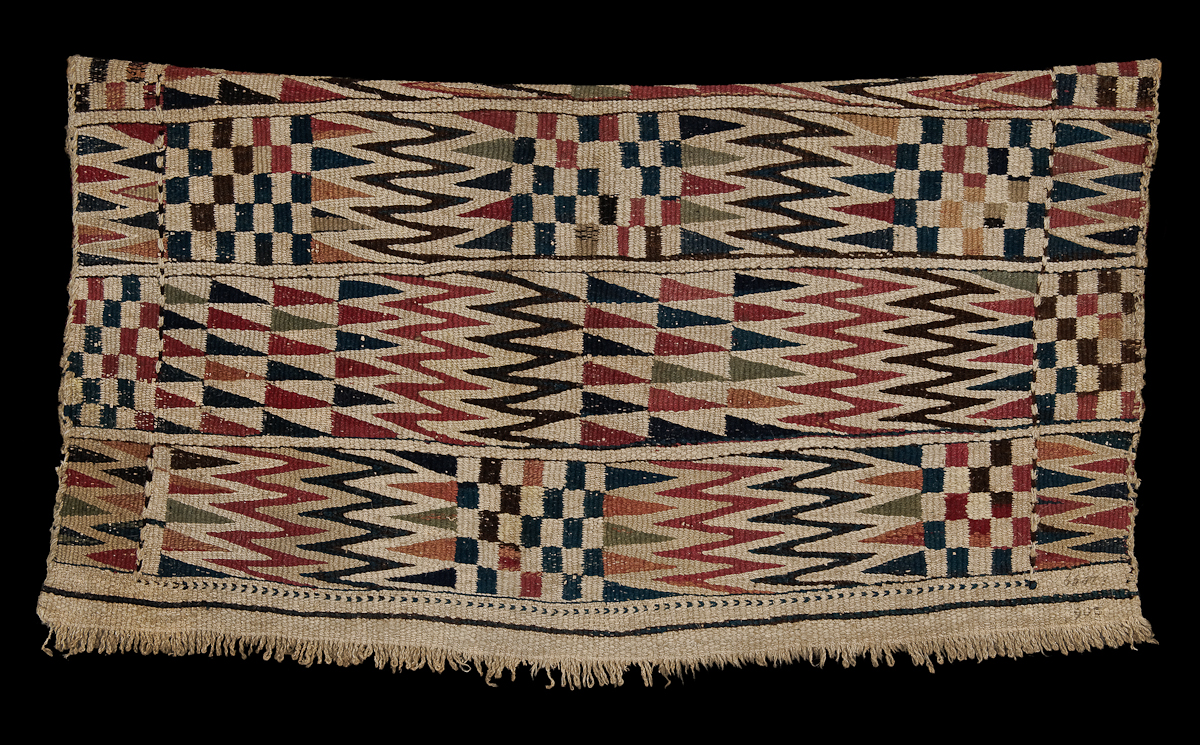
Coast Salish blanket 1884.88.9 © Pitt Rivers Museum


The blanket I was couriering is from the Coast Salish people of the North-West Coast of Canada/Northern USA. More specifically from San Juan Islands which sits in the Haro Strait between Vancouver Island and the North-West mainland coast, just south of Vancouver. It is from the Museum’s founding collection donated to the Museum in 1884 by General Augustus Henry Lane FoxPitt-Rivers on the formation of the Museum at the University of Oxford. It is woven from Coast Salish woolly dog hair and goat hair. The use of dog hair dates the blanket as being made before 1884 as the native dog whose hair was used in Salish weaving had died out by 1860. The blanket is one of ten chosen by Salish weavers from the 1800s to be part of the exhibition 'The Fabric of Our Land' with others from Scotland, Finland and the United States. The historical blankets are displayed among contemporary Salish weavings providing a unique opportunity to compare and contrast the rich tradition of weaving for the Salish people. The exhibition is curated by Sue Rowley who kindly had me stay with her whilst I was in Vancouver. Sue worked in collaboration with the local Musqueam people to create the exhibition. Again, I was fortunate enough to meet some contemporary weavers and be present for the exhibition opening which had around 900 attendees and included speeches by Musqueam weavers Wendy John and Debra Sparrow. The blanket will be on display until 15th of April 2018. On returning to bring the blanket back to Oxford there will be community visits arranged at MOA for weavers and Salish people to see the blanket up close. This work is crucial for the continuity of the craft and tradition of Salish weaving and its importance is summed up in this quote from Wendy Grant-John (Musqueam weaver and political leader) ‘Touching blankets that are over a hundred years old creates such a spiritual feeling, an understanding that the skill you’re reacquiring is the same that our ancestors had’

My visit to Canada gave me a glimpse of the importance of traditional craft and ways of life embedded in objects in European Museum’s far from their place of origin. Loans to exhibits such as ‘The Fabric of Our Land’ make it possible for First Nations people to really experience and get close to their ancestors who were involved in the creation of these special objects. The effect this has on future generations of, in this case weavers and Salish people is significant, it is vital that we enable and facilitate such exchanges. There is still much to do in addressing issues of colonial legacies inherent in ethnographic collections but efforts like this make small inroads.

The trip also provided me with the chance to learn from Canadian colleagues about differences and similarities in our curatorial practice and collections management. I was incredibly fortunate to have this experience and endeavoured to learn as much as possible from my trip. I was also lucky enough to spend time in Vancouver and able to visit Vancouver Island. What really impressed on me during my time in British Columbia was the amazing landscape, particularly the relationship between land, sea and nature so rooted in North-West coast iconography, myth and belief. I feel that I returned to Oxford with a greater understanding of North-West coast culture. It is clear that MOA as an institution is leading the sector in Canada and indeed globally for the work they do with indigenous communities particularly artists and young people and whilst the context is different for European collections where the objects are far from their home I feel that the physical distance only gives us greater responsibility to ensure that we make such objects as accessible as possible to whom these objects truly belong. As part of the public programme for the exhibition Salish weavers and artists will be giving gallery tours and talks as well as weaving demonstrations. There is even the chance to have a go at weaving yourself in the gallery should you get the chance to visit.

Faye Belsey

Assistant Curator

Monday, 15 May 2017

Learning to make armour from coconut - a tradition from Kiribati

On the 3rd April I was invited to Cambridge to attend a workshop on Coconut fibre armour from Kiribati. The Cambridge University Museum of Archaeology and Anthropology (MAA) is currently displaying the exhibition ‘The Island Warrior’ one of the many outcomes of the Pacific Presences research project. The coconut fibre armour from Kiribati has always held a fascination with me and the weapons that accompany it. I am inspired by the use of local materials, coconut fibre, shark’s teeth, ray skin and porcupine fish skin to make these fearsome objects. I think that the armour and weaponry of Kiribati epitomises the resourcefulness of an island nation. The Republic of Kiribati consists of thirty-three coral atolls isolated in the Pacific Ocean. The coconut fibre armour is unique to Kiribati and the Pitt Rivers Museum has the second largest collection of this armour in the UK after the British Museum. The armour consists of many component parts the most significant being the cuirass, which covers the torso, tunics, dungarees, trousers, forearm guards, waistbands and helmets. Today, the armoured warrior is a symbol of power and strength which appears on t-shirts and sarongs in Kiribati.


The ‘Island Warrior’ is exhibited in two show cases. One case displays the historic suit of armour from MAA’s collections and the other displays a contemporary suit made by artists Lizzy Leckie, Kaetaeta Watson and Chris Charteris. Also inspired by the use of local resources, Lizzy, Chris and Kaetaeta experimented with materials readily available to them from their home in New Zealand. They made the cuirass from twisted polyethylene twine used for fishing trawl nets. This material was successful after having discovered that the knotting technique used to make the original armour was indeed a similar technique used in making fishing nets. The overalls were made from sisal bailing twine. Other man made materials were used for the construction of the armour due to their availability, firmness and strength. As part of the workshop I was able to have a go at plying coconut fibre and the knotting and weaving techniques employed by the artists to make the contemporary suit. This opportunity gave me an insight into the specialist skills required, the time, effort and teamwork necessary to make a complete suit. I wasn’t very good at it and in attempting the weaving appreciated the whalebone needles Chris had made especially for the process, metal needles were extremely unforgiving on the hands! feel that the interdisciplinary approach embraced by the exhibition made me really examine the object and should be an approach adopted more often. The conservation element reminded me of the approach we recently applied at the PRM to reinterpret the Tahitian mourners costume from Captain Cook’s voyages now on display in the Cook case on the Lower Gallery. I was lucky enough the be able to stay for the exhibition opening where we were treated to Kiribati dancing from members of Kiribati community members living in the UK and working with the British Museum as part of their ‘object journeys’ project. We have on display in the Upper Gallery of the Museum a suit of coconut fibre Kiribati armour, do go and have a look when you are next visiting the Museum.


Faye Belsey

Assistant Curator