Showing posts with label British Museum. Show all posts

Monday, 12 October 2020

Picturing the Arctic: Loan to the British Museum Citi Exhibition, Arctic Culture and Climate

Sealskin and pigment map of the Bering Strait, 1966.19.1. Copyright Pitt Rivers Museum. 

Despite the current pandemic many Museum have now reopened to the public and are trying to resume ‘normal business’ as best as possible. A very public facing part of normal business for museums is to plan and hold a number of temporary exhibitions. Depending on the scale of the exhibition, these often take years in the planning. Just before the UK lockdown the Pitt Rivers Museum was preparing to loan an amazing sealskin pictogram (1966.19.1) from our permanent displays to the British Museum for the exhibition ‘Arctic: Culture and Climate’. Thankfully the exhibition has been rescheduled and will go ahead opening to the public on the 22nd October 2020 – 21 February 2021. The exhibition celebrates the ingenuity, creativity and resourcefulness of those who live in the Arctic regions and will include work by Arctic artists, poets and musicians as well as historical artefacts. The map we have lent to the exhibition of the Bering Strait was made by a Siberian Yupik man sometime between 1850-1865 and depicts intimate scenes of life with hunting, travelling, animal migrations, spiritual migrations, spiritual beings and events happening on the Russian and American coastlines. The map was most likely made by an important whaling captain and trader and passed on to British naval officer William Hooper. For the loan to happen we had to adapt our practices, overseeing the installation of the map in the gallery at the British Museum virtually via video call. This would not be possible for a more complex object but the map was secured to a backboard and so needed minimal handling to be condition checked and put in the display case. 


Faye Belsey

Deputy Head of Collections 

Thursday, 1 October 2015

Visit to the Indigenous Australia exhibition at the British Museum

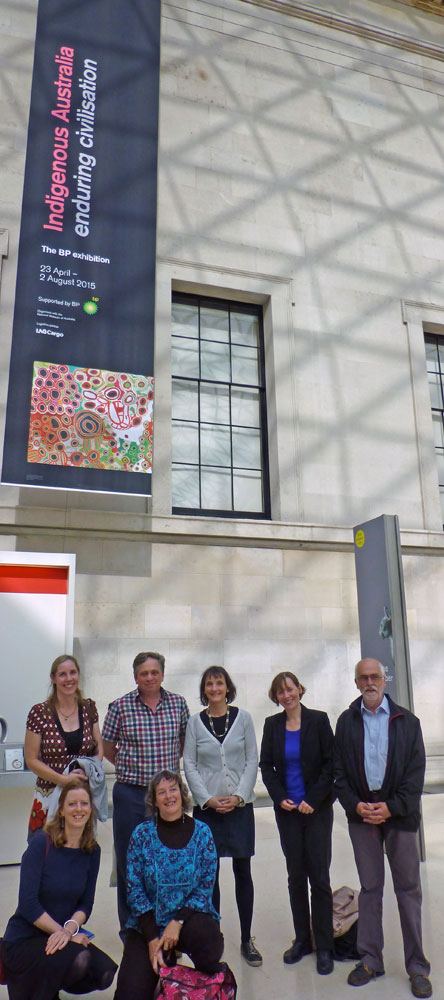
I always find exploring other museum collections and meeting colleagues working in other institutions a rewarding experience. Julia and I, both from the Collections Department at the Pitt Rivers, recently visited the British Museum to see the temporary exhibition Indigenous Australia enduring civilisation. The Museum Ethnographers Group (MEG) had organised a special tour of the exhibition, which included a talk by the Curator Gaye Sculthorpe.

MEG trip to the exhibition
We met up with the rest of the group from MEG, then Gaye gave an informative and interesting introductory talk before we looked at the exhibition. The British Museum collection was very impressive - including the work of contemporary Australian Indigenous artists, as well as older objects.

The Pitt Rivers Museum, along with other institutions,  had loaned some objects for the exhibition - which had plenty of visitors - so it was good to know people had this opportunity to see them on display.

A relaxing chat after the exhibition tour
with Curator Gaye Sculthorpe


After a good look around we then met up again with Gaye, who had kindly set aside time to have an informal chat with us all after we'd looked around.


Unfortunately the exhibition closed on 2 August. However, if you are interested, you can still get a copy of the publication Indigenous Australia: enduring civilisation, which was researched and written in conjunction with the exhibition. If you are in Australia, you will be pleased to hear part of the collection is travelling there for a temporary exhibition. Plus Gaye intends to continue to to bring attention to the importance of the British Museum's Australian collections, which will involve working directly with Indigenous Australians.
PRM 1982.12.1 © Pitt Rivers Museum

The Pitt Rivers Museum lent three objects to the British Museum for the exhibition. A wooden club from New South Wales; a  bark painting from Arnhem Land (right); and a carrying vessel from the Kimberleys (below). This type of vessel is sometimes called a coolamon and can be used for all sorts of things, including carrying a baby. The painting is the work of artist Billinyara Nabegeyo and is of the Rainbow Snake, which is very significant within Australian Indigenous culture.

On behalf of Julia and I, I'd like to say thank you to Gaye and MEG for this opportunity for such an insightful and enjoyable day.

Zena McGreevy
Senior Assistant Curator


PRM 1896.50.4 © Pitt Rivers Museum