Showing posts with label Indigenous Australia. Show all posts

Wednesday, 6 January 2016

Tiwi Islander Research Visit

In October last year Bede TungutalumDiana Wood Conroy, and Alison Clark visited the Museum to study the collections from Melville Island in Australia. Melville Island is located 100 kilometres north of Darwin and is the third largest island of Australia - after the mainland and Tasmania. Melville Island and the nearby Bathurst Island are known as the Tiwi Islands, which are home to nearly 2500 Tiwi-speaking people.

Bede is from Melville Island and is a senior Tiwi artist who is skilled in painting, carving and printmaking. Diana is an archaeologist and artist who has worked closely with indigenous communities on Melville Island since the 1970s. Alison is a researcher at the Cambridge Museum of Archaeology and Anthropology and studied the Tiwi collections at the British Museum as part of her PhD.

We were pleased to be able to show Bede, Diana, and Alison the objects in the Pitt Rivers Museum from Melville Island. This included three very heavy carved and decorated wooden burial poles and two large painted bark baskets. While we were all studying the collection they kindly told us more about these interesting objects.

The poles and baskets are still made and continue to be used in Pukumani ceremonies.

Nicholas and Alison from the Pitt Rivers looking at
one of the Pukumani poles with Alison, Diana and Bede
© Pitt Rivers Museum

This is a public ceremony performed to ensure the spirit of a dead person passes from the living to the spirit world. The painted bark baskets are placed on top of the poles at the end of the Pukumani ceremony as gifts for the spirits.


Looking closely at the bark baskets © Pitt Rivers Museum
I really enjoyed meeting Bede, Diana, and Ali and spending time with them talking about the objects and life on Melville Island.

From left to right:
PRM 1915.10.23, 1914.43.1,
 1915.10.25, 1915.10.24
© Pitt Rivers Museum

PRM 1915.10.20
© Pitt Rivers Museum

On the left you can see the carved poles we  looked at, the one in the middle has one of the  bark baskets placed over the top.

You can see the other bark basket on the right.

If you have an opportunity to visit, you will find all three of the Pukumani poles on permanent display in the Lower Gallery of the Museum.

Zena McGreevy
Senior Assistant Curator

Thursday, 1 October 2015

Visit to the Indigenous Australia exhibition at the British Museum

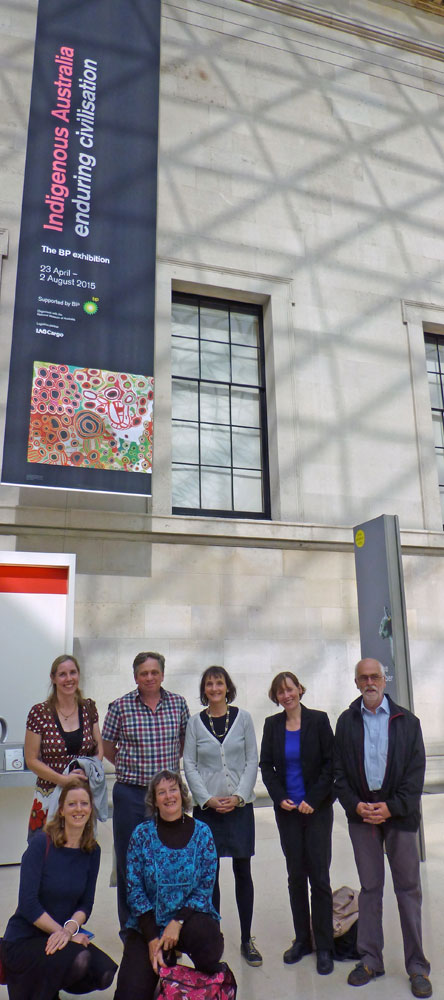
I always find exploring other museum collections and meeting colleagues working in other institutions a rewarding experience. Julia and I, both from the Collections Department at the Pitt Rivers, recently visited the British Museum to see the temporary exhibition Indigenous Australia enduring civilisationThe Museum Ethnographers Group (MEG) had organised a special tour of the exhibition, which included a talk by the Curator Gaye Sculthorpe.

MEG trip to the exhibition
We met up with the rest of the group from MEG, then Gaye gave an informative and interesting introductory talk before we looked at the exhibition. The British Museum collection was very impressive - including the work of contemporary Australian Indigenous artists, as well as older objects.

The Pitt Rivers Museum, along with other institutions,  had loaned some objects for the exhibition - which had plenty of visitors - so it was good to know people had this opportunity to see them on display.

A relaxing chat after the exhibition tour
with Curator Gaye Sculthorpe


After a good look around we then met up again with Gaye, who had kindly set aside time to have an informal chat with us all after we'd looked around.


Unfortunately the exhibition closed on 2 August. However, if you are interested, you can still get a copy of the publication Indigenous Australia: enduring civilisation, which was researched and written in conjunction with the exhibition. If you are in Australia, you will be pleased to hear part of the collection is travelling there for a temporary exhibition. Plus Gaye intends to continue to to bring attention to the importance of the British Museum's Australian collections, which will involve working directly with Indigenous Australians.
PRM 1982.12.1 © Pitt Rivers Museum

The Pitt Rivers Museum lent three objects to the British Museum for the exhibition. A wooden club from New South Wales; a  bark painting from Arnhem Land (right); and a carrying vessel from the Kimberleys (below). This type of vessel is sometimes called a coolamon and can be used for all sorts of things, including carrying a baby. The painting is the work of artist Billinyara Nabegeyo and is of the Rainbow Snake, which is very significant within Australian Indigenous culture.

On behalf of Julia and I, I'd like to say thank you to Gaye and MEG for this opportunity for such an insightful and enjoyable day.

Zena McGreevy
Senior Assistant Curator


PRM 1896.50.4 © Pitt Rivers Museum