Showing posts with label museum cataloguing. Show all posts

Wednesday, 17 February 2016

Caring for the Collections: A Model Boat

I am currently working on upgrading the Museum's model displays on the ground floor (Court Gallery). I work closely with the Conservation Team, who check the condition of the objects, and carry out any necessary treatment before they go on display. I catalogue each object in detail, take photographs of each one, and write the new display labels.

During this process we discovered a beautifully made model of a rowing boat from Malta. The carved wooden hull has been neatly painted and the model includes painted oars, a painted metal lamp, a wooden bucket and baler, a metal anchor, and decorative silks drapes hung over the cabin area.

Detailed model of a Maltese rowing boat, PRM 1908.5.1 © Pitt Rivers Museum
Originally given to the Museum in 1908 the drapes are now faded and extremely fragile, the damage caused by past exposure to the UV rays in natural light . In addition the anchor, which the Conservators did a spot test on to identify the metal, is made of lead that is seriously corroded.

Close ups showing the faded and fragile silk drapes (left) and the corroded anchor (right) © Pitt Rivers Museum
As you can imagine staff in the Museum are extremely busy and Conservation would need to spend many hours to stabilise the silk on the boat before it could go on display.  Consequently we are going to house the rowing boat in a custom made storage box within the reserve collections.

Even if the decision is made not to include a model in the new display I still catalogue each one in detail. I add any information and photographs to the appropriate record on the object database. These form the basis for the online object database, which is regularly updated. This ensures you can access all the known information, plus see what the objects look like, on the Museum website.

Part of the cataloguing process involves clearly numbering each detachable part of the boat with the appropriate unique identification number. This enables each part to be described in detail and means even if they become separated - for whatever reason -  each part can be accurately identified and linked to the correct information.
The accession number written on
one of the oars © Pitt Rivers Museum


We number objects by applying a layer of reversible acrylic adhesive in solvent - often called paraloid - which looks like clear nail varnish. We then write the number using a rotring pen, before applying another layer of the acrylic adhesive.


As I have just catalogued and photographed the Maltese rowing boat this seemed an ideal opportunity to show you this particular model. Described as a daisa, in the information written down when this was given to the Museum, this appears to be a model of a traditional water taxi used to carry passengers and their baggage. To propel the boat a man stood facing forward pushing on the two oars, rather than sitting down to row.

One of the distinct features when you look at the boat is the height of the stem and the stern. The shape of these - as well as being decorative - provided a means of support for passengers to easily board and disembark.

Carved hull with high stem and stern © Pitt Rivers Museum
I hope you have enjoyed looking at and reading about this beautifully made model.

I will continue to keep you informed about the redisplay of the models with regular posts so keep following this blog.

Zena McGreevy
Senior Assistant Curator

Thursday, 20 August 2015

Caring for the Collections: Good Gourd!


The information found either written on an object or on a label attached
to the object allows us to track the object down on the database, assign it the
correct accession number,catalogue it and record its location making the object
more accessible for staff and researchers. © Pitt Rivers Museum

The wooden drawer units  © Pitt Rivers Museum
Box storage  © Pitt Rivers Museum

After having embarked and completed the rather large and daunting project of cataloguing and improving the storage of plant fibre clothing in the collections at our store we turned our attention to a more manageable project to see us through the summer. The Museum has a large collection of gourds kept in a less than useful wooden drawer system at the store. Gourds are particularly vulnerable to getting broken or damaged due to their delicate composition, odd shapes and sizes and varying thickness/thinness. And so, to this end, for the well being of the gourds the wooden drawer system is being replaced with conservation grade boxes and packaging.

The collections of the Pitt Rivers Museum and indeed ethnographic collections all over the world demonstrate imaginative use of the gourd. Gourds of all shapes and sizes are a natural resource across the globe and in societies today gourds are still being used as bowls, vessels, hats, musical instruments and for many other utilitarian purposes. Conservator Jeremy Uden and myself have been surprised by the variety of shapes, sizes and uses of the gourd and the varying thicknesses from eggshell thin to an inch or more thick. We are half way through the cataloguing and re-storage project and are getting an eye for identifying preferred decorative techniques from country to country. As well as gourds we are also working through vessels made from seed and nut including coconut vessels mostly from Oceania. Coconuts are readily available to Pacific Islanders and prove useful repositories for carrying and storing water and drinking water and kava from.


Above: gourds and coconut vessels in the process of being
catalogued and packed  © Pitt Rivers Museum

Gourd of the Lengua Indians; 1903.19.3  © Pitt Rivers Museum
Decorative techniques also vary greatly, with surfaces being incised with linear, figurative and geometric designs and decorated with burnt patterns known as pyro engraving. Coconut shells are inlaid with pearl shell and shell beads for aesthetic effects and white lime rubbed into incised designs to highlight the pattern. A particularly ingenious method of carving the lid so that it fits perfectly onto the gourd vessels is that of the Lengua Indians of the Paraguayan Chaco, South America. One end of the gourd is cut from the other with a zigzag line. Some of the coconuts and gourds have been decorated with perfect circular patterns created with a compass. We have more than one example of a coco de mer, or double coconut having been refashioned into a Hindu Sadhu's begging bowl with metal chain suspension for wearing around the neck. The value of the gourd as a utilitarian object is also emphasised by the local repairs found on some of them. Rather than make a new one, someone has taken the time to repair a damaged gourd already fashioned as a vessel. Later in the year the Museum will have a temporary display curated by our conservation department focusing on objects with local repairs 'Preserving What is Valued' including gourds. Some of these techniques and methods of using and decorating gourds can been seen on display in the Museum Court in the Geometric Form in Art case C.145.A and also in musical instruments particularly stringed lutes and zithers where the gourd forms the resonator part of the instrument.

Hindu Sadhu's begging bowl made from a double coconut;
1933.51.65   © Pitt Rivers Museum


Above, two gourd vessels which have local repairs where the
gourd has split and broken  © Pitt Rivers Museum


Above are coconut shells fashioned into water carrying vessels.
The top photograph shows how a plant fibre basketry frame has been
made to cradle the two coconuts and the one below has simply
been decorated with pearl shell; 1887.1.578 & 1933.38.27  © Pitt Rivers Museum

Above; gourds decorated with pyro-engraving technique, where burn marks
applied often with a poker have been used to make patterns and
decoration on the gourd; 1900.55.431 & 1934.8.102  © Pitt Rivers Museum

The two gourds above have been decorated with incised designs and
patterns and then rubbed with lime which is white and
acts highlight the design; 1935.56.15 & 1946.6.63 .2  © Pitt Rivers Museum


Faye Belsey
Assistant Curator


Wednesday, 21 January 2015

New Acquisitions: Native American Interests

Turner collection on my desk ready for cataloguing © Pitt Rivers Museum
I recently had the pleasure of accessioning a delightful collection of Native American material kindly donated to the Museum by Jessica Turner. The collection was amassed by her father Geoffrey Eric Slade Turner, a keen Native American enthusiast. Geoffrey Turner was very familiar with the Museum having worked in an administrative position in the secretary's office at the Pitt Rivers neighbour, the Oxford University Museum of Natural History for over 50 years. His passion for the Americas and service to the Pitt Rivers Museum was recognised with the title ‘Honorary Assistant Curator (later Consultant) in North American Indian ethnology. 


child's slippers; 2014.43.17 .1 & .2  © Pitt Rivers Museum
Moose hair workbox; 2014.43.10 © Pitt Rivers Museum
Despite his interest in the culture and fauna and floral of North America remarkably in his lifetime he never made the journey across the pond. Despite this, his knowledge and interests ensured that he had a healthy correspondence with North American experts. The recent donation also included an extensive collection of photographs, postcards and letters, which having had a brief perusal indicate Turner established a warm friendship with his American counterparts. The photographs included scenes of ‘cowboy’s and Indians’ and postcards featuring notable figures from the Mexican Revolution of 1910, further showing his interest in Native American history. 

There are 37 artifacts in Jessica Turner’s donation which include a model totem pole, moose hair embroidered pieces, moccasins and skin pouches to name a few. Among the objects were letters and itemized listings of most of the objects detailing where they came from, approximate dates and other provenance information. The collection includes beautiful examples of moose hair embroidery including this satin and bark workbox and card case. My favorite item from the collection are these child’s slippers made from Caribou skin with white fur cuffs.


Embroidery techniques and a selection of moccasin vamps © Pitt Rivers Museum


Catalogued and traded up ready for photography © Pitt Rivers Museum
The collection is an interesting array highlighting Turner’s personal interests, eye for the aesthetically pleasing and scholarly interests such as the index cards with white cotton woven braid illustrating hair embroidery techniques. These techniques feature in the publication written by Turner as a Pitt Rivers Museum Occasional Paper titled ‘Hair Embroidery in Siberia and North America’, 1955. Again, emphasizing his scholarly interests are a collection of Moccasin vamps showing straight edges, scalloped edges and seal-fur.


Page 31 of Turner, 'Hair Embroidery' © Pitt Rivers Museum
Catalogued and traded up ready for photography
The collection has now been catalogued, photographed and put in storage. Given that most of the collection was organic it was frozen for a period before accessioning. The collection includes some early pieces and was mostly in good condition. I spent time making a soft mount for two beadwork necklaces, which would otherwise get tangled in storage.

Beaded necklace on soft mount for storage; 2014.43.24 © Pitt Rivers Museum


Faye Belsey
Assistant Curator 

Wednesday, 6 August 2014

Paddles Project in the Lower Gallery

The lower gallery of the Museum is currently closed to enable the movement of several large display cases at the east end of the gallery. While the gallery is closed a team of conservators, collection managers and technicians are taking the opportunity to take down over 500 objects suspended from the floor of the gallery above. All four sides of the gallery have paddles, walking sticks, staffs and calendar sticks on open display above the heads of the visitors.

Grills in the floor 
© Pitt Rivers Museum


The last time the objects were taken down and cleaned was in 2009, when the Museum was closed to redevelop the entrance and install air conditioning equipment. As part of the building works, holes were cut into the floor of both galleries and metal grills installed. This was done to improve circulation of the cooled air to all parts of the Museum. Unfortunately, collections and conservation staff have become concerned over the past year that the addition of the grills in the floor has substantially increased the levels of dust and debris settling on the objects suspended beneath. While high levels of dust are not good for an object, it can generally be removed fairly easily. However, we have found paddles with new water stains, sweetie wrappers and even breadcrumbs stuck to the surface.


Examples of some of the paddles covered with dust and debris 
in the areas directly below the grills © Pitt Rivers Museum

Staff originally tried to think of a way to prevent the dust and debris falling through, but this was problematic as the grills needed to remain clear for the air to circulate. It was also not possible to remove the objects, as the Museum does not have capacity in its stores for over 500 additional long objects. Even if space were available, it would be a sad decision as the paddles on open display are part of the quirky nature of the Museum.


A conservator removing the dust a debris with a brush and vacuum 
© Pitt Rivers Museum

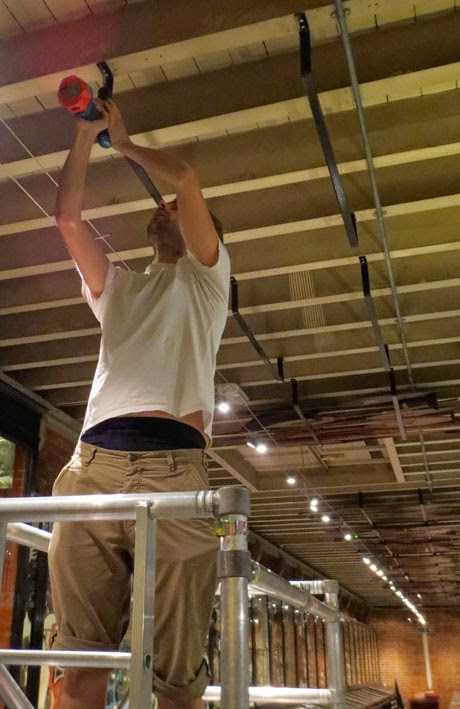
Technician Alan Cooke working from a scaffold tower 
to remove the brackets from the old positions 
© Pitt Rivers Museum
The solution we have devised is to move the brackets supporting the objects to positions where the objects do not sit directly below the grills in the floor. This involves taking down all the objects from a rack, unscrewing the brackets and moving them to the new positions along the wooden beams. In some areas the brackets need to be re-orientated to avoid the grills. While the objects are down they are cleaned, assigned a condition assessment, and their cataloguing and location information checked. The objects are then returned to their new positions.

When the gallery re-opens on Saturday 6th September, remember to look up!

Heather Richardson

Head of Conservation