Showing posts with label Percy Manning. Show all posts

Thursday, 9 March 2017

Percy Manning: The man who collected Oxfordshire


On Monday 20th February we welcomed the Kirtlington Morris dancers to the Museum to mark the opening of the temporary exhibition ‘Oxfordshire Folkloreand Customs: Celebrating the centenary of antiquarian and folklorist Percy Manning’ in the Didcot case on the Lower Gallery. The Kirtlington Morris have kindly donated some contemporary pieces of Morris dancing kit to the exhibition. They performed a number of dances outside the front of the Museum of NaturalHistory and after joined us for some celebratory tea and cake!


The exhibition closes on the 8th May. Kirtlington Morris will be participating in Oxford folk weekend alongside other Oxfordshire Morris teams on the 21st-23rd April.


Monday, 16 January 2017

Percy Manning: the man who collected Oxfordshire


Percy Manning was an antiquarian and folklorist, who died one hundred years ago in 1917. He was particularly interested in collecting objects and information about popular folk customs, and donated over 200 objects to the Pitt Rivers Museum. We at the PRM are creating a small temporary display to celebrate this centenary. The display contains objects related to folklore customs in Oxfordshire including a Morris Dancers outfit (1895.46.1), whit horns (1902.16.7), objects collected by Percy Manning such as candlesticks (1911.29.24, 1911.29.25 and 1911.29.37) and lace makers pot (1911.29.45) and contemporary Morris dancers accessories loaned by Kirtlington Morris.


Mock up of the layout for the display case © Pitt Rivers Museum
Two lanterns collected by Percy Manning 1911.29.33 and 1911.29.34 © Pitt Rivers Museum
The PRM display is one of many exhibitions and events happening in and around Oxford in 2017 to celebrate the life and achievements of Percy Manning. For more information about them visit here 

Madeleine Ding
Curatorial Assistant

Wednesday, 28 October 2015

Percy Manning Archive

Madeleine Ding looking through one of Manning's notebooks © Pitt Rivers Museum
In 2017 Oxford University Museums and libraries will be celebrating the centenary of folklorist, archaeologist and antiquarian Percy Manning. Oxford educated Manning, born in 1870 in Leeds, came to Oxford in 1888 to study at New College and went on to live out his adult life in Oxford. He was very much apart of the intellectual hub that encapsulated Oxford and to this end became very involved in various Oxford societies. His interests in folklore, custom and tradition in Oxfordshire led him to collect material culture reflecting this, in particular was his interest in collecting in the material and immaterial sense anything associated with Morris dancing and one of his most notable achievements was reviving this ‘dying’ tradition.

Object labels found in the archive possibly referring to 
objects donated to the PRM by Manning in 1911 
© Pitt Rivers Museum

In 1911 Manning donated a plethora of what can only be described as miscellaneous utilitarian objects of English origin to the Pitt Rivers Museum. Unlike the archaeological material he had donated to the Ashmolean Museum, the objects donated to the PRM come with comparatively little contextual information. The motivation for him to collect these objects and then donate them to the PRM is unclear though the influence of the PRM’s curator at the time, Henry Balfour, was sure to have played a role.

Article written by Henry Balfour on Whithorns kept by Manning 
© Pitt Rivers Museum

My colleague Madeleine Ding and I are planning how the PRM should commemorate Manning in 2017 and hope to have small display including a Morris dancers outfit from Kirtlington, Whit horns from Ducklington and other objects from the PRM’s collections. In order to try and get a better understanding of this material and Manning himself, we recently visited the new Weston Library to view parts of Manning’s extensive archive held by the Bodleian. Given Manning’s fastidiousness with recording information about traditions and folk life in Oxfordshire, we were hoping to find more references to the material now in the PRM’s collections. The archives are very interesting and include correspondence between Manning and his filed collector Thomas James Carter, newspaper clippings and snippets of articles. It left us with lots to think about!

Mannings notes on the revival of Morris dancing © Pitt Rivers Museum
Article that appeared in Folklore magazine, 1897, the publication of the 
Folklore society of which Manning was a member, written by Manning 
on 'Some Oxfordshire Seasonal Festivities' © Pitt Rivers Museum
Correspondence from Carter to Manning listing expenses of having 
traveled to various Oxfordshire villages for fact finding and 
collecting on behalf of Manning © Pitt Rivers Museum


Faye Belsey 
Assistant Curator 

Wednesday, 11 March 2015

Lace: facilitating knowledge exchange

On the 20th of February I welcomed a research visit from Nicolette Macovicky, Russian and East European Studies and David Hopkin, Faculty of History. They came to look at lace and lace related objects in the Pitt Rivers collections. Many people visiting the museum would assume that the collections whilst global are not local, they would be mistaken, much of the lace related material in the collections is from Oxfordshire and neighbouring counties. To highlight the more local objects in the collections, some of the objects retrieved for Nicolette and David's visit featured in the 2006-2009 ESRC-funded research project 'England: The Other Within: Analysing the English Collections at the Pitt Rivers Museum'

The Pitt Rivers Museum are a partner in Nicolette and David's HEIF Heritage Knowledge Exchange funded project 'By the Poor, For the Rich: Lace in context. Bridging the gaps between archives, textiles and social history collections'. Other project partners include the Museum of English Rural Life and The Lace Guild. Both having expertise in social and historical contexts of lace and lace making it was very interesting for me to hear what Nicolette and David thought of the selection of objects they looked at on their visit.

Bobbin winder as reconstructed by conservation; 1911.29.17.  © Pitt Rivers Museum

Included in the selection were lace making tools such as this bobbin winder (1911.29.17), collected by folklorist and antiquarian Percy Manning. Manning spent most of his adult life collecting objects from Oxfordshire. This bobbin winder is from Launton, an Oxfordshire village on the eastern outskirts of Bicester. The bobbin winder itself was in poor condition and needed some remedial conservation work involving reconstructing the bobbin winder to figure out how it would have worked. The bobbin winder is a practical object and is very simple in design, compared with another example we have on display which is made from pieces of turned wood, this bobbin winder is rudimental in comparison but does exactly the same job. Inscribed on the bobbin winder is 'Machine for winding thread on to a bobbin used in lace making bought of Maria Woods of Launton, Oxon, 1894.'. Using information from the census, David hopes to be able to track down Maria Woods of Launton and find out more about her.


Also collected by Manning are the dick pot (1911.29.45), lace makers candle stand (1911.29.22) and horse (1911.29.20 .1). The 'horse' was used to rest the lace pillow on whilst working. Nicolette thought that the low height of this particular horse indicated that it could have been used by children or for teaching lace making. Adequate lighting was important in lace making, the candle stand was used to concentrate the light from a single candle and focus it on the lace pillow. Finally, the dick pot would have been used for hot embers, the lace makers would place the pot under their skirts to keep themselves warm. It is surprising that the dick pot does not have a lid and the dangers of catching fire to the voluminous skirts would have been likely. Sitting near a fire was not an option for fear of the smoke dirtying the lace thread with which they were working. Again, David is going to further research this by looking through old newspaper archives fro reports of accidents and fires involving lace makers.
Candle stand; 1911.29.22 © Pitt Rivers Museum


Lace 'horse' 1911.29.20 .1 © Pitt Rivers Museum
'Dick pot' 1911.29.45 © Pitt Rivers Museum


Lace making display in court, C.115.A © Pitt Rivers Museum

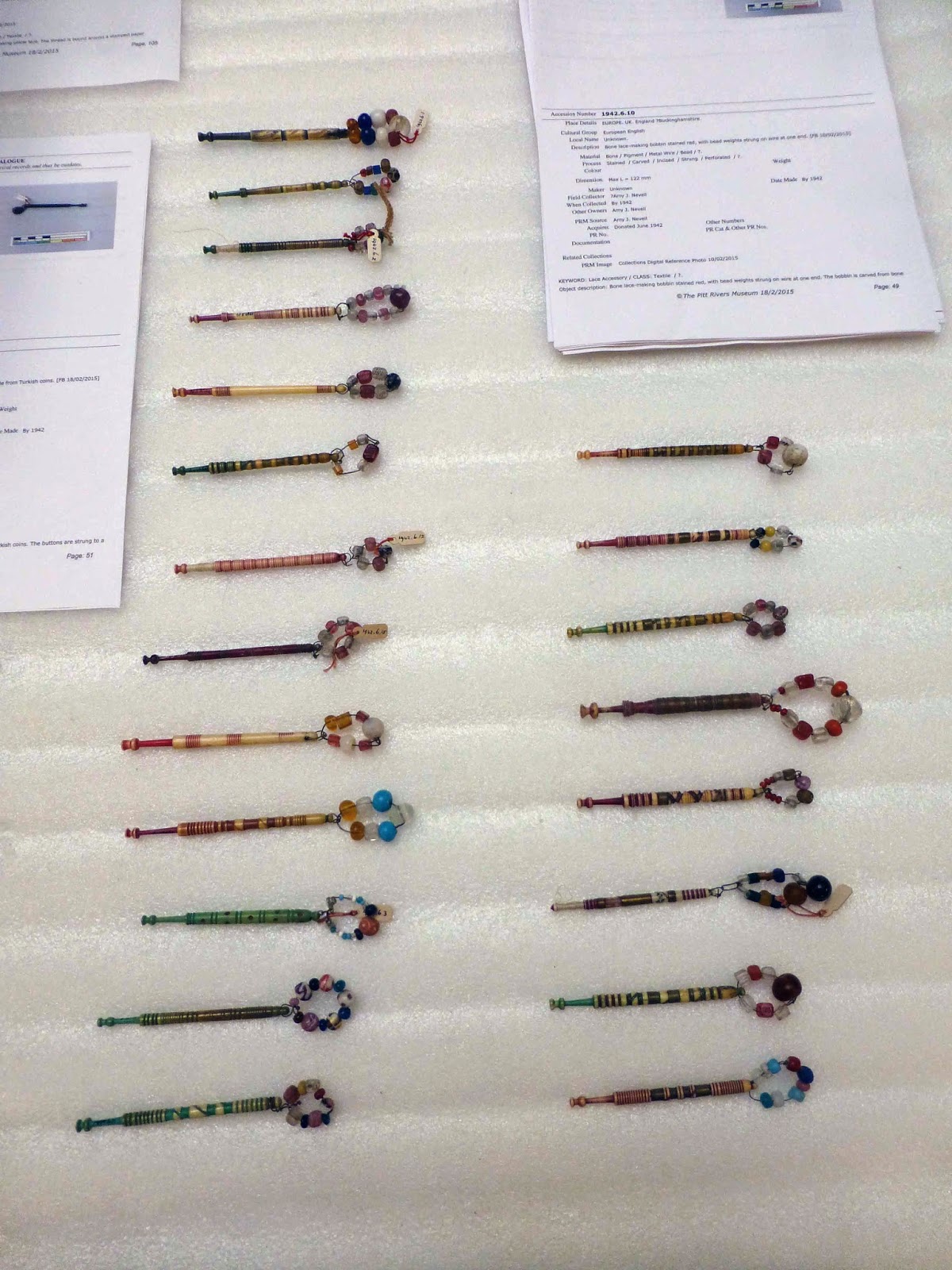
Of all the lace making material we have, the majority of the collection consists of beautifully made bobbins. There are bobbins made from both bone and wood, the bone ones being unique to the UK. The aesthetic around lace making is best illustrated by the lovingly crafted bobbins, often given as keepsakes and love tokens. They are weighted with glass beads which may have been traded from the continent. The square beads with impressed lines, made using a file, were made specifically for the bobbins to provide grip and prevent the bobbin from slipping when in place.

I look forward to seeing how the project progresses and hearing back from Nicollete and David once they have followed up some of the leads and done some further research. If you are interested in lace making, there is a display in the Museum Court, case 115.A, with a large number of bobbins and lace making  material.

Faye Belsey
Assistant Curator


Wednesday, 4 March 2015

Percy Manning Spinning Wheels

Percy Manning was an antiquarian and folklorist who spent much of his adult life around Oxfordshire. Manning's centenary celebrations occur in 2017 so in preparation for that I have done some research on some of the objects in his collection.


Along with 143 objects donated to the Pitt Rivers Museum, Manning donated objects to the Ashmolean Museum and his archives are in the Bodleian Library. Percy Manning gave three spinning wheels to the Pitt Rivers Museum.  Two upright spinning wheels from Great Tew in Oxfordshire and a portable spinning wheel from an unknown location.  Spinning wheels increase production of thread 10 fold compared to hand spinning with a distaff.

© Pitt Rivers Museum
Spinning wheel 1911.29.14 (left) 
This vertical spinning wheel is known as a ‘castle’ style.  The spinning wheel has two flyers so using two hands you can spin two threads at the same time.  This wheel would have been used to spin linen.  The wheel is turned with a foot treadle.  This spinning wheel is Flemish in style but could have been used anywhere.

Spinning wheel 1911.29.15 (below) 
The spinning wheel has a horizontal bed and is known as a ‘saxon’ type.  The bent rim wheel turns one flyer.  This wheel would spin fine thread.  This spinning wheel is typically English in style.

The two large spinning wheels came from Great Tew.  Great Tew is a rural village about 16 miles from Oxford.  Manning was interested in the village of Great Tew.  On a farm close to the village are the remains of a Roman settlement.  Manning kept articles about the Roman remains found at Beaconsfield Farm.  Tessellated pavements were found as early as 1810.  Manning also got information from Mr Matthew Boulton, the owner of Great Tew estate.  The village was an estate village with most of the population tenant farmers and craftspeople.  The village contains an exceptionally large number of listed buildings, built, rebuilt and renovated by a succession of landlords, and has a reputation as a picturesque village.

© Pitt Rivers Museum

Spinning wheel 1911.29.16 (right). The girdle or belt spinning wheel is a working spinning wheel.  The small size means that the tool could be tucked into a belt when being used.  The spinner turns the handle on the right hand side.  This turns the cog, which turns the flyer.  The material ready to be made into thread is held in the distaff.  James Webster of Salop was a manufacturer of this type of wheel.  The Webster family were clock makers.

For more information on spinning see Spinning Wheels, Spinners and Spinning by Patricia Baines, published London 1977.

Thanks to Alan Raistrik, independent scholar, for information provided.

Madeleine Ding
Assistant Curator