Showing posts with label Europe. Show all posts

Wednesday, 11 March 2015

Lace: facilitating knowledge exchange

On the 20th of February I welcomed a research visit from Nicolette Macovicky, Russian and East European Studies and David Hopkin, Faculty of History. They came to look at lace and lace related objects in the Pitt Rivers collections. Many people visiting the museum would assume that the collections whilst global are not local, they would be mistaken, much of the lace related material in the collections is from Oxfordshire and neighbouring counties. To highlight the more local objects in the collections, some of the objects retrieved for Nicolette and David's visit featured in the 2006-2009 ESRC-funded research project 'England: The Other Within: Analysing the English Collections at the Pitt Rivers Museum'

The Pitt Rivers Museum are a partner in Nicolette and David's HEIF Heritage Knowledge Exchange funded project 'By the Poor, For the Rich: Lace in context. Bridging the gaps between archives, textiles and social history collections'. Other project partners include the Museum of English Rural Life and The Lace Guild. Both having expertise in social and historical contexts of lace and lace making it was very interesting for me to hear what Nicolette and David thought of the selection of objects they looked at on their visit.

Bobbin winder as reconstructed by conservation; 1911.29.17.  © Pitt Rivers Museum

Included in the selection were lace making tools such as this bobbin winder (1911.29.17), collected by folklorist and antiquarian Percy Manning. Manning spent most of his adult life collecting objects from Oxfordshire. This bobbin winder is from Launton, an Oxfordshire village on the eastern outskirts of Bicester. The bobbin winder itself was in poor condition and needed some remedial conservation work involving reconstructing the bobbin winder to figure out how it would have worked. The bobbin winder is a practical object and is very simple in design, compared with another example we have on display which is made from pieces of turned wood, this bobbin winder is rudimental in comparison but does exactly the same job. Inscribed on the bobbin winder is 'Machine for winding thread on to a bobbin used in lace making bought of Maria Woods of Launton, Oxon, 1894.'. Using information from the census, David hopes to be able to track down Maria Woods of Launton and find out more about her.


Also collected by Manning are the dick pot (1911.29.45), lace makers candle stand (1911.29.22) and horse (1911.29.20 .1). The 'horse' was used to rest the lace pillow on whilst working. Nicolette thought that the low height of this particular horse indicated that it could have been used by children or for teaching lace making. Adequate lighting was important in lace making, the candle stand was used to concentrate the light from a single candle and focus it on the lace pillow. Finally, the dick pot would have been used for hot embers, the lace makers would place the pot under their skirts to keep themselves warm. It is surprising that the dick pot does not have a lid and the dangers of catching fire to the voluminous skirts would have been likely. Sitting near a fire was not an option for fear of the smoke dirtying the lace thread with which they were working. Again, David is going to further research this by looking through old newspaper archives fro reports of accidents and fires involving lace makers.
Candle stand; 1911.29.22 © Pitt Rivers Museum


Lace 'horse' 1911.29.20 .1 © Pitt Rivers Museum
'Dick pot' 1911.29.45 © Pitt Rivers Museum


Lace making display in court, C.115.A © Pitt Rivers Museum

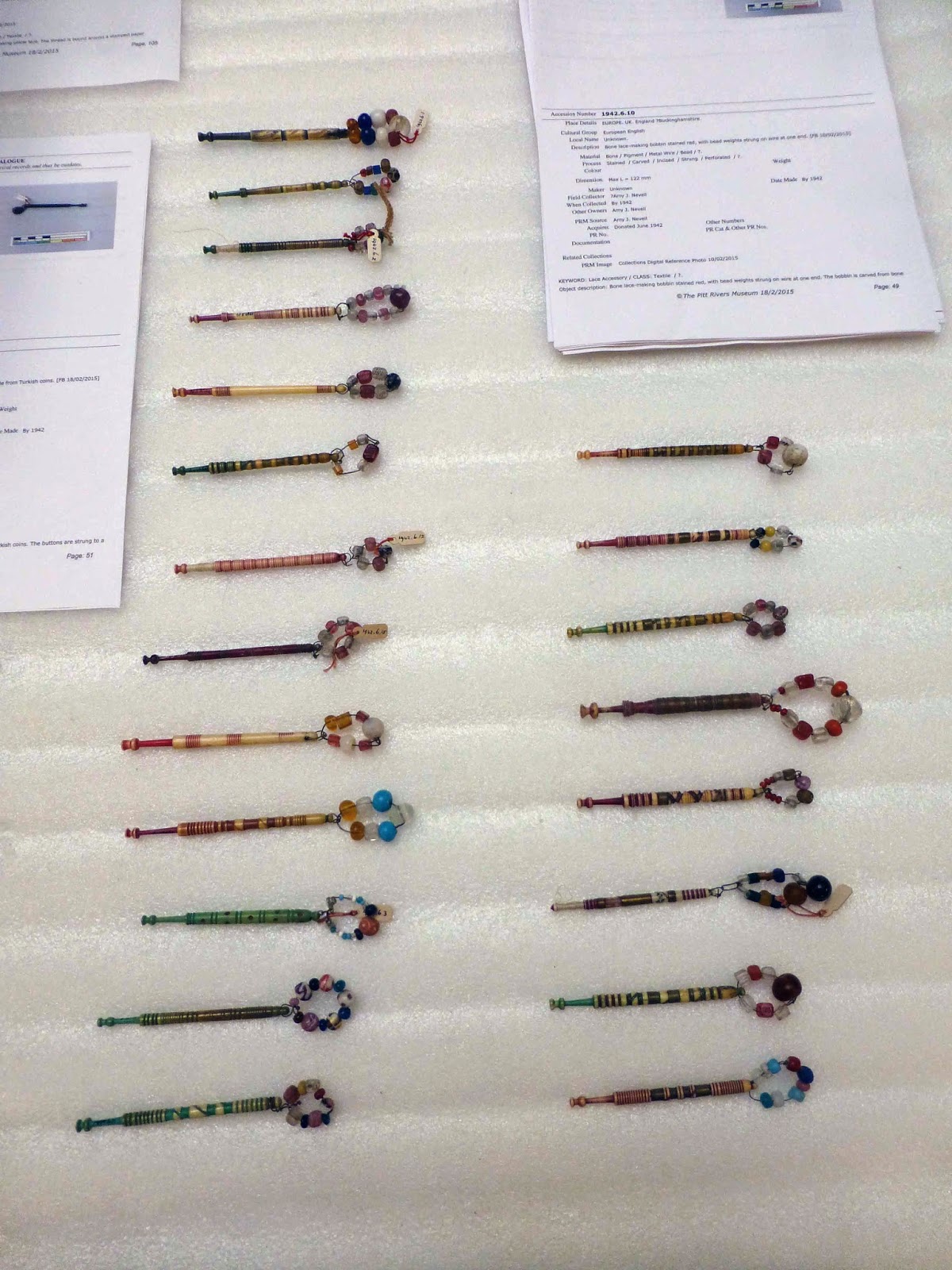
Of all the lace making material we have, the majority of the collection consists of beautifully made bobbins. There are bobbins made from both bone and wood, the bone ones being unique to the UK. The aesthetic around lace making is best illustrated by the lovingly crafted bobbins, often given as keepsakes and love tokens. They are weighted with glass beads which may have been traded from the continent. The square beads with impressed lines, made using a file, were made specifically for the bobbins to provide grip and prevent the bobbin from slipping when in place.

I look forward to seeing how the project progresses and hearing back from Nicollete and David once they have followed up some of the leads and done some further research. If you are interested in lace making, there is a display in the Museum Court, case 115.A, with a large number of bobbins and lace making  material.

Faye Belsey
Assistant Curator


Wednesday, 29 October 2014

Trench Art Collection

Model military cap PRM 1999.45.2
© Pitt Rivers Museum
This year is the start of the First World War Centenary, which seems an opportune moment to show you this collection of objects made from artillery shells and bullet casings.
Letter opener PRM 1999.45.3
© Pitt Rivers Museum


Professor Nicholas Saunders, a trench art specialist, purchased these for the Museum in 1999.


Part of the collection is on permanent display. If you visit the Museum, look at the 'Recycling' display on the first floor and the '20th Century Firearms' on the top floor. If you visit on a Wednesday afternoon, up to the 12th November,  you could join the free First World War tour, which starts at 3.15.

Ashtray PRM 1999.45.1
© Pitt Rivers Museum
Model coal scuttle PRM 1999.45.4
and vases PRM 1999.45.7 and
PRM 1999.45.8 © Pitt Rivers Museum
You can also explore this collection online using the Museum object database. Where you are asked for an accession number, enter '1999.45.', which is the museum identification number for this collection.

Or to discover the wide variety of objects in the Museum collection made from recycled bullets, select 'bullet' from keywords and 'recycled' for process, then search. Simply click on the individual records to see the full details about each one.

Vases left to right: PRM 1999.45.6,
PRM 1999.45.9, PRM 1999.45.10
© Pitt Rivers Museum

I encourage you to take the time to explore these interesting objects. I really like the way these show the creativity of human beings in taking something designed to cause destruction and transforming it into something decorative.
Vase PRM 1999.45.5
© Pitt Rivers Museum

Zena McGreevy
Senior Assistant Curator


If you are interested in reading more about trench art see:

Kimball, Jane A. (2004), Trench Art: An Illustrated History, Silverpenny Press.
Sanders, Nicolas J. (2003), Trench Art: Materialities and Memories of War, Oxford: Berg.
Sanders, Nicolas J. (2002), Trench Art, Princes Risborough: Shire.
Sanders, Nicolas J. (2001), Trench Art: A Brief History and Guide, 1914-1939, London: Leo Cooper. 

Part of this collection was included in the temporary exhibition Transformations: The Art of Recycling. Held at the Museum from 2000 until 2002 this celebrated the human creativity in recycling and re-using objects.

Wednesday, 22 October 2014

Installing 'Myanmar - The Golden Land' at Linden Museum, Stuttgart, Germany

On Tuesday 14th October, setting off at 6.30am, I embarked on a journey by truck across Europe to deliver a crate of eight objects from the Pitt Rivers Museum (PRM) collections from Myanmar (Burma) to Linden Museum, Stuttgart for the exhibition 'Myanmar - The Golden Land'. I travelled all day to arrive in Frankfurt late Tuesday evening. After an overnight stop my journey resumed at 9.00am the next morning, arriving in Stuttgart a few hours later. 


The front of Linden Museum, Stuttgart

The exhibition has been two years in the planning by the exhibition curator and head of Asian and South East Asian collections at Linden Museum, Dr Georg Noack. Dr Noack visited Oxford last year to make a selection from the PRM collections. The chosen objects included a zither in the form of a crocodile (1938.34.581) which is displayed in the exhibition with a similar more contemporary zither in the same style. Dr Noack explained to me that whilst contemporary versions of the zither are made and played in Myanmar today the older version makes a more pleasing sound as the wood is carved thinner and the resonator is a better shape.


The PRM zither (1938.34.581) is displayed on the plinth
at the front © Pitt Rivers Museum


Tiles packed at bottom of PRM crate
© Pitt Rivers Museum
Also included in the exhibition from the PRM are four large, and very heavy, ceramic tiles and a carved stone Buddha from the Shwegugyi Temple complex. The temple was built in 1473 by King Dhammazedi as a replica to the temple in India where Buddha attained enlightenment. The temple complex had seven stations around it with paths leading to the centre. The tiles are displayed with other tiles from the same Temple which are ordinarily dispersed among Museum collections all over Europe. 

The weight of the tiles (between 15 - 17 kg each) made the crate which they had to travel in very heavy! Usually the PRM conditions of loan stipulate that the PRM courier should be the only person to handle the PRM collections during installation and de-installation at the loan venue. However, on this occasion given the weight and cumbersome nature of the tiles an exception was made and the Linden conservator kindly helped me to remove the tiles from the crate and into the display cases.  


Tile with glazed green figures with human 
bodies and mouse-like heads, 1892.41.481
© Pitt Rivers Museum


Tiles on display in the gallery © Pitt Rivers Museum

Tile prepared for condition reporting © Pitt Rivers Museum

On a smaller scale we also loaned an ebony box (1890.13.9) used to contain tattooing pigment and tattooing apparatus (1894.27.41). Tattooing was important in Myanmar culture and Myanmar men used to be tattooed from waist to knees. Having tattoos was a sign of manhood. You can read more here.


Box and tattooing apparatus on display © Pitt Rivers Museum
The exhibition design is indeed very golden, the walls of the galleries being covered in gold foil reflecting the gilded temple rooftops of Myanmar. Installation ran very smoothly with the help of the Linden Museum conservation team to condition check the objects with me before installing them in the display cases. The exhibition opened on Friday 18th October and will close on 17th May 2015.

Faye Belsey
Assistant Curator