Showing posts with label textiles. Show all posts

Monday, 30 July 2018

Textiles from the Arab World: A dress from Palestine


I am working on the Esmée Fairbairn-funded Multaka-Oxford project. As the Collections Officer, part of my role is cataloguing a recent offer of textiles collected from across the Middle-East and North Africa, which the museum is in the process of acquiring. Costume and textile collections are some of my favourite to work with, particularly because how we dress can say so much about us. As such, costume and textile objects will be a great jumping off point for discussions with our volunteers and participants.

Lately I’ve been working on textiles that were collected from Palestine, like this beautifully embroidered dress:

This traditional dress (thōb) is probably from either Ramallah or Bethlehem and likely made around the 1920s-30s. It is made from hand woven natural linen and decorated with distinctive red silk embroidery. The silk would likely have been imported from Syria. The dress shows many of the features of traditional Palestinian costume, including the rich colour of the threads and the square chest panel (Qabbah) with embroidered motifs.  


The embroidery on the dress is mainly in cross-stitch and couching, and features beautiful geometric, floral and foliate patterns. Such motifs and how they are laid out is significant in traditional Palestinian embroidery, saying a great deal about who made it and where it was from. Creating embroidered dress was (and is) traditionally an art carried out by Palestinian women, passed down through families, and the particular patterns are deeply tired to identity. Specific motifs may speak to family, age, social status or location - even down to a particular village!


                                                                                       This dress features motifs such as ‘feathers’:


‘Moon of Bethlehem’ (or possibly ‘Moon of Ramallah’):


The weave of the linen on this dress is quite open, which makes it easier to produce counted thread embroidery, such as cross-stitch.


I love being able to see the smaller details, such as the reverse of the embroidery and the clearly hand-finished hems. As someone who sews, knits and embroiders in my spare time, the care, skill and patience involved in producing a dress like this is inspiring. There is so much to look at and think about!

Abigael Flack
Collections Officer

Monday, 27 March 2017

A lesson in making the colour of the night sky and deepest ocean

The indigo mixture and below indigo in the pounder 
Last week three of us from the Pitt Rivers Museum, Julia Nicholson, Head of Collections, Jeremy Uden, Head of Conservation and myself were lucky enough to attend a two day workshop on indigo hosted by the conservation department of the Bodleian Library and led by indigo expert Jenny Balfour-Paul. Jenny has studied this mysterious colour, the colour so imbedded in our everyday lives as indicated by the title of her book “Indigo: from Egyptian Mummies to Blue Jeans” for over 20 years. This rich, deep colour, derived from the indigo plant, we learnt, is a chemical marvel. We made a chemical dye vat (with a kit from Maiwa) using natural indigo adding chemicals thiourea dioxide and lye to act as alkaline and as a reducing agent. Ideally, we would have made a fermentation vat using all natural materials whereby bacteria would break down the indigo naturally but this is a long process which could take several days or weeks and we only had a short time. 

We left the vat overnight and returned the next day to see what it had done. Amazingly the vat is clear/yellowish, not blue as you would expect. The smell was pungent. As the material is dipped into the vat it comes out green and turns blue when it hits the air through oxidization. It was amazing seeing the transformation before our very eyes. We dipped paper into the vat, removing the scum from the surface to make dye gods, a Japanese tradition to bring good luck to the success of the vat.

We also played with indigo as a pigment, braking the raw indigo down with a pestle and mortar and adding honey and gum arabic to make paint. We experimented with burnishing and used gold to paint over the indigo. This was a technique used in ancient manuscripts from Asia, the Middle East and Europe which we had seen in the Bodleian collections on the 


first day of the workshop. We have a number of indigo 
dyed textiles in the collections of the PRM including 
beautifully shiny indigo textiles from Southwest China


All hands in the indigo vat, below, Japanese dye god
Jenny Balfour-Paul has been kind enough to donate her collection of Textiles from the Arab world to the Museum. Many of the textiles use the rich tradition of indigo dying. I look forward to cataloguing Jenny's collection and researching it further in the coming months.

Many thanks to the conservation department of the Bodleian Library for hosting the event and for letting us use their photographs from the workshop in this blog. 

Faye Belsey
Assistant Curator


Wednesday, 11 March 2015

Lace: facilitating knowledge exchange

On the 20th of February I welcomed a research visit from Nicolette Macovicky, Russian and East European Studies and David Hopkin, Faculty of History. They came to look at lace and lace related objects in the Pitt Rivers collections. Many people visiting the museum would assume that the collections whilst global are not local, they would be mistaken, much of the lace related material in the collections is from Oxfordshire and neighbouring counties. To highlight the more local objects in the collections, some of the objects retrieved for Nicolette and David's visit featured in the 2006-2009 ESRC-funded research project 'England: The Other Within: Analysing the English Collections at the Pitt Rivers Museum'

The Pitt Rivers Museum are a partner in Nicolette and David's HEIF Heritage Knowledge Exchange funded project 'By the Poor, For the Rich: Lace in context. Bridging the gaps between archives, textiles and social history collections'. Other project partners include the Museum of English Rural Life and The Lace Guild. Both having expertise in social and historical contexts of lace and lace making it was very interesting for me to hear what Nicolette and David thought of the selection of objects they looked at on their visit.

Bobbin winder as reconstructed by conservation; 1911.29.17.  © Pitt Rivers Museum

Included in the selection were lace making tools such as this bobbin winder (1911.29.17), collected by folklorist and antiquarian Percy Manning. Manning spent most of his adult life collecting objects from Oxfordshire. This bobbin winder is from Launton, an Oxfordshire village on the eastern outskirts of Bicester. The bobbin winder itself was in poor condition and needed some remedial conservation work involving reconstructing the bobbin winder to figure out how it would have worked. The bobbin winder is a practical object and is very simple in design, compared with another example we have on display which is made from pieces of turned wood, this bobbin winder is rudimental in comparison but does exactly the same job. Inscribed on the bobbin winder is 'Machine for winding thread on to a bobbin used in lace making bought of Maria Woods of Launton, Oxon, 1894.'. Using information from the census, David hopes to be able to track down Maria Woods of Launton and find out more about her.


Also collected by Manning are the dick pot (1911.29.45), lace makers candle stand (1911.29.22) and horse (1911.29.20 .1). The 'horse' was used to rest the lace pillow on whilst working. Nicolette thought that the low height of this particular horse indicated that it could have been used by children or for teaching lace making. Adequate lighting was important in lace making, the candle stand was used to concentrate the light from a single candle and focus it on the lace pillow. Finally, the dick pot would have been used for hot embers, the lace makers would place the pot under their skirts to keep themselves warm. It is surprising that the dick pot does not have a lid and the dangers of catching fire to the voluminous skirts would have been likely. Sitting near a fire was not an option for fear of the smoke dirtying the lace thread with which they were working. Again, David is going to further research this by looking through old newspaper archives fro reports of accidents and fires involving lace makers.
Candle stand; 1911.29.22 © Pitt Rivers Museum


Lace 'horse' 1911.29.20 .1 © Pitt Rivers Museum
'Dick pot' 1911.29.45 © Pitt Rivers Museum


Lace making display in court, C.115.A © Pitt Rivers Museum

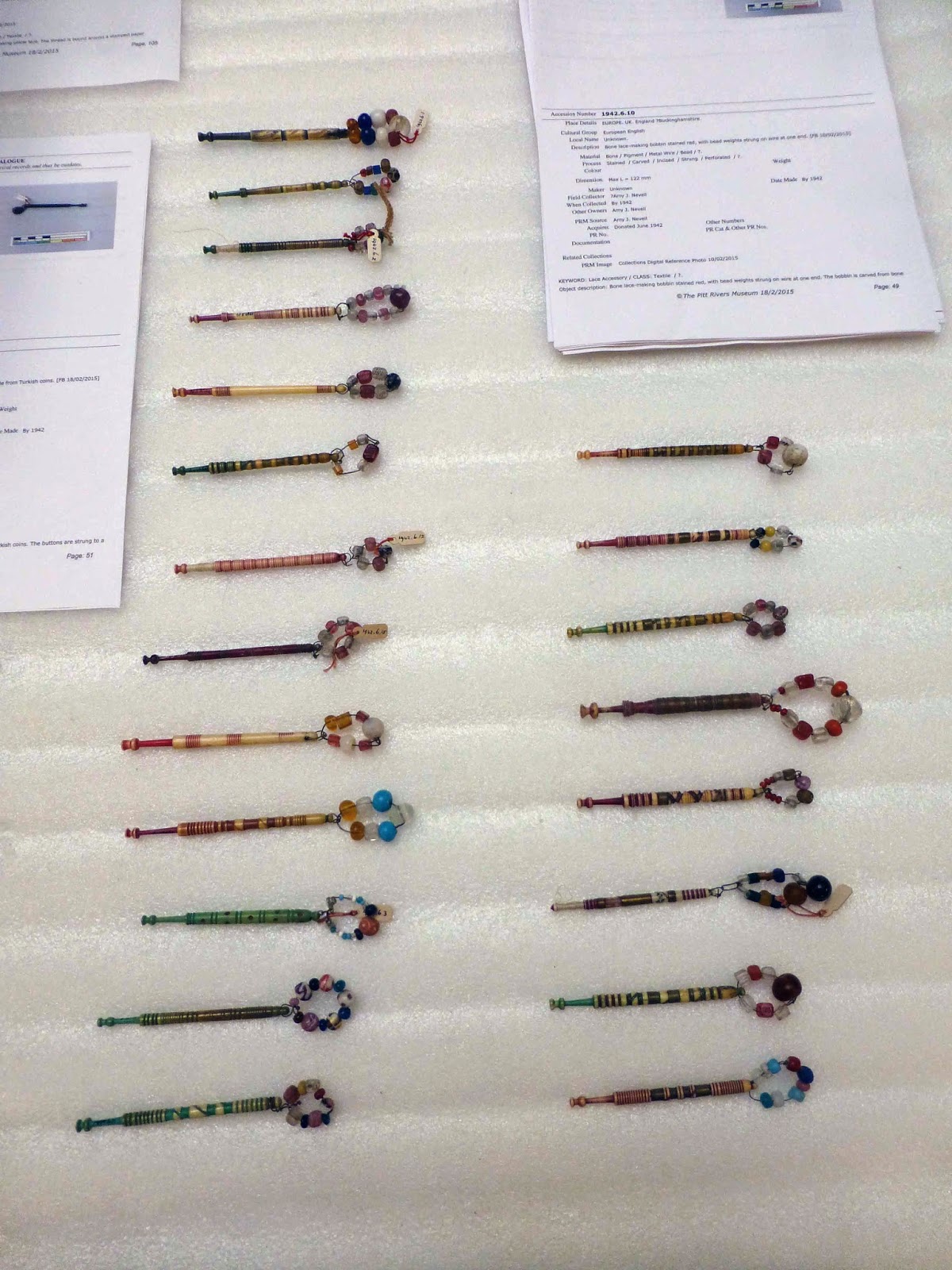
Of all the lace making material we have, the majority of the collection consists of beautifully made bobbins. There are bobbins made from both bone and wood, the bone ones being unique to the UK. The aesthetic around lace making is best illustrated by the lovingly crafted bobbins, often given as keepsakes and love tokens. They are weighted with glass beads which may have been traded from the continent. The square beads with impressed lines, made using a file, were made specifically for the bobbins to provide grip and prevent the bobbin from slipping when in place.

I look forward to seeing how the project progresses and hearing back from Nicollete and David once they have followed up some of the leads and done some further research. If you are interested in lace making, there is a display in the Museum Court, case 115.A, with a large number of bobbins and lace making  material.

Faye Belsey
Assistant Curator


Wednesday, 5 November 2014

Pest Management: A Bag Full Of Trouble!

Signs of moth © Pitt Rivers Museum
Although the three galleries in the Museum have many display cases filled with objects, there are another 57,500 objects not currently on display. These reserve collections are homed in storage in and around the galleries. It is the job of the Conservation Department to care for and monitor the collections both on display and in storage.

Over the past few years, museums across the UK have seen an alarming increase in the number of common clothes moth (Tineola bisselliella) amongst their collections. This increase could be attributed to a rise in temperature, the decline of pesticides used within museums and an increase in visitor numbers. Much of the collection at the Pitt Rivers is made from natural fibres such as textiles, skins, hair, fur, feathers and foodstuff. Unfortunately these are the materials that the larvae of the clothes moth consume. If a moth infestation goes unnoticed it can devastate an object leaving it unrecognisable. It is therefore vital that the Conservation Team have an ongoing integrated pest management (IPM) program in place.

The IPM program at the Pitt Rivers involves weekly checks of a number of moth pheromone traps located throughout the Museum. The pheromone traps are designed to attract the male moth, which get stuck on the traps sticky surface. Capturing the male moth reduces the potential for reproduction and the number of moth caught indicate if there is an increase in moth activity within a case. As a Department we also train the other museum staff, including the Collections Department and Front of House Staff, to be vigilant and report any moth seen within the Museum. Even with these safeguards moth infestations can unfortunately still occur.

Removing debris © PRM
During October 2014 one of the Collection Team retrieved a number of textile bags from storage under a case in the Lower Gallery ready for a Visiting Researcher. The member of staff noticed a moth in the polythene wrapping of one bag. Conservation was notified and went to investigate. 32 textile and fur bags were fond to have moth within their polythene wrapping. As a precaution all 32 bags were removed and placed in a freezer at minus 31 degrees for one week. Freezing at such a low temperature kills the eggs, larvae and adult moth.

The saddlebag after conservation,
PRM 1947.1.13 © PRM
Once removed from the freezer the bags were checked over in Conservation. 8 of the bags were found to have an active infestation, whereas the remaining bags showed no sign of moth. Unfortunately 3 of the 8 bags had been adversely affected.

One of these was a section from a woollen saddlebag thought to be from Turkey. The polythene wrapping was not quite big enough for the saddlebag and where the wool was exposed along one edge the moth had gathered. Thankfully once the moth and larvae was removed there was relatively little damage.

Below you can see a woollen shoulder bag from Greece. This bag had a large number of moth within its folds and again along an exposed edge. There are patches of yellowed staining thought to be ethnographic food deposits from use. The stained areas had attracted the moth and were the places most affected by the infestation. The staining is part of the object's history and can tell the story of its use therefore we would never try to remove it. Once the moth debris was removed there was some loss of fibres.

From left to right: Section of the bag showing staining with moth damage before and after treatment, the complete bag after being treated in conservation; PRM 1965.11.4B © Pitt Rivers Museum

The next one was a bag from the Miju Mishmi peoples of the Lohit Valley, Tibet. At first this decorative cotton bag appeared to only have a small number of moth on its handle. However the inside of the bag had plant debris remaining from when the bag was in use. This debris had attracted a large number of moth. Thankfully although the moth appeared plentiful there was no physical damage to the textile.

Left and centre: the damage found inside the bag, right: the bag after conservation treatment:
cotton bag from Tibet PRM 1948.7.49 © Pitt Rivers Museum

All the bags that had been removed for freezing have now been placed in sealed polythene bags for storage. The affected storage drawers, along with a number of other 'high risk' cases containing natural fibres, have been highlighted and marked with a sparkly moth sticker. These stickers are designed to indicate to all staff to be extra vigilant and take the time to check through the contents for any sign of moth.

Kate Jackson
Conservator

Thursday, 2 October 2014

The Huipil of San Antonio Aguas Calientes

Anyone traveling today through the Mayan villages and towns of highland Guatemala and observing the riot of colour expressed in the clothing that women create and wear would find it difficult to believe it was not always so.

A prime example of the profound change that has, in fact, taken place is the huipil worn by women in San Antonio Aguas Calientes. Today the women of San Antonio are noted throughout Guatemala for both their weaving skill, their design sense and their use of colour. However a traveler in 1900 would have noted that their huipil was an exceedingly dull affair. The ground fabric was a natural pale brown handspun and hand woven cotton with narrow warp stripes. Onto this simple background were brocaded a few doubled-faced supplementary weft motifs.


Woman with jug, San Antonio Aguas Calientes. CIRMA, Yas Collection, late 19th Century.
How did this rapid and radical change occur? Margot Blum Schevill believes that one impetus was the fact the San Antonio women increasingly came into contact with women from other villages where the design of the huipil was more complex and colourful. Other researchers point to the influence of needlepoint pattern books to which weavers began to have access. With these graphic aids the weaver could begin to reimagine the design the huipil.


Another important factor must have been increasing availability to commercial threads and to synthetic dyes. Women would travel to the nearby town of Antigua with the vegetables or textiles they had to sell and use part of their profits to buy threads and dyes from local merchants or from traders who came from Guatemala City on market days.

It is also important to note that fashion is not static even in a culture as economically impoverished as the Maya. Especially over the last 50 years the aesthetic expressed in all aspects of the woman’s traje (outfit), including the huipil, has continued to change in almost every village. As in San Antonio these changes extend even to the colour of the ground fabric. In the remote village of Chajul, for example, it had long been white. Today it is often red or blue.


Hupil from San Antonio with velvet trim notably missing, Sam Noble Museum, University of Oklahoma, Norman, OK


There is a hint as to the role of fashion in a fine example of a huipil from San Antonio in the collection of The Sam Noble Museum at the University of Oklahoma at Norman. If you compare it with a close comparable in the Pitt Rivers’ collection (2012.104.37) you’ll note that the velvet trim that was once applied to the neck and arm openings has been removed. Only a shadow remains. One wonders why the owner decided to remove the trim before disposing of the huipil?


Hupil from San Antonio in the Pitt Rivers Museum (2012.104.37) with velvet trim around neck © Pitt Rivers Museum. 


The answer may have been related to fashion. As far as the owner (or her daughter or granddaughter) was concerned the huipil was no longer in fashion. Thus the trim was removed to be recycled in a new huipil that expressed the weaver’s newly acquired taste and aspirations.

Dai Williams
Independent researcher.


In 2012 Dai Williams generously donated a portion of his collection of Guatemalan textiles to the Pitt Rivers Museum. To look more closely at this specific collection please search for it on the Museum’s online catalogue via the Pitt Rivers Museum website.

Wednesday, 16 July 2014

New Accessions


In 2009 Deryn O'Connor generously donated to the Museum a collection of more than 200 textiles made by the Miao people of Guizhou Province, southwest China. Textiles are very important in the life of the Miao people. Their costumes are an expression of group identity and cohesion, as well as of the individual’s standing within a group. 

The Miao are particularly well known for their richly woven and embroidered festival costumes. The cloth, usually woven on traditional looms, is made of hemp and ramie bast fibres grown in the region. They use a range of decorative techniques on the textiles, including wax resist, appliqué, and expertly executed embroidery stitches in silks and cotton. 

Cataloguing this interesting collection was an opportunity to look closely at these textiles and the techniques used. If you visit the Museum you can see some of these for yourself on display in the new acquisitions case in the ground floor Court Gallery. Alternatively you can see and explore the whole collection for yourself via the Museum's online database.


Wax resist dyed cotton textile; 2009.135.70 © Pitt Rivers Museum
Woman's jacket with silk embroidery and appliqué; 2009.135.8 
© Pitt Rivers Museum

Detail of the hem of pleated skirt showing wax resist dyed decoration, 
embroidery and cotton appliqué design; 2009.135.39 
© Pitt Rivers Museum

Detail of embroidery showing minute cross stitch embroidered pattern; 
2009.135.47 © Pitt Rivers Museum

Detail of silk embroidery in satin stitch on green silk paper background 
from an apron; 2009.135.54 © Pitt Rivers Museum


Wax resist dyed cotton textile. Dyed with indigo and embroidered 
with coloured silk yarns. Piece for a baby carrier; 2009.135.69 
© Pitt Rivers Museum

Faye Belsey
Assistant Curator

To read more about Miao textiles:


O'Connor, Deryn, 1994.  "Miao Costumes"  James Hockey Gallery, WSCAD, Farnham. Catalogue to coincide with the 1994 exhibition at the West Surrey College of Art and Design. Most of the costumes illustrated were then in the collection of Gina Corrigan whose location photos illustrate the text plus studio shots of the exhibition costumes. Deryn O'Connor was until 1990 Principal Lecturer in Textiles at WSCAD and was responsible for much of the research. Excellent reference work with beautiful photos both in China and in the studio.

Corrigan, Gina, 2001.  "Miao Textiles from China" Fabric Folios series published by The British Museum Press. The costumes are in the British Museum collection and most were collected by Gina Corrigan. Helpful reference work with excellent photos.


Smith, Ruth with Textiles from The Gina Corrigan Collection. Researchers: Margaret Baker, Gina Corrigan, Ros Downing, Marianne Ellis, Cobi Erskine, Deryn O’Connor, Thea Nield, Jeni Pinel, Phyllis Smith, Ruth Smith, 2005.  "Miao Embroidery from South West China" Occidor Ltd. The impetus for the book arose from the study of the collection of costume and textiles brought back from China by Gina Corrigan. This book is an attempt to record some of the embroidery stitches and techniques before they disappear. Ten researchers, some of whom have visited Miao villages, have analysed and recorded the decorative stitch techniques in the collection and these are illustrated with Gina’s photographs. The focus of the investigation has been the most highly decorated items of Miao clothing, namely the women’s festival jackets, skirts, aprons and baby carriers.