Showing posts with label museum access. Show all posts

Wednesday, 1 November 2017

Sensing Culture at the Pitt Rivers Museum, October 2017

In October Jamie Cameron (Research Assistant, Oxford Internet Institute) came to the Pitt Rivers Museum to 3D scan an object in the museum’s collection; a model of a totem pole (also known as a crest pole) made by the Northwest Coast Haida (1891.49.13 .1 - .2). The scan will be 3D printed and used for Sensing Culture, a Heritage Lottery funded project, led by the Royal National Institute of Blind People (RNIB). One of the aims at the project is to develop and produce ways in which the visitor experience for blind and partially sighted people can be improved. Other museums within the University of Oxford GLAM (Gardens, Libraries, Archives and Museums) are also involved.

 Jamie Cameron '3D scanning' the model Crest Pole © Pitt Rivers Museum


Our colleague Laura Peers (Curator of the Americans and Professor of Museum Anthropology) recommended the wooden model of a Haida totem pole for 3D printing. The pole was made in Haida Gwaii, British Columbia, Canada, most likely by artist Charles Edenshaw. Our documentation tells us that the model pole was collected by resident missionary Charles Harrison (who published accounts of the Haida) at the end of the 19th Century. The pole itself is carved with ‘crest figures’ that relate to lineages, aspects of status and property rights. To the Haida of the Northwest Coast, the act of looking up at these representations shown on the sides of giant crest poles would have triggered a visual reminder of the stories of how ancestral beings bestowed certain rights on a family. The figures on this particular model pole include an eagle, bears and their cubs in human or ancestral form, frogs and humans.

Unfortunately we don’t yet have insight into why this particular model totem pole was made. Could it have been a prototype for a much larger pole that was never carved? Was it a commercial product for Europeans, or could it have been made to order by European collectors to illustrate the types of narratives on totems that the Haida produced?

 © Pitt Rivers Museum (1891.49.13 .1 - .2) 
In 2009 the museum received a Haida delegation as part of the project “Haida Material Culture in British Museums: Generating New Forms of Knowledge”. The delegates, when looking at the model crest pole, observed that some of the original museum labelling is incorrect, and that the bear at the bottom of the pole was holding in its mouth a prawn or shrimp, and not a crayfish as had been labelled. They also added that this pole might be depicting the bear mother story, a popular Haida narrative. These observations were added to our online database, a living document which reflects the multi-vocality and dynamism of the museum’s collection. Visits like these highlight the importance of retaining relationships between museums and the living communities from which material culture was taken from, often under very difficult and problematic circumstances. The Pitt Rivers Museum always aims to be at the forefront in repairing relationships damaged in the past by European colonial collecting practices. We continue to generate positive outputs such as material repatriation, loans to source communities, access for originating communities to engage with and reconnect with the collection both physically and digitally, and collaborative work, such as the Great Box Project in 2014


Jamie used 3D imaging technologies, including photogrammetry, to create a ‘scan’ of the totem pole. This will be 3D printed, and such prints will allow visitors who are blind or partially sighted to ‘read’ the object through touch. Haida art uses a structured formline design, where different coloured paints highlight certain features, and on carvings such as the model pole, formline appears in incisions in shallow and deep relief. Visitors will be able to feel the incised lines on the 3D print to help understand the layout and proportions of the totem pole. Many museums are using 3D printing to engage their visitors, and it is just one of the ways that the Pitt Rivers Museum works to enable access to its collections.


Nicholas Crowe 
Assistant Curator

Wednesday, 11 March 2015

Lace: facilitating knowledge exchange

On the 20th of February I welcomed a research visit from Nicolette Macovicky, Russian and East European Studies and David Hopkin, Faculty of History. They came to look at lace and lace related objects in the Pitt Rivers collections. Many people visiting the museum would assume that the collections whilst global are not local, they would be mistaken, much of the lace related material in the collections is from Oxfordshire and neighbouring counties. To highlight the more local objects in the collections, some of the objects retrieved for Nicolette and David's visit featured in the 2006-2009 ESRC-funded research project 'England: The Other Within: Analysing the English Collections at the Pitt Rivers Museum'

The Pitt Rivers Museum are a partner in Nicolette and David's HEIF Heritage Knowledge Exchange funded project 'By the Poor, For the Rich: Lace in context. Bridging the gaps between archives, textiles and social history collections'. Other project partners include the Museum of English Rural Life and The Lace Guild. Both having expertise in social and historical contexts of lace and lace making it was very interesting for me to hear what Nicolette and David thought of the selection of objects they looked at on their visit.

Bobbin winder as reconstructed by conservation; 1911.29.17.  © Pitt Rivers Museum

Included in the selection were lace making tools such as this bobbin winder (1911.29.17), collected by folklorist and antiquarian Percy Manning. Manning spent most of his adult life collecting objects from Oxfordshire. This bobbin winder is from Launton, an Oxfordshire village on the eastern outskirts of Bicester. The bobbin winder itself was in poor condition and needed some remedial conservation work involving reconstructing the bobbin winder to figure out how it would have worked. The bobbin winder is a practical object and is very simple in design, compared with another example we have on display which is made from pieces of turned wood, this bobbin winder is rudimental in comparison but does exactly the same job. Inscribed on the bobbin winder is 'Machine for winding thread on to a bobbin used in lace making bought of Maria Woods of Launton, Oxon, 1894.'. Using information from the census, David hopes to be able to track down Maria Woods of Launton and find out more about her.


Also collected by Manning are the dick pot (1911.29.45), lace makers candle stand (1911.29.22) and horse (1911.29.20 .1). The 'horse' was used to rest the lace pillow on whilst working. Nicolette thought that the low height of this particular horse indicated that it could have been used by children or for teaching lace making. Adequate lighting was important in lace making, the candle stand was used to concentrate the light from a single candle and focus it on the lace pillow. Finally, the dick pot would have been used for hot embers, the lace makers would place the pot under their skirts to keep themselves warm. It is surprising that the dick pot does not have a lid and the dangers of catching fire to the voluminous skirts would have been likely. Sitting near a fire was not an option for fear of the smoke dirtying the lace thread with which they were working. Again, David is going to further research this by looking through old newspaper archives fro reports of accidents and fires involving lace makers.
Candle stand; 1911.29.22 © Pitt Rivers Museum


Lace 'horse' 1911.29.20 .1 © Pitt Rivers Museum
'Dick pot' 1911.29.45 © Pitt Rivers Museum


Lace making display in court, C.115.A © Pitt Rivers Museum

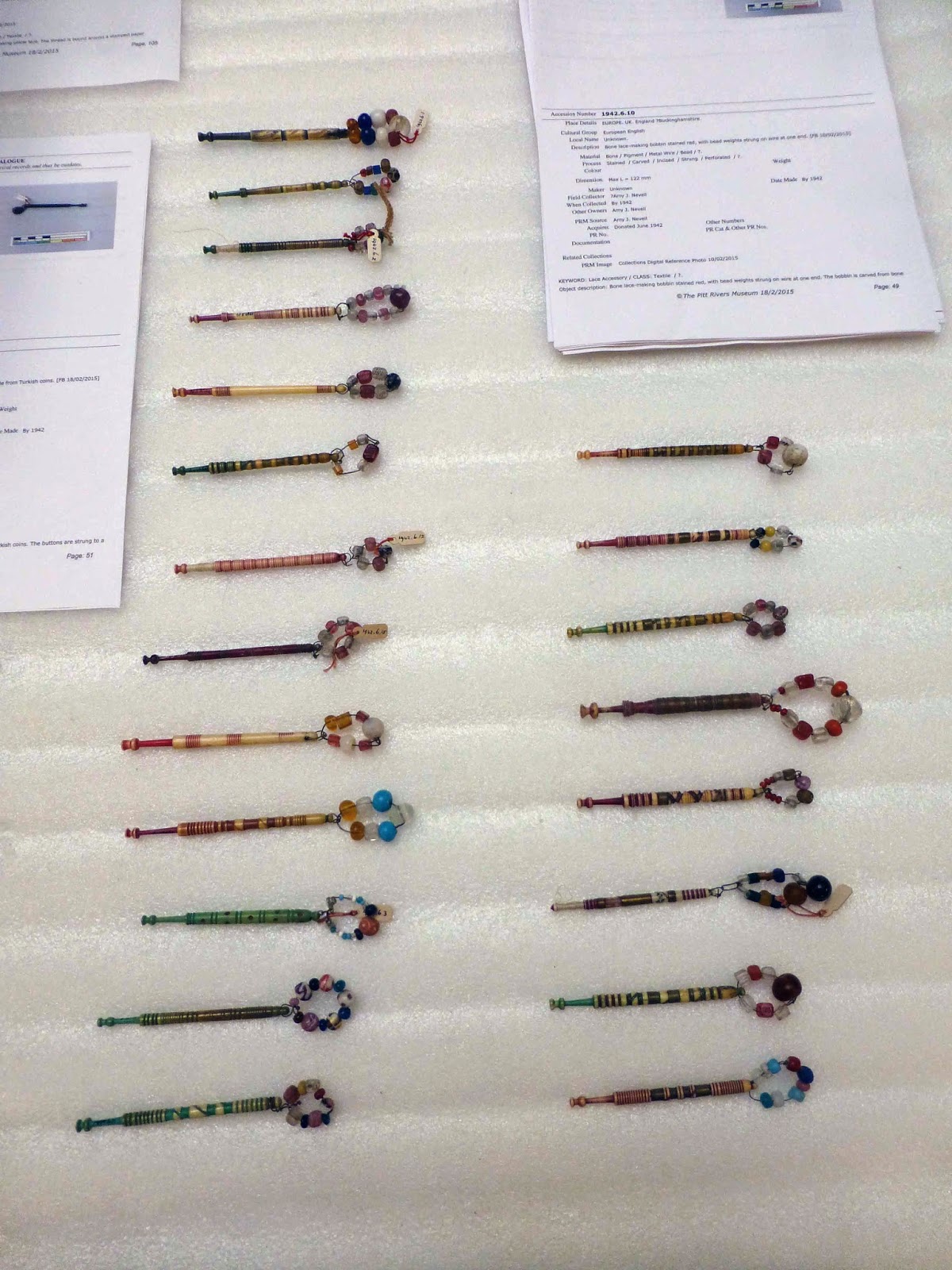
Of all the lace making material we have, the majority of the collection consists of beautifully made bobbins. There are bobbins made from both bone and wood, the bone ones being unique to the UK. The aesthetic around lace making is best illustrated by the lovingly crafted bobbins, often given as keepsakes and love tokens. They are weighted with glass beads which may have been traded from the continent. The square beads with impressed lines, made using a file, were made specifically for the bobbins to provide grip and prevent the bobbin from slipping when in place.

I look forward to seeing how the project progresses and hearing back from Nicollete and David once they have followed up some of the leads and done some further research. If you are interested in lace making, there is a display in the Museum Court, case 115.A, with a large number of bobbins and lace making  material.

Faye Belsey
Assistant Curator


Friday, 9 January 2015

Bellarmine Jars

In the Pitt Rivers Museum we have seven Bellarmine bottles.  The bottles are also known as Bartmann jugs or ‘greybeards’. 


The vessels were originally used to transport wine from Northern Germany to England in the 16th and 17th century.  The name Bartmann means ‘man with a beard’ in German.  This type of vessel was made at a pottery in Frechen near Cologne.

The vessels are stoneware and salt glazed.  The bearded face is a mould added to the neck of the vessel.  Later 17th-century vessels also had moulded medallions on the body of jug.

The jugs in the Pitt Rivers Museum were recently studied by a researcher interested in witch bottles and concealed objects. Two of the Pitt Rivers Museum bottles have contents and could have been used as witch bottles.    

The bottles contain nails, pins and hair.  One bottle contains a cloth heart. 

Top right: PRM accession number 1893.81.4
 
Left: PRM accession number 1910.18.1 with its contents pictured below.


Jugs from the PRM collections for inspection in the visiting researchers' room 

Witch bottles are said to offer protection and counteract spells cast by witches. The Museum of Soho has a bellarmine bottle that was found concealed in a wall. 

Madeleine Ding
Assistant Curator